

- Chaudhary claims that the Bangladesh Army Chief acted questionably during the unrest, indirectly referencing Jamaat-e-Islami and failing to prevent violence, raising suspicions of possible external influence.
- Former Bangladeshi minister and close aide to Sheikh Hasina, Mohibul Hasan Chaudhary, alleges that U.S.-linked NGOs and political networks funnelled significant funding to select groups from 2014 onward, helping create a climate of agitation against the government.
- Foreign media outlets and diplomatic missions amplified tensions and contributed to youth radicalisation by platforming radical preachers and conducting opaque training programs in Bangladesh, said Chaudhary in the interview.
- Chaudhary claimed that the Gen Z protests of Bangladesh were not organic but pre-planned, pointing to premature U.S. statements about casualties and the alleged deployment of trained snipers by anti-government actors.
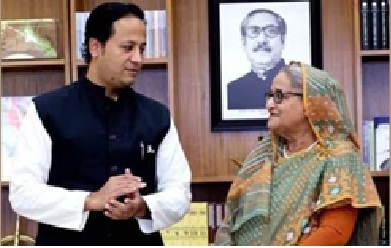
In a rare, unusually candid interview, former Bangladeshi minister and close aide to Sheikh Hasina, Mr Mohibul Hasan Chaudhary, laid out a detailed account of how external forces, especially actors in Washington, may have shaped the dramatic fall of the Awami League government. Speaking from an undisclosed location, he described a sequence of events that, in his view, did not resemble a spontaneous political collapse but rather a coordinated campaign that blended local unrest, foreign influence, and geopolitical pressure.
What emerges from his narrative is a picture of a government pushed to the brink through a mix of diplomatic pressure, media manipulation, targeted funding, and engineered chaos in the streets. The flow of incidents he describes suggests a pattern that has been consistently replicated across parts of the Global South.
A Military Shift and Signs of External Collusion
One of the central elements in Chaudhary’s account is the conduct of the Bangladesh Army chief during the final weeks of unrest. He describes several of the general’s actions as “questionable,” particularly the way he publicly positioned himself and the specific groups he chose to highlight. The indirect mention of Jamaat-e-Islami in the army chief’s address added to these concerns, raising doubts about which actors were influencing the trajectory of the protests. Yet Yunus’ public narrative remained conspicuously silent on the role of Jamaat-e-Islami, leaving an important aspect of the crisis unexamined.
Chaudhary argues that the Army Chief failed to uphold his own assurances, protecting public property, preventing mob violence, and stopping retaliatory attacks, allowing extremist elements to operate freely. This naturally raised serious questions: was he acting on his own, or were outside actors, potentially even the CIA, shaping his decisions? Chaudhary does not make a direct accusation, but he stresses that the pattern was too pronounced to overlook.
Media, Missions, and the Radicalisation of Youth
A significant part of the interview focuses on how foreign media outlets and diplomatic missions allegedly contributed to shaping an anti-government environment. He points to Western and non-Western international news networks like Al Jazeera, which amplified religious and social tensions by platforming radical preachers and circulating provocative content online.
He also alludes to foreign embassies conducting training programs for local preachers, with the nature of these sessions remaining opaque to Bangladeshi regulators. According to him, this gradually contributed to pockets of ideological radicalisation among the youth.
Foreign-Funded NGOs and the Push for Destabilisation
Chaudhary argues that, from 2014 onward, specific U.S.-linked organisations, including USAID and the International Republican Institute, played a far more political role than publicly acknowledged. Large sums of money, he claims, were funnelled to a small set of NGOs, many of them allegedly involved in building a climate of agitation.
He further alleges a long-standing nexus among Western political families, particularly the Clintons, Muhammad Yunus, and U.S.-based advocacy platforms. According to him, these partnerships helped fuel anti-government sentiment and financed groups ranging from cultural activists to the Hijra community to extremist networks, all with the intention of manufacturing a state of disorder.

Premeditated Chaos and the Use of Snipers
The most disturbing portion of his account concerns the violence during the Gen Z protests. What began as a mobilisation over public sector job quotas quickly spiralled into a nationwide riot. Chaudhary insists this was not an organic escalation but a scripted series of events.
He points to the timing mismatch between U.S. diplomatic statements and actual casualties, an envoy prematurely announcing deaths before any had occurred, as evidence that a predetermined narrative was already in circulation. He also claims that trained snipers were deployed by anti-government actors, a tactic far removed from normal riot control in Bangladesh.
The Russia Factor: Pressure Washington Didn’t Appreciate
Beyond street-level unrest, Chaudhary highlights geopolitics as a major trigger behind Washington’s alleged displeasure. Bangladesh’s refusal to vote against Russia at the United Nations, its continued imports of Russian wheat and fertiliser, and its heavy dependence on Russian military and nuclear infrastructure placed Dhaka in a difficult but unavoidable position. He believes, Hasina’s insistence on balancing Bangladesh’s strategic interests made her government a target for those expecting full alignment with Western positions.
Chaudhary also ties the unrest to U.S. political actors who pushed sanctions and punitive legislation against Bangladeshi officials. He cites figures such as Senator Bob Menendez, later arrested on corruption charges, as examples of how lobbying networks can be leveraged to pressure foreign governments.
For him, this was not a unified U.S. state strategy, but rather a coalition of influential individuals and institutions advancing a shared objective: the removal of Sheikh Hasina.
A Familiar Playbook Across the Global South
Chaudhary places Bangladesh’s experience in a wider context, noting similar Gen Z-driven upheavals in other countries. He argues that young populations with legitimate grievances are often weaponised by external actors to trigger political transitions under the banner of “democracy promotion.”
Whether one accepts or contests his account, the interview provides a rare window into how those inside the former government interpreted the events leading to its fall and why they believe a much larger geopolitical game was unfolding behind the scenes.
Ultimately, the 2024 crisis seems to have been shaped by both internal fragilities and external interests. The economic slowdown, youth unemployment, and disillusionment with long-term single-party rule in Bangladesh created a combustible domestic environment. The United States, through its ecosystem of aid, might have inadvertently strengthened opposition networks that were prepared for mobilisation under a deteriorating situation. Overall, the incident underlines how, in the modern geopolitical arena, aid, activism, and influence have become deeply intertwined and how fragile democracies like Bangladesh can easily become battlegrounds for competing global interests.

Tejashree P V holds a Master’s degree in English Literature from IGNOU and a Bachelor’s degree in Journalism, English, and History from Vivekananda Degree College. A UPSC aspirant, she has a keen interest in international affairs, geopolitics, and policy.
 Archita Gaur
  Anjali Singh
  Divyanka Tandon