

- The K-4 Submarine-Launched Ballistic Missile, commonly referred to as Kalam 4, represents a significant technological advancement in India’s strategic deterrence policy.
- K-4 (Kalam 4) is an intermediate-range nuclear-capable submarine-launched ballistic missile that is designed and developed by India’s Defence Research and Development Organisation (DRDO) and manufactured by Bharat Dynamics Limited (BDL) in India.
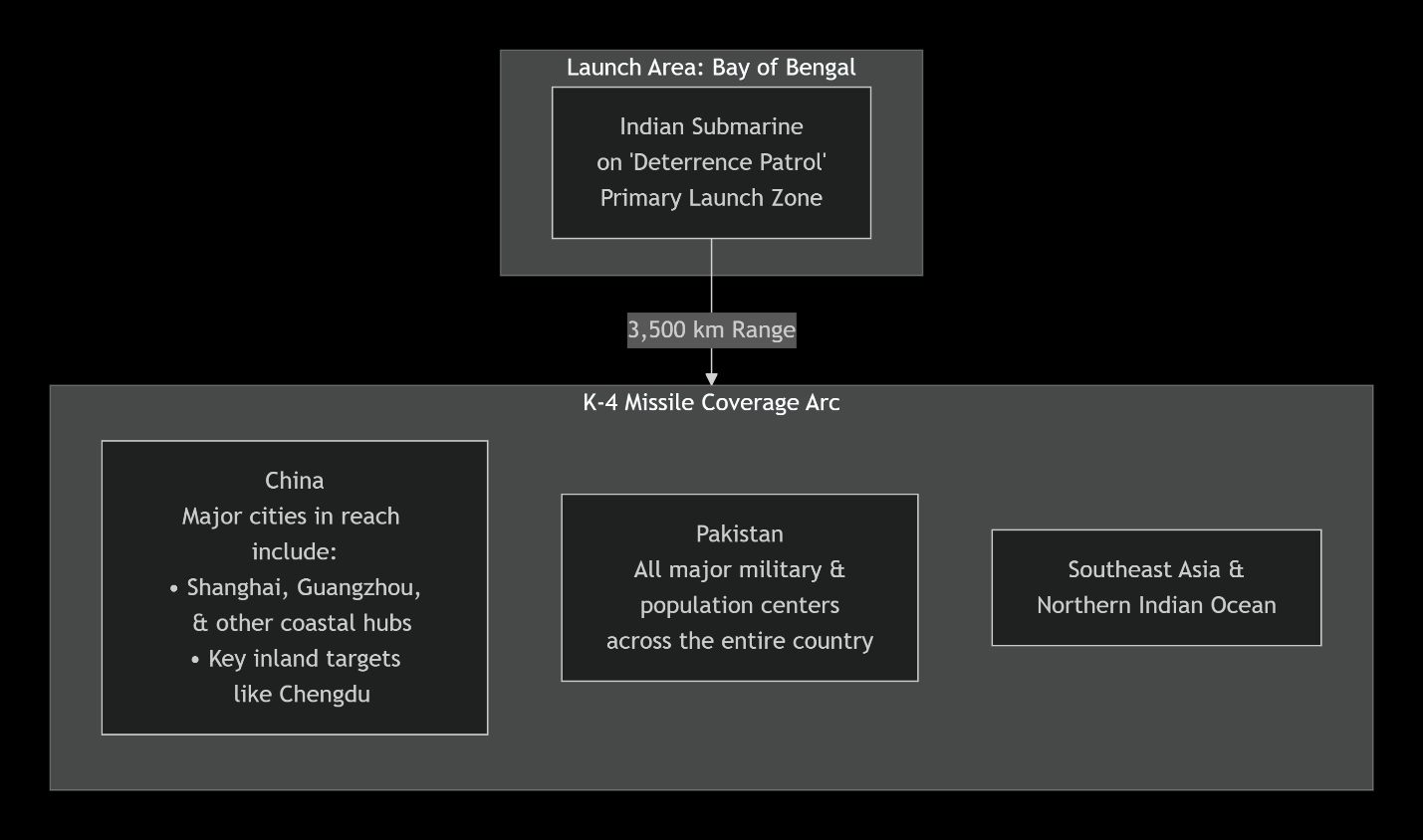
- With an approximate range of 3,500 km, K-4 supersedes the limitations of its predecessor SLBM, K-15 (Sagarika), and allows Indian SSBNs to target enemy strategic assets while remaining within safeguarded waters.
- Operating from secure zones of the Bay of Bengal bastion, the K-4 nuclear-capable ballistic missiles onboard SSBNs will operate from secure zones of the Bay of Bengal bastion.
The security of India has been based all these years on the understanding that peace can be sustained by an air of strength and not by an air of weakness. This ancient wisdom of far-sighted strategic thinkers of old India states that peace can be sustained only by having sufficient strength to ward off an attack.
“शान्तिः शक्त्युपपन्ना स्यात् न शान्तिः दुर्बलस्य तु”
(Peace is secured through strength; the weak can never maintain peace.)
In the current strategic context, this ideology manifests itself in India’s nuclear deterrence policy. The K-4 Submarine-Launched Ballistic Missile, commonly referred to as Kalam 4, represents a significant technological advancement in India’s strategic deterrence policy. Developed by DRDO and intended for deployment on Arihant-class nuclear-powered ballistic missile submarines, the K-4 missile significantly improves India’s nuclear deterrent capability by ensuring the country’s sea-based nuclear capability moves from a symbolic capability to a credible second-strike capability. With an approximate range of 3,500 km, K-4 supersedes the limitations of its predecessor SLBM, K-15 (Sagarika), and allows Indian SSBNs to target enemy strategic assets while remaining within safeguarded waters. The development is crucial from the point of India’s No First Use Policy and Minimum Deterrence.
India’s nuclear policy positions the country between restraint and resolution, a notion deeply rooted in classical statecraft:
“अहिंसा परमो धर्मः धर्महिंसा तथैव च”
(Non-violence is the highest duty, yet force in defence of righteousness is equally a duty.)
This deterrence balance will be made possible through the K-4 SLBM, which would enable “India to retain its capability to retaliate decisively even after a strike.”
Of all nuclear strike capabilities, the maritime component of nuclear triads is known to be the most survivable and stable nuclear force. In this respect, the role of the Indian Navy is crucial as a holder of India’s assured second-strike capability guarantee. This is because it deploys nuclear-capable submarines to offer depth to the Indian nuclear program.
“Whenever order and stability are threatened, decisive action becomes inevitable.” In advancing cutting-edge missile technology and incorporating timeless values of control and responsibility, the K-4 SLBM reflects a beautiful melding of old and new concepts in the national strategic vision of Indian national security.
Core Technical Overview
K-4 (Kalam 4) is an intermediate-range nuclear-capable submarine-launched ballistic missile that is designed and developed by India’s Defence Research and Development Organisation (DRDO) and manufactured by Bharat Dynamics Limited (BDL) in India. Operated under the control of the Indian Navy’s Strategic Forces Command, K-4 is intended to be utilised on Arihant-class submarines for ballistic duties and is a critical component of the nuclear-based defence system of the country. Its operational range is given as 3,500 km, which can be extended up to 4,000 km by curtailing its payload capacity. It uses a two-stage solid rocket motor for propulsion, carries one strategic nuclear warhead, and possesses a sophisticated guidance system package that includes both inertial navigation systems (INS) as well as corrections from NavIC & GPS Satellites with a reported circular error probable of less than 10 meters. It is currently at an advanced stage of trials and is expected to be operationalised soon.
The most distinctive technological aspect of K-4 is its submerged cold-launch technology, which is essential for its stealth as well as safety capabilities associated with submarine operations. Unlike other missiles, for which engine ignition takes place inside the submarine, K-4 utilises gas generators to come out of its tubes in a gas bubble that surrounds it during its initial emergence into the water, after which it ignites its engine upon exiting the water surface to prevent damage to the submarine. This technological aspect helps to make India one of a few select nations to own highly sophisticated submarine-based ballistic missiles with strategic capabilities.
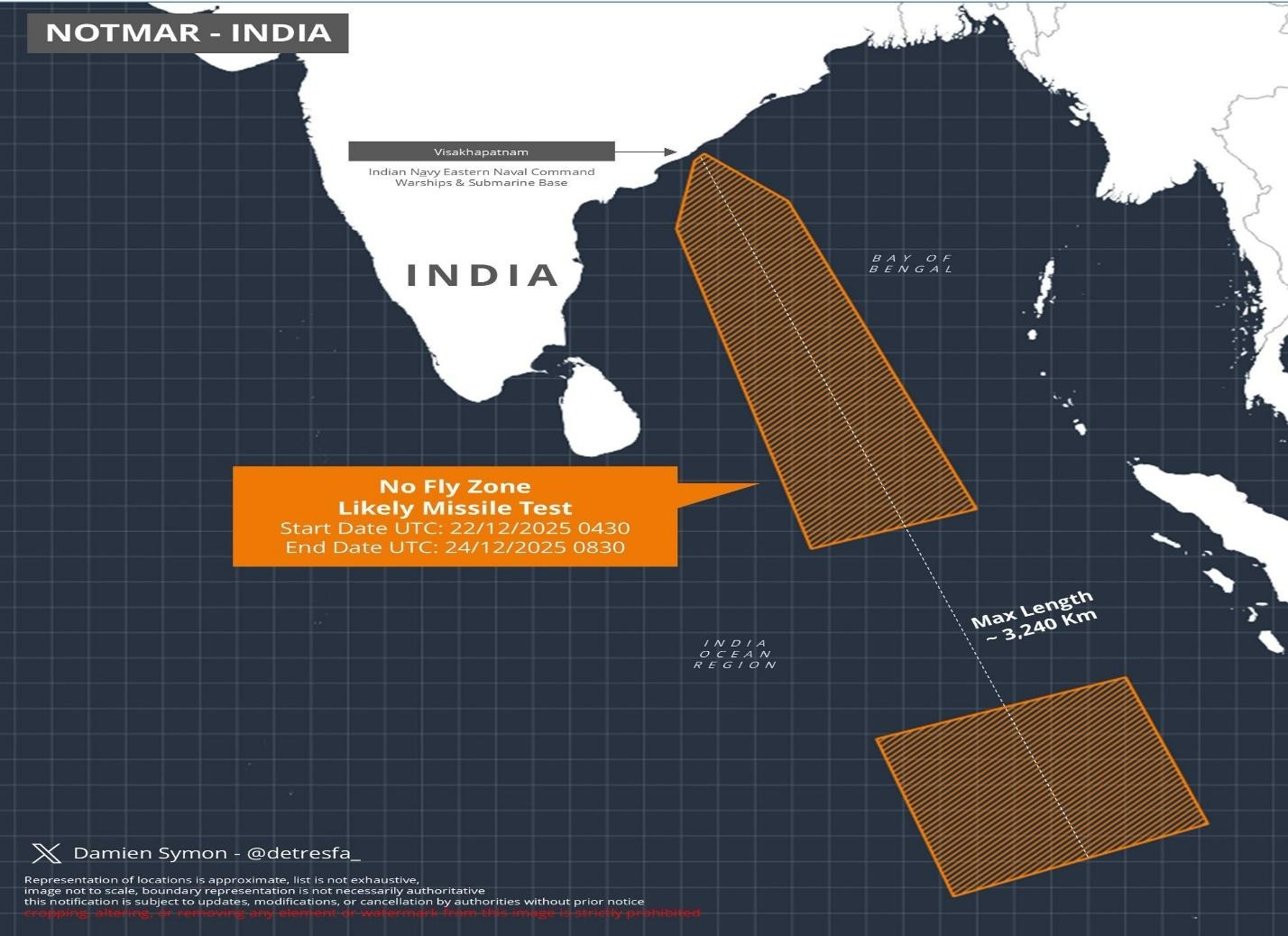
After its launch, K-4 follows a ballistic trajectory that includes a boost phase before exiting the Earth’s atmosphere, followed by a phase and culminates in its hypersonic re-entry stages for final target impact. K-4 possesses superior accuracy and power to function as a ‘minimum credible’ deterrent consistent with India’s nuclear doctrine. Strategically, the K-4 nuclear-capable ballistic missiles onboard SSBNs will operate from secure zones of the Bay of Bengal bastion. With missiles ranging from this safe zone, the strike power extends to the entire territory of Pakistan, as well as large parts of China, much of Asia, and the entire coastline of the Indian Ocean.
Launch Vehicles and Platforms
As the sea-based component of India’s nuclear triad, the K-4 (Kalam 4) submarine-launched ballistic missile is exclusively used by Indian Navy nuclear-powered ballistic missile submarines (SSBNs). The Arihant-class SSBNs, such as INS Arihant and INS Arighaat, each have four vertical launch tubes and serve as their main launch platforms. Larger follow-on submarines such as the S4* SSBN and INS Aridhaman feature eight launch tubes, enabling a larger missile load and improved patrol endurance. With the K-4’s underwater cold-launch method, the missile is ejected from the launch tube by a gas generator before rocket ignition above the water surface. This design maintains stealth while reducing submarine stress. Under India’s nuclear deterrence policy, SSBN-based deployment ensures a credible and assured second-strike capability by providing mobility, concealment, and survivability.
| Submarine | Missile Tubes | K-4 Load | Status |
| INS Arihant | 4 | 4 | Operational |
| INS Arighaat | 4 | 4 | Commissioned (2024) |
| INS Aridhaman | 8 | 8 | Trials |
| S4* | 8 | 8 | Launched |
| Platform / Test Type | Number of Tests | Purpose / Notes | Year(s) |
| Developmental / Pontoon Launches | Multiple (≥4) | Early validation of cold-launch, trajectory, and propulsion | 2010–2016 |
| INS Arihant (Submarine Launch) | 1 | First SSBN-based test, validating submerged launch | 2016 |
| INS Arighaat (Submarine Launches) | ≥2 | Full-range launches (~3,500 km), operational readiness | 2024–2025 |
| Missile | Estimated Range | Notes |
| K-5 | 5,000–6,000 km | Under development |
| K-6 | 6,000+ km | Reported MIRV capability |
| S5 SSBN | 13,500 t | Up to 12 SLBMs |
K-4 Missile Impact Assessment
Damage modelling analysis is employed to calculate the effects of the K-4 SLBM, with attention given to zones of explosion and thermal damage, and without attention given to harm due to casualties. The areas of fireball formation, structural and heat damage are estimated under lower (~50 kt), medium (~200 kt), and higher (~500 kt) illustrative yields; on impact, lower-yield damages extend up to 6 km and maximum high-yield damage up to 18 km. Assurance of intolerable damage is essential for strategic stability, and very high levels of accuracy with a CEP < 10 m provide assured deterrence even at lower yields. Induction onto Arihant-class SSBNs like Arihant, Arighaat, Aridhaman, and S4* promises improved survivability, missile density, and submarine patrol duration, thereby strengthening India’s assured second-strike capability under NFU (No First Use).
War-Like Hypothesis
Analysts believe that India’s sea-based deterrent remains viable in a hypothetical strategic conflict scenario because of ongoing submerged patrols in protected bastion areas like the Bay of Bengal. Retaliatory reaction modelling is conducted only under centralised authority in accordance with India’s declared nuclear doctrine. Rather than being a tactical combat activity, the missile launch is handled as a controlled technological sequence.
Launch Process
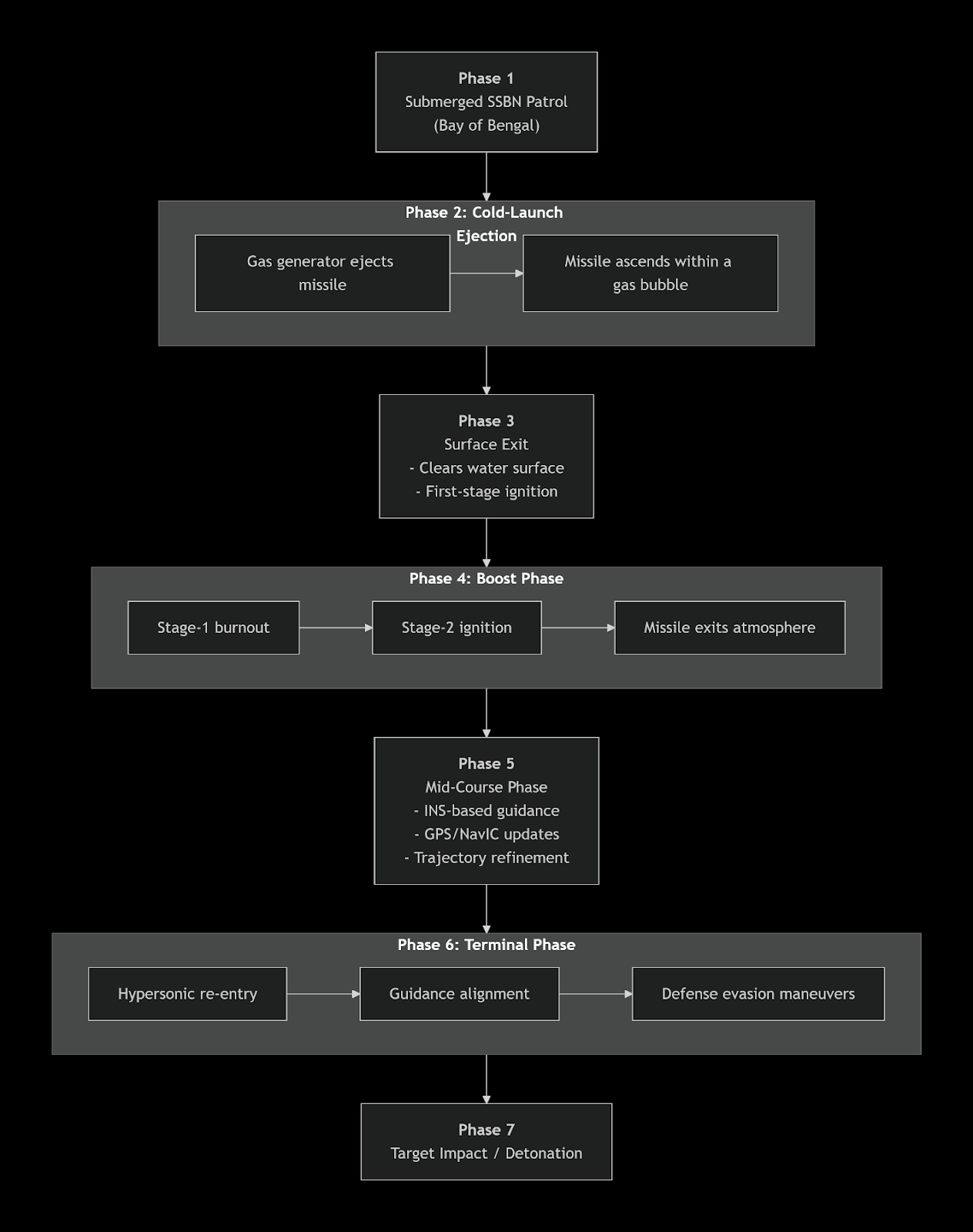
The operation commences with the submerged Arihant-class SSBN, which is generally situated in the Bay of Bengal, as the entire process begins with the nuclear-capable underwater deterrent patrol mission itself. The submarine initiates the cold-launch process once the authenticated launch command is received. The missile is forcibly launched from the launch tube due to the high-pressure gas generator system’s action. A significant technical aspect is activated during the underwater ascent phase: this involves the gas generator mounted at the nose section, which produces a stabilising gas bubble (or cavity) surrounding the missile. As the rocket translates vertically to the top of the 40-50 meters of the underwater path, the gas bubble significantly reduces the effects of the resultant hydrodynamic forces as well as stresses upon the rocket’s structure itself. The rocket concludes the first stage once the second stage burns out, when the rocket enters the mid-course phase, and it goes into orbit as desired.
The final stage gets activated once the re-entry spacecraft separates to descend back into the atmosphere at hypersonic velocities. The terminal stage generally involves integration of Terrain Contour Matching (TERCOM) capabilities for target alignment, followed by atmospheric manoeuvring to circumvent the missile defence system for precise target destruction upon impact.
Conclusion
The K-4 (Kalam-4) SLBM, which combines expanded range, superior precision, and survivable submarine deployment, is a significant development in India’s sea-based nuclear deterrent. Arihant-class SSBNs are more likely to survive thanks to their cold-launch technology, two-stage solid propulsion, and accurate guidance system, which together guarantee both operational dependability and stealth. When combined with remarkable accuracy, conceptual modelling of missile impact shows that even modest yields can produce credible strategic impacts. The K-4 strengthens India’s No First Use doctrine and promotes regional strategic stability by offering a credible second-strike capability when integrated with numerous SSBN systems. All things considered, the K-4 is a perfect example of how cutting-edge technology and doctrinal caution can work together to provide India with a strong and durable sea-based nuclear deterrent.

Piyush Anand is a Biotechnology Engineering student at Chandigarh University. His primary interest lies in International Affairs, Defence and Strategy. Views expressed are the author’s own.
 Anjali Singh
  Aayush Pal