
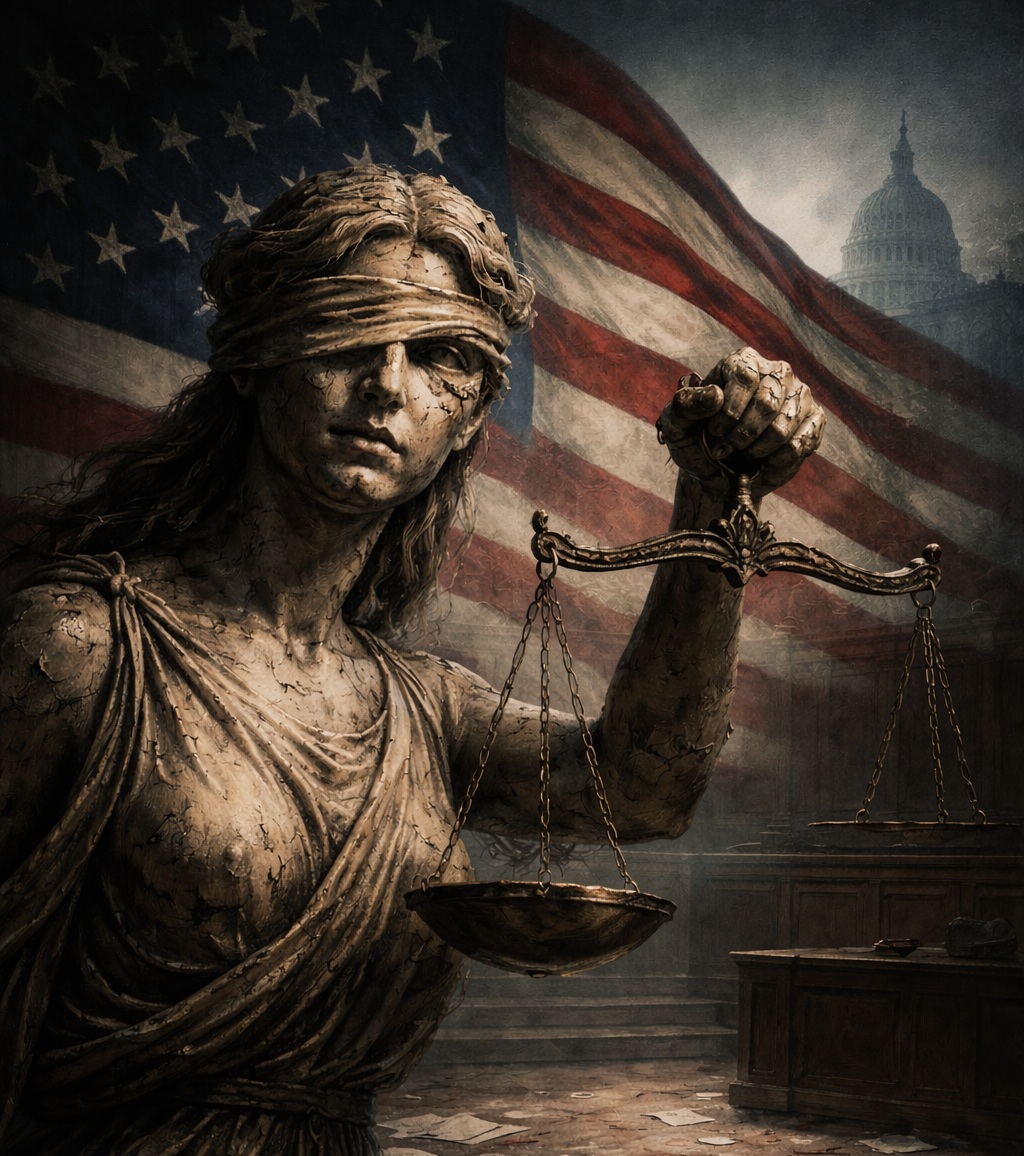
- In nearly 35 court proceedings, federal judges across the United States accused the Department of Justice of deliberate lying.
- When a federal court is obliged to declare the government’s work as ‘intentionally inaccurate,’ the social compact that links citizens to the state begins to dissolve.
- The change from a single fabricated transcript in California to thirty-five federal cases of ‘fictional’ declarations marks a shift from a series of errors to a systemic policy.
- A state that cannot guarantee the truth in its own sworn papers cannot accurately assess the democratic health of others.
For decades, the United States has travelled the world as a self-proclaimed proponent of the “Rules-Based International Order.” From the United Nations podiums to the lecture halls of fledgling democracies, Washington has maintained a distinct rhetorical posture: an independent judiciary and a Justice Department (DOJ) above the fray of party conflict are the hallmarks of a civilised society. That moral posture now stands severely compromised. A succession of seismic revelations, most notably reported in a recent 60 Minutes investigation and meticulous research by New York University’s Ryan Goodman,[1] indicates that the “City upon a Hill” is suffering from a terminal case of institutional rot.
The findings are more than just a collection of administrative blunders; they reveal a systemic failure of legal ethics. In nearly 35 court proceedings, federal judges across the United States accused the Department of Justice of deliberate lying.[2] This includes altering records, providing “fictional” sworn statements, and misleading the bench.
The Rise of “Narrative Management”
The rule of law is based on a single fundamental assumption: that the State, above all others, is bound by truth when it appears in court. When government lawyers deceive the courts, the system not only fails but also corrodes from within. Professor Goodman’s data, which includes over 400 cases filed since early 2025, displays a remarkable pattern of activity. There have been 26 documented examples of outright noncompliance with court orders, as well as 68 findings of “arbitrary and capricious” action. This is the language of a failed state, not a superpower. When a federal court is obliged to declare the government’s work as “intentionally inaccurate,” the social compact that links citizens to the state begins to dissolve.[3]
The DOJ, once the defender of the United States Constitution, has evolved into an ideological blunt-force instrument. The symptoms are obvious in the selective prosecution of political dissidents, the abuse of immigration law, and the horrific firing of internal watchdogs. When ethics personnel, such as Joseph Tirrell, are fired for questioning the Attorney General’s directions, it sends a clear message to the rank and file: loyalty to the administration takes precedence over the facts of the case.[4] If such behaviour were to occur in South Asia, Africa, or Eastern Europe, it would be condemned internationally. When it happens in Washington, it is quietly embraced.
A History of Malfeasance: The California Precedent
This institutional collapse has a long history in the United States, albeit the current extent is unparalleled. A disturbing 2015 case from California demonstrates how readily the guardrails of justice can be removed. In that case, a prosecutor was found fabricated a confession transcript to achieve a conviction. The prosecutor fabricated incriminating words that the defendant never made—a literal and criminal “narrative management” strategy.[5]
The Observer’s piece on this incident underlined a scary reality: when the state uses the judiciary to construct reality rather than discover it, innocent lives are lost. While that case concerned a single rogue prosecutor, the current federal situation indicates that “fiction-building” has become a departmental tactic. The change from a single fabricated transcript in California to thirty-five federal cases of “fictional” declarations marks a shift from a series of errors to a systemic policy.
The Exodus of Integrity
Institutions are only as powerful as the individuals that inhabit them. Since January 2025, the DOJ has lost more than 2,900 experienced attorneys. This is not the typical “changing of the guard” that comes with a new administration; it is a brain drain of institutional memory.[6] This competence gap is being supplied by political loyalists who value “narrative” over “precedent.” This is evident in the sheer sloppiness of the deception emails ordering prosecutors to misrepresent the status of disqualified officials, which are plagued with typos and mistakes.[7] It represents a culture of impunity, in which actors believe they are no longer accountable to the courts or the public.
As former federal prosecutor Alexis Loeb bluntly stated, losing a court’s faith is a permanent stain. In the American judicial system, the “presumption of regularity”, the belief that the government acts in good faith, is the lubricant that keeps the wheels of justice spinning. Without it, every government filing is questionable, and every trial becomes political theatre.[8]
The Hypocrisy Gap
The most far-reaching implications of institutional disintegration extend beyond American courtrooms. They play out around the world, where the United States has long served as judge, jury, and moral tutor on issues of democracy and the rule of law. For decades, Washington has used judicial integrity to further its foreign policy objectives. Countries are evaluated, shamed, sanctioned, or diplomatically cornered based on the United States’ evaluations of its courts, investigative agencies, and legislative procedures. Annual democracy indexes, State Department papers, and congressional hearings commonly evaluate sovereign legal systems, often with little cultural or constitutional background.[9]
India is a regular target of this selective anger. From judicial nominations and the function of investigative agencies to legislative reforms imposed by Parliament, India’s internal processes have been scrutinised through an American perspective that believes its own institutions are intrinsically superior.[10] Criticism is rarely accompanied by self-reflection. Advice is given without accountability.
That moral asymmetry is now collapsing. When US federal judges are forced to record that their own Justice Department issued deceptive or “intentionally inaccurate” remarks, Washington’s moral lectures lose any meaning. A state that cannot guarantee the truth in its own sworn papers cannot accurately assess the democratic health of others. This isn’t abstract hypocrisy; it’s hypocrisy put into court documents.[11] American influence has never been based solely on military or economic might. It has relied on moral authority and the notion that its institutions operate with greater honesty. When that conviction fails, so does the influence that was created on it.
A Crisis of Moral Authority
For the global community, and particularly for growing countries in the Global South, the domestic American crisis reveals a deepening “hypocrisy gap.” The late Noam Chomsky famously stated that those who do not hold themselves to the same standards as others cannot be regarded seriously. This sentiment is now shared by chancelleries around the world.[12]
How can the United States demand transparency in foreign elections or judicial proceedings when its own Justice Department is mired in a labyrinth of “fictional” declarations? This loss of moral authority is possibly the most serious consequence of the current situation. It undermines America’s soft power and reinforces the arguments of its geopolitical adversaries, who allege that Western “values” are really a ruse for power politics.
The Collapse of Public Trust
The domestic consequences are terrible. According to The Economist’s 2024 survey, faith in American institutions has slipped to the bottom of the G7 ranks.[13] This is not the consequence of “misinformation” from other parties, but rather a sensible response by the public to the obvious disintegration of their institutions.[14]
When a law becomes negotiable, it ceases to be law. It becomes a tool for the powerful to suppress opposition and solidify power. The culture of deceit within the DOJ indicates that “ends justify means.” If the state may lie to a judge to achieve a policy purpose, what is to stop it from lying to the public?
References:
- [1] https://x.com/allenanalysis/status/2006713559971926278?s=20
- [2]The “Presumption of Regularity” in Trump Administration Litigation
- [3]Litigation Tracker: Legal Challenges to Trump Administration Actions
- [4]A top DoJ official trained Pam Bondi on ethics rules in the department. Then he was fired
- [5]California Prosecutor Falsifies Transcript of Confession
- [6]Unprecedented errors are eroding the credibility of Trump’s Justice Department
- [7]With many career lawyers gone, Justice Dept. hires Trump loyalists for court
- [8]Unprecedented errors are eroding the credibility of Trump’s Justice Department
- [9]Democracy and Human Rights in U.S. Foreign Policy: Evolution, Tools, and Considerations for Congress
- [10]India strongly objects to the remarks of the US State Department Spokesperson
- [11]Unprecedented errors are eroding the credibility of Trump’s Justice Department
- [12] Chomsky, Hegemony or Survival, 2003
- [13]America’s trust in its institutions has collapsed
- [14]U.S.: Leader or Loser in the G7?

Pranav S is a Project Assistant at the Energy Department, Government of Karnataka with an MA in Public Policy. Views expressed are the author’s own.
 Kumar Satish
  Aayush Pal
  Archita Gaur