- The prospective inclusion of Turkey in this defence alliance will enhance the deal, as the three nations embody distinct capabilities.
- Among these three nations, Pakistan is the sole country possessing nuclear capacity and a substantial military force.
- The Gulf nations, particularly Saudi Arabia, can no longer depend on Washington for their security.
- The infusion of Saudi capital and Turkey’s sophisticated military technologies will bolster Pakistan’s defence stance against India.
According to sources from international media outlets, the negotiations are at an advanced stage, and a settlement on Turkey’s inclusion in the mutual defence pact between Pakistan and Saudi Arabia is considered the most probable outcome. Hakan Fidan, the External Affairs Minister from Ankara, has confirmed the ongoing discussions with Islamabad and Riyadh but has denied any confirmation of the deal. Given the turbulence in the West Asian region, this participation is considered a significant advancement toward the establishment of an Islamic NATO.
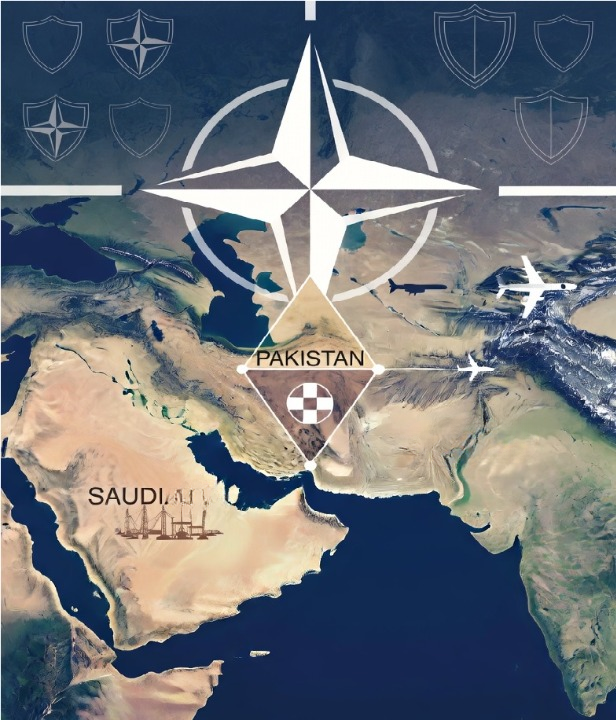
The NATO-style Strategic Mutual Defence Agreement was signed by Pakistan and Saudi Arabia on 17 September 2025. This bilateral defence pact, akin to Article 5 of the NATO accord, asserts that an assault on one nation will be considered an assault on the other nations. This agreement was established during the period when Israel conducted aerial strikes on Qatar, resulting in casualties, including Qatari civilians. Washington failed to prevent the attack on Doha, despite having U.S. military troops stationed in the Gulf region, including Qatar. The U.S. military installations also failed to avert the missile assault from Iran during the Israel-Iran conflict in 2025. The Gulf nations, particularly Saudi Arabia, can no longer depend on Washington for their security. Consequently, Riyadh engaged with Pakistan, resulting in the activation of the defence accord.
The prospective inclusion of Turkey in this defence alliance will enhance the deal, as the three nations embody distinct capabilities. The Kingdom of Saudi Arabia holds the requisite wealth to implement the new military programs. Among these three nations, Pakistan is the sole country possessing nuclear capacity and a substantial military force. The recent inclusion of Turkey enhances the advanced military technology industrial base. Turkey is at the forefront of military drone and aircraft development. Turkey incorporates innovative technology into this mutual defence agreement.
Pakistan Defence Ties with Saudi Arabia and Turkey
The defence relationship between Pakistan and Saudi Arabia is longstanding. The present state of Pakistan’s defence relations with Riyadh commenced shortly after the Arab Spring in the Middle East. The fight for the promotion of democracy in the area proved to be a particularly difficult challenge for Riyadh with the movement’s emergence in neighbouring Yemen. Saudi Arabia aimed toformalise defencee collaboration throughout the Gulf region and the Muslim world. This led to the establishment of the Islamic Military Counterterrorism Coalition (IMCTC), comprising 34 Muslim nations, in 2015. The inaugural head of this coalition was Raheel Sharif, the former Chief of the Armed Forces of Pakistan. This coalition served as the precursor of the modern mutual defence pact between Islamabad and Riyadh.
There is an unparalleled expansion of defence and strategic collaboration between Pakistan and Turkey. Turkey backed Pakistan on the Kashmir issue at international forums, including the United Nations. Turkey supported Pakistan during its conflict with India last year. Turkey not only refrained from publicly endorsing Islamabad through remarks but also supplied drones, which were pivotal in the fight. Turkey has supplied Pakistan with advanced aircraft, naval assets, and enhanced collaboration via cooperative military drills.
Gains for Turkey and Reaction from Other Countries
By entering this defence treaty, Ankara achieves dual benefits: firstly, it has been previously asserted that the defence relations between Pakistan and Turkey are already robust. Both countries aim to strengthen their defence relations by increasing cooperation through co-production. Both nations regard one another as low-risk partners. Ankara and Islamabad seek to leverage their relationship with each other to enhance their regional presence.
In contrast to its relationship with Pakistan, Turkey’s relationship with Riyadh is undergoing reorganisation. Turkey began to recognise the diplomatic and economic advantages of the Kingdom after the significant rift over issues like the Arab Spring and the assassination of Jamal Khashoggi at the Saudi consulate in Istanbul. Saudi Crown Prince Mohammad Bin Salman possesses exclusive access to the White House in Washington, which is advantageous for Ankara, given Turkey’s contentious status within NATO.
Turkey’s impulse to join the defence pact with Saudi Arabia and Pakistan also comes in the context of the failure of its effort to join the European Union. Since 1987, Ankara has been looking to secure its membership in the European Union, but its application was never accepted by the Union. The European countries didn’t consider Turkey as part of Europe. Under the leadership of President Erdogan, present-day Turkey has accepted that it is not going to be accepted by the European Union and therefore, is looking for strong ties with Asian countries through using its Muslim identity.
The inclusion of Turkey in the defence accord is advantageous for both Riyadh and Islamabad. It will confer legitimacy on their mutual defence accord and enhance their shared aspiration to establish a unified defence organisation. The credibility of the defence institution has been enhanced as nations such as Qatar endorsed Turkey’s participation in the defence treaty. Qatar supports Turkey’s initiative to join the mutual defence pact due to the security cover Turkey provides for Qatar. On the social media platform ‘X,’ Qatar’s former prime minister welcomed Turkey’s admission and emphasised that Egypt should also join the group.
Implications for India
Contemporary geopolitics is experiencing a transformation due to President Trump’s unilateralism, the Russian conflict in Ukraine, and China’s assertiveness. All nations are modifying their foreign and defence policies in response to prevailing circumstances. This defence agreement is referred to as the ‘Islamic NATO.’ The efficacy of the agreement is contingent upon future events; it carries significant consequences for India.
First, it will enhance Pakistan’s strategic and military standing not only within the Muslim world but will also complicate India’s strategic and deterrent calculations. Second, the infusion of Saudi capital and Turkey’s sophisticated military technologies will bolster Pakistan’s defence stance against India. It may also enhance Pakistan’s backing for terrorist organisations in India. Third, it will affect India’s strategic standing in West Asia, perhaps undermining its recent achievements in the region. Fourth, it will provide Pakistan with enhanced diplomatic backing in the event of a future war with India. Turkey provided diplomatic and military assistance to Pakistan during their conflict with India in May 2025. This disagreement will escalate further as a result of the mutual defence agreement. Finally, India is a participant in the anti-terror coalitions of Israel and the UAE in the region, raising concerns that it may become entangled in future regional confrontations. The disputes in the region may escalate in the future as a result of this accord.
Ultimately, it can only be said that regional and global politics have become unstable and unpredictable. India must seek more allies that have comparable strategic interests. This may necessitate a significant reconfiguration of India’s foreign policy alongside essential modifications to its defence policy. India must enhance its economy and military to address the current crisis.

Dr Mohammad Rizwan holds a PhD in political science from Jamia Millia Islamia. His doctoral research focuses on Pakistan’s relations with major global powers. Views expressed are the author’s own.
 Anjali Singh
  Parag Gilada