
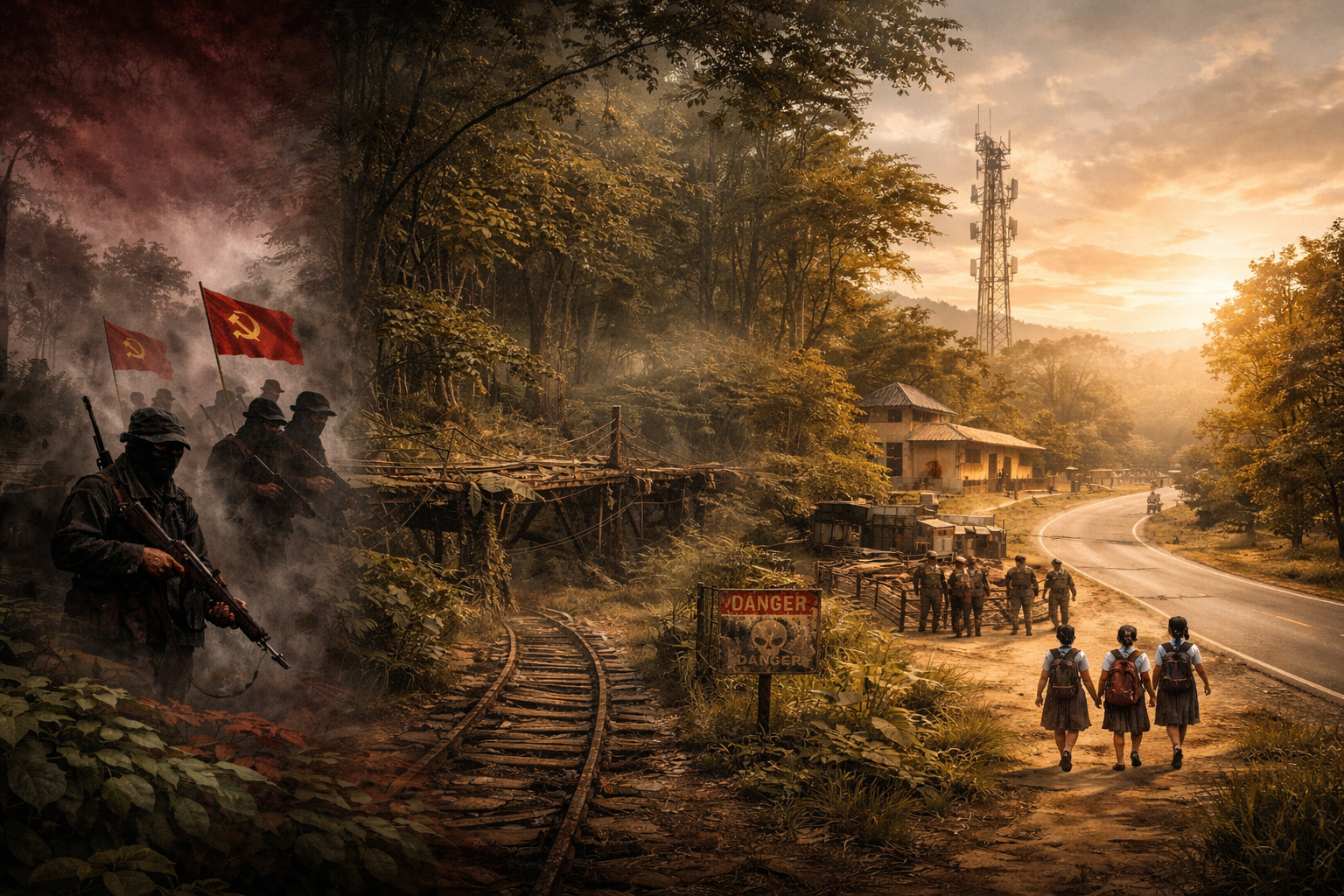
- For more than half a century, the Naxalite movement represented one of the gravest internal national security challenges to the Indian Republic.
- Naxalism was an organised and sustained contest over state authority, economic control, and political legitimacy across some of India’s most vulnerable regions.
- The most decisive shift occurred after 2014, when the Indian state adopted an integrated doctrine combining security dominance with development saturation.
- The true measure of our victory is not the elimination of the Maoists, but ensuring the absence of the conditions that triggered their rise.
For more than half a century, the Naxalite movement represented one of the gravest internal national security challenges to the Indian Republic. This armed movement was even more dangerous compared to Khalistan and the Jihadi terror. It was not merely an armed rebellion; it was a movement built on an ideology responsible for the death of one hundred million people in the last one hundred years.
The Naxal/Maoist operation was purely Gramscian in nature. Antonio Gramsci argued that revolutionary movements must operate on two planes. The war of manoeuvre refers to direct, frontal confrontation with the state—armed insurrection, rapid offensives, and attempts to seize territory or power. And the war of position, by contrast, is a prolonged struggle within civil society: building ideological hegemony, infiltrating institutions, shaping culture, and eroding the legitimacy of the state before any decisive clash.
It was an organised and sustained contest over state authority, economic control, and political legitimacy across some of India’s most vulnerable regions. Dr Manmohan Singh once described Naxalism as “the single biggest internal security challenge ever faced by our country.” The phrase endured because it captured the scale of the problem: a movement that at its height affected over 200 districts, paralysed development corridors, and imposed a continuous human and economic cost on the state and its citizens.
However, as the end of Left-Wing terrorism is coming to an end by March 2026, it is a moment of reflection and not celebration. The Naxal movement was not without validation. The movement originated in Naxalbari in 1967, a region that functioned under a feudal agrarian system. It was the landless peasants in the tea plantations who faced exploitation, low wages, and weak legal protections, creating fertile ground for radical mobilisation. Influenced by Maoist ideology and led to an armed resistance against landlords. While not exclusively a tea workers’ movement, the plantation conditions provided the social terrain, and the movement slowly shifted away from tea estates toward forested tribal regions, where it evolved into a prolonged insurgency against the Indian state.
Origins: Ideology Armed with Violence
The Naxalite movement emerged in 1967 from the tea gardens of Naxalbari in West Bengal, led by Charu Majumdar, Kanu Sanyal and Jangal Santhal. From the outset, the movement rejected parliamentary democracy. Majumdar said, “he who does not take up arms is not a true communist”, and this call became an operational doctrine steeped in Maoism.
Over time, splinter groups emerged into what later became the CPI (Maoist) in 2004, adopting the strategy of “protracted people’s war.” The movement’s leadership—figures such as Kishenji (Mallojula Koteshwar Rao), Ganapathy, and Basavaraj—sought not reform but replacement of the Indian state through terror and violence.
The Human and Economic Toll
Between the late 1990s and the mid-2010s, Left-Wing Extremist/Terrorism violence claimed thousands of lives—including civilians, security personnel, and Maoist insurgents themselves. Government data compiled by the Ministry of Home Affairs (MHA) states that civilians suffered maximum fatalities by a group that claimed it fought for the people.
The economic consequences were equally severe, though less visible due to underreporting, fragmented, and deliberately softened during the 1990s, 2000s, and largely until 2014 due to a combination of structural, political, and ideological factors. The Indian National Congress, which held power at the centre, was cautious in labelling Maoism as an existential security threat,t and the main driving force was Coalition Politics, i.e. dependence on Left support (2004–08). Therefore, it led to the downplaying of attacks and avoiding sustained national narratives on Maoist violence.
All the Naxal-affected regions overlapped with mineral-rich belts containing coal, iron ore, bauxite, and forest resources. Yet the people living in these areas suffered chronic under-investment due to violence. Any projects were systematically targeted, and supply chains disrupted. Repeated attacks on railways, roads, telecom towers, and construction ensured basic amenities never reached the people, so they remain disgruntled and susceptible to Moist indoctrination.
The Maoist movement also took a serious economic toll. Over the last 25 years, the Indian state has spent thousands of crores of rupees on counter-insurgency, police modernisation, central armed police force deployment, and compensation funds that would have ideally gone towards productive capital infrastructure development and employment. Security-Related Expenditure (SRE) schemes alone have consumed thousands of crores since the early 2000s, supplemented by special central assistance packages and infrastructure-specific funding for Left-Wing Extremism (LWE) districts.
As K.P.S. Gill, one of India’s most experienced counter-insurgency practitioners, observed with characteristic clarity: “Insurgencies survive not because they are just, but because the state hesitates.” That hesitation—political, administrative, ideological and strategic—proved costly.
Urban Naxals: A Political and Social Cover
No serious account of Naxalism/Maoism can ignore the role of sympathetic narratives within sections of so-called civil society and its intellectual rabble rouser activist circles that rationalised, and even romanticised Maoist violence as an understandable response to state failure. Arundhati Roy metamorphically called the Maoists “Gandhians with guns claiming Maoist cadres took arms after having exhausted non-violent, constitutional methods.
This ideological indulgence gave the Maoist intellectual covering fire, as written by Antonio Gramsci. The Maoists found support in journalists, lawyers, NGOs, students in universities and academics who repeatedly advocated for rights shaded into apologetics for armed coercion. Though small in numbers, loud in their reach, they created a prolonged ambiguity that delayed decisive action.
The term “urban Naxals” entered popular discourse in the 2010s, used by political leaders to describe sections of urban intellectual, legal, and NGO activist ecosystems accused of providing ideological legitimacy to Maoist narratives. The term is deemed controversial by a section of our society with the capacity for rhetoric. But the fact remains, dismissing this tag would be intellectually dishonest because these are the people who call for violence from the safety of their homes and university classrooms. George Orwell said, “Those who call for violence often survive it; those who live with it rarely do.”
Historically, Maoist doctrine has emphasised urban networks for logistics, propaganda, legal defence, and international advocacy. For the Maoist, the left intelligentsia acted as its Over Ground Workers; such movements rarely survive without above-ground sympathisers.
Dissent in democracy is necessary, but not in support of insurgency. What in turn happened was a sustained ideological cover that rationalised violence, which led to a delayed state response and confused public morality, such as we see in places like the JNU. Democracies must protect free speech, but they cannot tolerate armed rebellion and seditious behaviour in public. Anyone who will one day study this movement will know that when intellectual ambiguity is provided, it helps terrorists; clarity and action weaken them.
India Paid in Blood
In the last four decades, the Naxalite or Maoist insurgency has imposed a heavy human cost on India. According to consolidated data from the Ministry of Home Affairs (MHA) and independent security databases, between the 1980s and mid-2020s, more than 15,000 people have lost their lives due to Maoist violence.
Civilians have borne the brunt of it, with estimates indicating that between 9,000 and 12,000 civilians were killed. The Maoists killed their victims by targeted assassinations, reprisals, landmine blasts, and coercive violence used to enforce Maoist control over local populations.
Security forces have suffered approximately 2,700–3,000 fatalities, particularly during the peak years of the conflict between 2008 and 2012, when large-scale ambushes were frequent.
Maoist combatant deaths, from planned and intensified counter-insurgency operations, are estimated to number between 4,500 and 6,000 over the same period. However, in the last decade, the ratio has shifted in favour of the state, with Maoist casualties significantly outnumbering civilian and security force deaths. Since 2014, fatalities among our security forces have witnessed a steep decline due to improved security coordination, infrastructure expansion, and sustained governance in the insurgency-affected areas.
Post-2014 State Consolidation a Turning Point
The most decisive shift occurred after 2014, when the Indian state adopted an integrated doctrine combining security dominance with development saturation. The Modi government abandoned episodic responses in favour of sustained territorial control.
Ajit Doval, India’s National Security Advisor, articulated the underlying logic succinctly:
“Internal security failures begin where the state withdraws from contested spaces.” This insight reshaped operational thinking. Instead of temporary clear-and-hold operations, the emphasis moved to clear-hold-build-govern.
Infrastructure as Counter-Insurgency
The Modi government used infrastructure as a strategic instrument. Between 2014 and 2024, the government accelerated:
- Construction of thousands of kilometres of all-weather roads in Left Wing Extremism (LWE). areas
- Expansion of railway lines into previously inaccessible tribal regions
- Installation of over 4,800 mobile towers, breaking insurgent information monopolies
- Opening of bank branches, ATMs, and postal services, integrating local economies
- Establishment of Eklavya Model Residential Schools, ITIs, and health centres
These were not peripheral projects because the infrastructure development needed to take place right in the Red Corridors. Roads enabled commerce, and railways integrated forested interiors into national markets. Digital connectivity diluted insurgent propaganda and coercive control.
Amit Shah repeatedly emphasised this linkage: “Development and security are not alternatives; they are complements.” He also drew a firm line on violence itself and said, “There can be no dialogue with those who hold the gun. First abandon violence, then talk.”
This reflected on the Union Budget. Allocations for LWE-specific security and infrastructure rose steadily, crossing ₹3,400 crore annually by the mid-2020s, with a final push toward the March 2026 deadline.
Decline and Denouement
The results are measurable. The number of affected districts fell sharply, and violent incidents declined. Most of the senior Maoist leaders were neutralised or surrendered. Recruitment dried up as state presence became permanent rather than episodic.
Prime Minister Narendra Modi framed the moral dimension of this effort with restraint:
“The biggest injustice to the poor is allowing violence to rule where governance should.” By 2025, only a handful of districts remained on the MHA’s “most affected” list, and even there, insurgent activity was sporadic rather than systemic.
Inconvenient Truth
As more information about the atrocities and crimes of Maoist come to light, the citizens of India are now learning more about an ugly truth, which was only whispered, and that is the Sexual Violence used as a tool for discipline and intimidation. Such heinous acts were documented but underreported and avoided by Urban Naxals because it was an inconvenient truth. The left-liberals harp on gender equality and liberation, but when one reads the testimonies from surrendered cadres, women and men, it is clear there were coercive sexual relationships, forced partnerships, and exploitation of women within senior Maoist ranks.
It is a bitter irony that a group that calls for equality is very much hierarchical, with the absence of internal accountability that enabled mass abuse. Those who dissented were called Counter-Revolutionary, Agent / Informer / Police agent, and it was the womenwho most often faced punishment and rape was used as a tool for discipline.
Sexual violence has also occurred against civilians in Maoist-influenced areas, particularly as a tool of intimidation against families accused of informing or resisting Maoist authority. Fear, social stigma, and lack of police and local administration ensured it would take years before such atrocities could be verified. Acknowledging Maoist sexual violence is essential to dismantle romanticized portrayal.
There is also substantial, well-documented evidence that Maoist cadres systematically targeted the families of surrendered members and defectors as a method of deterrence and internal discipline. They killed and assaulted family members of surrendered cadres and publicly humiliated relatives through kangaroo courts (Jan Adalats). Even the government acknowledged that such actions deterred defection, but in the long run, such acts proved detrimental to the cause.
A Sombre Conclusion
March 2026 may be the formal end of Naxalism as an organised insurgency, but it will not be the end of this saga. Armed movements in India have been defeated, and ending Maoist terror is necessary for our economic growth. That is why there cannot be any structural inequities, and there should be continuous good governance. We as a nation simply cannot afford to remember Naxalism too casually just because it has ended. This Red Chapter, soaked in blood and tears, must be remembered and taught in our schools and universities as a cautionary tale.
The Indian state has paid a heavy price—in lives, in resources, and in delayed development—for decades of political mismanagement. But once the state took decisive action and accelerated infrastructure and ended administrative paralysis, the results were instantaneous. Going forward, our lesson should not be triumph nor vindication but a reflection of what the people endured under the barrel of a gun, without roads, schools, markets, and justice, but more importantly, truth and reconciliation. The true measure of our victory is not the elimination of the Maoists, but ensuring the absence of the conditions that triggered their rise.
References:
- Ministry of Home Affairs. Annual Report on Left Wing Extremism. Government of India; multiple years.
- Government of India. Security Related Expenditure (SRE) Scheme Guidelines. MHA.
- Singh M. Address to Chief Ministers on Internal Security. Prime Minister’s Office; 2006.
- Gill KPS. The Endgame in Punjab. Har-Anand Publications; 1997.
- Ministry of Finance. Union Budget Documents 2014–2026. Government of India.
- Home Affairs Standing Committee Reports on LWE. Parliament of India.
- Shah A. Statements and reviews on LWE eradication. Ministry of Home Affairs; 2019–2026.
- Doval A. Lectures and policy remarks on internal security. National Security Council Secretariat.
- Ministry of Home Affairs. Annual Report 2022–23. Government of India, 2023. Accessed January 2026.
— Provides official cumulative and year-wise data on civilian, security force, and Maoist fatalities related to Left-Wing Extremism. - Ministry of Home Affairs. Left Wing Extremism Division: Status Paper. Government of India.
- South Asia Terrorism Portal. Fatalities in Maoist Violence in India. Institute for Conflict Management
- Planning Commission / NITI Aayog. Development Challenges in LWE-Affected Areas.
- Ministry of Home Affairs, Government of India. Annual Report 2012–13. New Delhi: MHA; 2013.
- Government of India. Women Naxals disclose instances of sexual exploitation. Press Information Bureau; 2012.
- The Times of India. Women Maoists are being sexually exploited, say officials. January 6, 2015.
- The Times of India. Women Naxals disclose instances of sexual exploitation: Govt. March 13, 2012.
- The Statesman. Women Naxals victims of sexual and psychological abuse: police. August 29, 2018.

Balaji is a freelance writer with an MA in History and Political science and has published articles on defence and strategic affairs and book reviews. He tweets @LaxmanShriram78. Views expressed are the author’s own.
 Dr Mohmmad Rizwan
  Archita Gaur
  Kumar Satish