
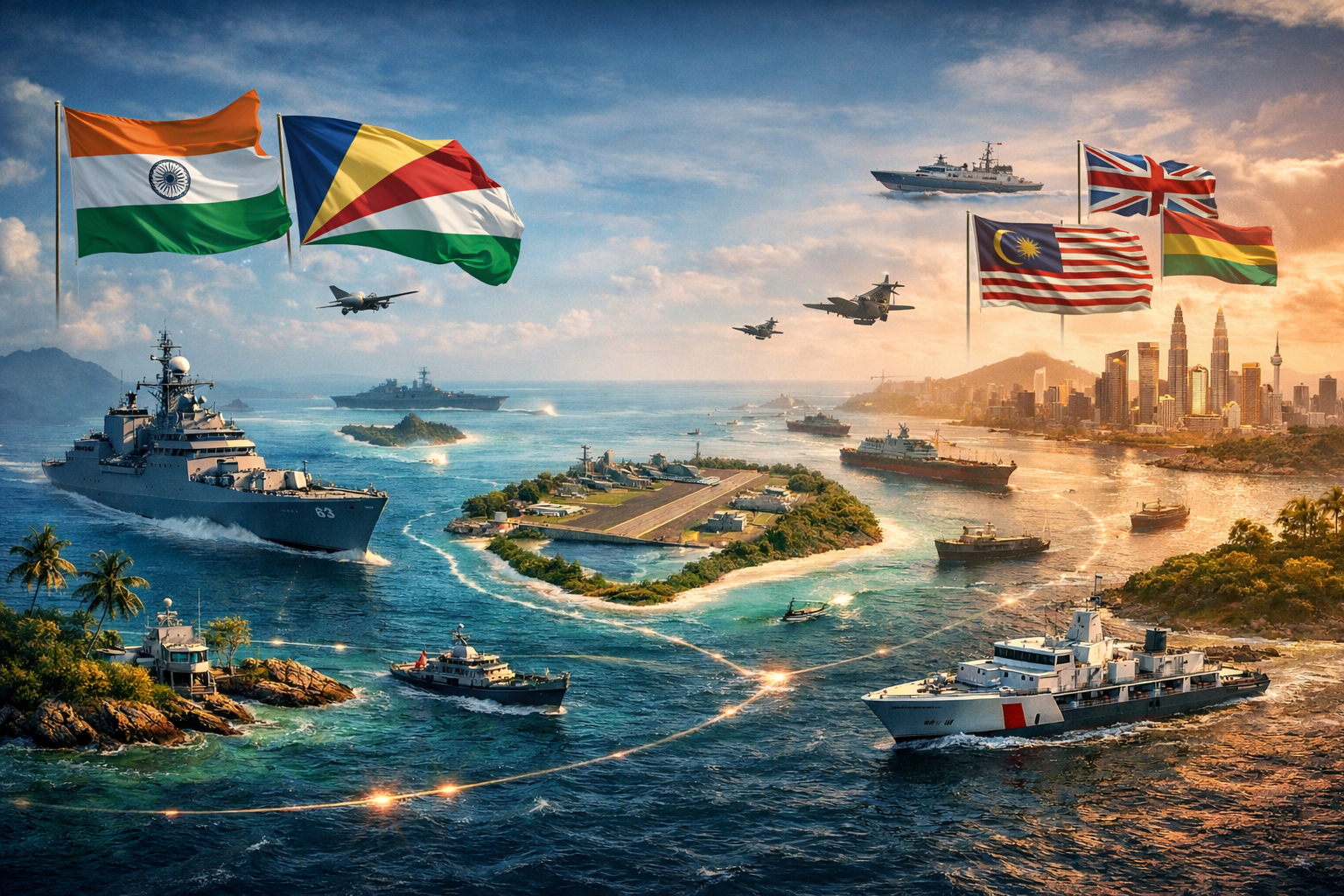
- The India–Seychelles relationship is strategically important because Seychelles, located in the southwestern Indian Ocean near the African continent, provides significant geopolitical visibility and accessibility.
- The relationship between India and Malaysia is moving from declaratory diplomacy to functional and operational cooperation. Malaysia plays a key role in India’s engagement with ASEAN.
- India is a natural and significant player in the region due to its geographical location at the heart of the Indian Ocean.
In the 21st century, maritime presence is key to territorial influence. Recognising this fundamental geopolitical reality, India and Seychelles continue to strengthen their relationship. In a major development, the Seychelles President, Patrick Herminie, visited India in early February. During the visit, both countries signed a 175-million-dollar special economic package, under which India will provide 125 million dollars in credit and 50 million dollars in grants.
This package will significantly support social housing, mobility, vocational training, health, and the defence sectors in Seychelles. Both countries also signed seven important agreements, including cooperation in ocean services, capacity building, ocean observation, and the establishment of hydrographic facilities.
This visit is particularly important because Seychelles is now a member of the Colombo Security Conclave. The Colombo Security Conclave is a regional maritime security initiative in the Indian Ocean Region comprising India, Sri Lanka, the Maldives, Mauritius, Bangladesh, and Seychelles as full members. This grouping is crucial for strengthening regional cooperation, as these countries are located at critical maritime junctions. The Indian Ocean has emerged as the new epicentre of global connectivity, making regional cooperation increasingly important.
The Indian Ocean Region facilitates approximately 75 per cent of global maritime trade and nearly 50 per cent of daily global oil consumption. Critical choke points such as the Strait of Malacca and the Strait of Hormuz lie within this region, and a substantial share of global trade passes through these routes. India is a natural and significant player in the region due to its geographical location at the heart of the Indian Ocean. In terms of naval capability and military strength, the Indian Navy is among the strongest in the region.
India consistently calls for stability, transparency, inclusivity, and freedom of navigation in the Indian Ocean. It maintains that regional resources should be equitably shared and not dominated or militarised by a few countries. The India–Seychelles relationship is strategically important because Seychelles, located in the southwestern Indian Ocean near the African continent, provides significant geopolitical visibility and accessibility. Seychelles greatly relies on Indian maritime support, particularly during disasters and humanitarian assistance operations.
The Chagos Issue and Regional Tensions
However, other countries are also asserting their presence in the region. A recent example is the controversy surrounding Mauritius. Like Seychelles, Mauritius is a member of the Colombo Security Conclave. In May 2025, the United Kingdom and Mauritius signed a treaty to transfer sovereignty of the Chagos Archipelago to Mauritius. However, the joint UK–US military base on Diego Garcia will continue to operate under a 99-year lease to the United Kingdom, with options to extend further. At present, the UK Parliament has not fully ratified the treaty. In early 2026, the debate was paused in the House of Lords, particularly due to concerns about compliance with older UK–US security agreements. This development has gained further attention because President Trump has been vocal in opposing the deal. He does not want the United Kingdom to proceed with the agreement, as he believes it could threaten US control over Diego Garcia.
The Maldivian President, Mohamed Muizzu, has also expressed concerns, stating that increasing military competition in the Indian Ocean could lead to further instability. Since Seychelles is geographically close to Mauritius, any instability in that region could have implications for it as well.
Therefore, the partnership between India and Seychelles is not merely about bilateral cooperation but also about maintaining balance in the broader Indian Ocean Region. Through its partnership with India, Seychelles gains a sense of strategic deterrence. This deterrence is essential for preserving the balance of power in the region. As one of the largest powers in the Indian Ocean, India carries the responsibility of maintaining stability, transparency, and maritime freedom.
India–Malaysia Strategic Convergence
Similarly, India’s relationship with Malaysia is also strategically significant. Malaysia is an important Southeast Asian country located in the Indo-Pacific region, near the Strait of Malacca. This strait is crucial due to its proximity to India’s Andaman and Nicobar Islands. Under India’s Act East Policy, strengthening ties with Southeast Asia has become a priority, making the India–Malaysia partnership increasingly important.
Prime Minister Narendra Modi recently visited Malaysia on a two-day visit at the invitation of Malaysian Prime Minister Anwar Ibrahim. In 2024, both countries elevated their relationship to a Comprehensive Strategic Partnership. Following this, the first security dialogue between India and Malaysia was organised in January 2025.
The relationship between India and Malaysia is moving from declaratory diplomacy to functional and operational cooperation. Malaysia plays a key role in India’s engagement with ASEAN. India considers ASEAN its extended neighbourhood and seeks to strengthen economic, strategic, and connectivity partnerships with the region.
Both India and Malaysia share common interests in economic growth, technological development, and regional stability. They have strengthened cooperation in defence, maritime security, and counter terrorism. Both countries have expressed zero tolerance towards terrorism. This move is important because Malaysia has traditionally tried to balance its relationship between India and Pakistan. Even before the Pahalgam terrorist attack, which was widely regarded as a state-backed terrorist attack carried out by Pakistan-based terrorist elements, Malaysia had called for restraint and supported the idea of a joint investigation between India and Pakistan.
The Zakir Naik Factor and Bilateral Sensitivities
However, this development is also significant due to the Zakir Naik issue. India has had a longstanding dispute with Zakir Naik. In 2016, authorities alleged that his speeches had influenced radical elements. Following this, the Government of India banned his organisation, the Islamic Research Foundation. Zakir Naik left India the same year and has since been residing in Malaysia, while India revoked his passport and sought his extradition, making it a diplomatic challenge between India and Malaysia. In this context, both India and Malaysia agreeing to zero tolerance towards terrorism is a positive step and may help in addressing bilateral challenges.
The Indo-Pacific has become a central theatre in global geopolitics. Malaysia, like India, understands the strategic competition unfolding in the region. It faces its own regional tensions and recognises the influence of major powers, including the United States and China. Malaysia seeks to maintain strategic autonomy and avoid being drawn into external power rivalries. This approach aligns with India’s broader vision of regional balance, inclusivity, and multipolarity.
Thus, India and Malaysia share geopolitical similarities in their outlook towards regional security, economic cooperation, and strategic autonomy in the evolving Indo-Pacific order.

Aayush Pal is a freelance writer on contemporary geopolitical developments. The views expressed in his work are entirely his own.
 Kumar Satish
  Anjali Singh