
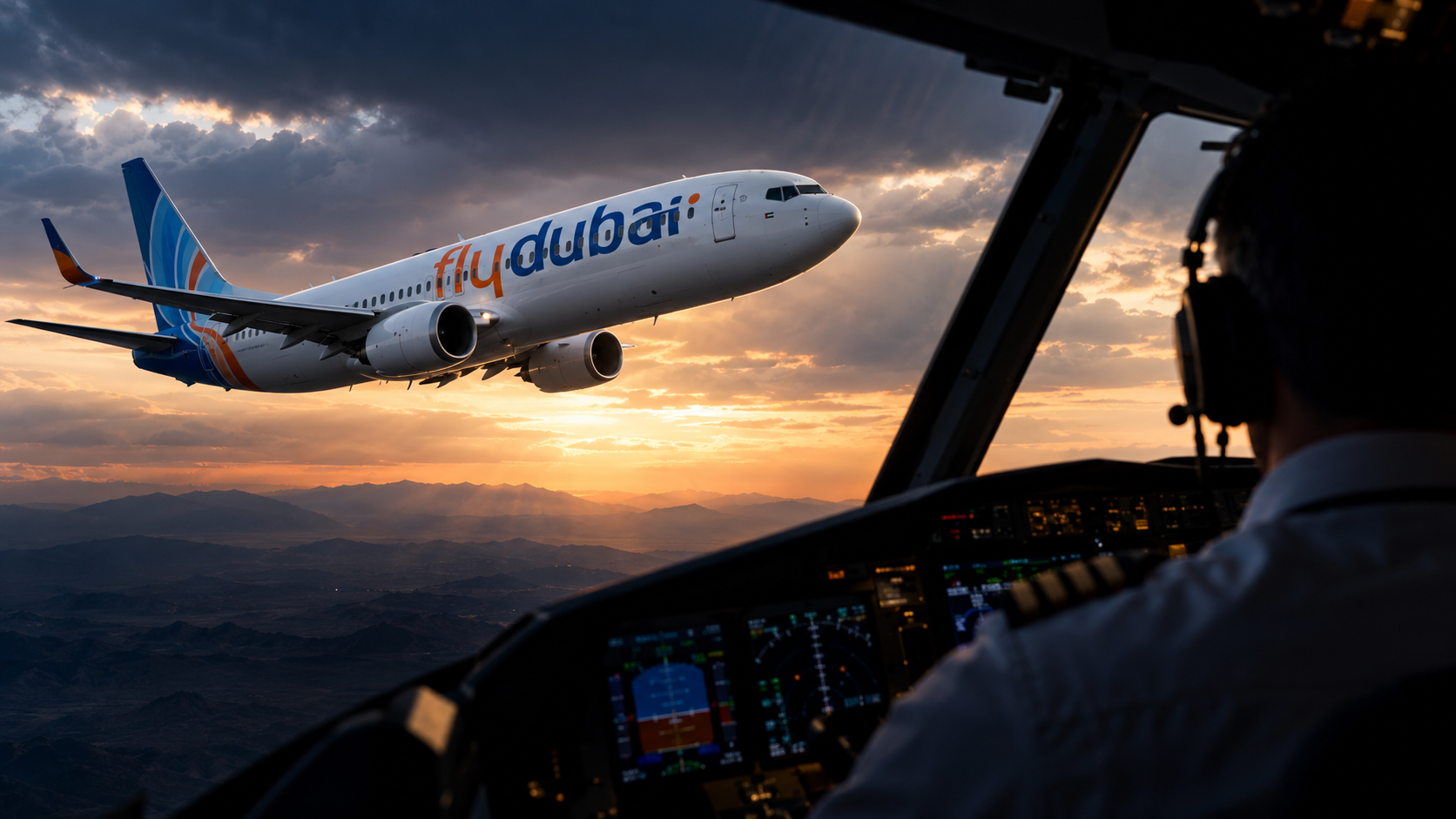
- Investigators have concluded that the co-pilot attempted to commit a terrorist act, according to counselor Dr. Hamad Saif Al Shamsi.
- He attempted to seize control of the flying controls while the aircraft was in the air and attacked the captain with a crash axe, a common emergency weapon stored in the cockpit.
- Despite being hurt and lying on the ground, Smit Machchhar was still able to access and unlock the cockpit door. This made it possible for passengers and crew to enter and defeat the assailant.
- As the threat originated from the cockpit, pilot screening and ongoing evaluation will come under renewed scrutiny, particularly on routes that are geopolitically sensitive.
On the morning of September 30, 2026, flydubai aircraft FZ1073, a Boeing 737 MAX flying from Dubai to Tel Aviv, nearly crashed over Saudi airspace.[1] It did not, and a significant part of the reason is that an Indian pilot continued battling although injured and on the floor of the flight deck.
The flight and the descent
The aircraft left Dubai International Airport early that morning with more than 170 passengers and crew on board, most of them Israeli nationals. The route has operated regularly since the normalisation of UAE-Israel relations under the Abraham Accords.
According to flight-tracking data from organizations such as Flightradar24,[2] the first clear signals of problems occurred at 9:21 a.m. UAE time, when the aircraft was traveling at around 34,000 feet. It then began a steep descent, losing an estimated 15,000 to 17,000 feet in roughly a minute at nose-down inclinations significantly greater than those seen in a typical commercial descent. Speeds rose sharply, and the aircraft approached or briefly exceeded its operational limits, putting heavy G-forces on the airframe. It then climbed, descended again and eventually stabilised at a lower altitude.
A different story was revealed via the aircraft’s transponder. As the airplane diverted, the code changed from 7700, the general emergency signal, to 7500, which indicates unlawful interference, and then back to 7700.[3]
What happened inside the flight deck
According to official reports from Saudi and UAE authorities, the crisis started in the cockpit. The early findings published by Saudi Arabia’s Ministry of Interior on October 1 said that the co-pilot, who was later identified as Hamam al-Hammami, attacked the captain wounding both men.[4]
Later, the UAE Attorney-General’s office went even farther. Investigators have concluded that the co-pilot attempted to commit a terrorist act, according to counselor Dr. Hamad Saif Al Shamsi. Accordingly, he attempted to seize control of the flying controls while the aircraft was in the air and attacked the captain with a crash axe, a common emergency weapon stored in the cockpit.
The captain, Smit Machchhar, an Indian national, suffered several injuries. Despite being hurt and lying on the ground, he was still able to access and unlock the cockpit door. This made it possible for passengers and crew to enter and defeat the assailant.
A collective response
The intervention was a collaborative effort. Along with other crew members and passengers, reserve pilots who were traveling as passengers assisted in restraining the co-pilot and regaining control. At approximately 9:45 a.m. Saudi time, the relief crew flew the aircraft, which had sustained damage from the extreme maneuvers, including damage to its rudder, to a safe landing at Prince Sultan bin Abdulaziz International Airport in Tabuk, Saudi Arabia.
All passengers and crew were accounted for, and there were no passenger fatalities. The captain and co-pilot received medical attention. Machchhar was later transferred to Abu Dhabi for further treatment, and the passengers were flown on to Israel aboard replacement aircraft the same day.
Recognition for Captain Machchhar
Machchhar, a Dubai-based pilot with flydubai, has been widely recognised for his conduct. On 2 October, Prime Minister Narendra Modi spoke to him by video call from his hospital bed in Abu Dhabi. The captain described fighting for his life, realising the aircraft was in a descent, and making a determined effort to open the door so that others could intervene. The UAE’s General Civil Aviation Authority formally commended his courage and rapid response, and that of the crew and passengers who helped contain the situation. Indian officials stayed in close coordination with UAE authorities on his medical care. Furthermore, Benjamin Netanyahu, Prime Minister of Israel
Israeli Prime Minister Benjamin Netanyahu also acknowledged his courage, calling him a “ true hero” and saying his actions helped avert a catastrophic mid-air disaster.[5] India’s diplomatic efforts also facilitated timely support and coordination with authorities in Saudi Arabia and the UAE.
The investigation
UAE authorities are leading the investigation, with Saudi authorities having coordinated with a UAE security team. The co-pilot has been identified in multiple reports as an Omani national. The inquiry is examining the full circumstances, including motive, any prior planning or direction, and any associated links, through technical examination and analysis of physical and digital evidence. The pilots were returned to the UAE after medical clearance.
It is worth being precise about what is established and what is not. Flydubai’s early statement described an “altercation” in the flight deck, stressed that motives were still under investigation and cautioned against premature speculation. The UAE Attorney-General has since stated the investigators’ determination that this was an attempted terrorist act. Questions remain open about the exact sequence of events in the cockpit, the precise control inputs during the dives and the full technical assessment of the stresses on the airframe. Until the inquiry reports, responsible commentary should rest on what officials have confirmed.
Security lessons
The incident has prompted temporary adjustments to flight operations and closer scrutiny of aviation security protocols, particularly crew vetting and background checks for personnel on flights to sensitive destinations. Passenger and crew information for the flight had been shared in advance under existing security arrangements.
Aviation security depends on multiple layers of protection, several of which functioned effectively here. But as the threat originated from the cockpit, pilot screening and ongoing evaluation will come under renewed scrutiny, particularly on routes that are geopolitically sensitive.
The aircraft itself also withstood extreme loads and remained flyable. The safe landing owes much to prepared crew and passengers who acted decisively in a confined, high-stakes setting.
The record so far
The verified timeline is clear. The flight departed Dubai, a disturbance began in the cockpit, the aircraft lost extreme altitude and recovered, passengers and crew intervened, and the plane landed safely in Tabuk. Official findings to date attribute the start of the crisis to the co-pilot’s assault and his attempt to take control for terrorist purposes. Captain Machchhar’s role is central to that record and has been recognised by governments and aviation authorities for its part in preventing a catastrophe.
As the UAE completes its inquiry and coordinates with international partners, the priority is to let the investigation establish the remaining facts. In the meantime, the lesson from FZ1073 is plain: sustained vigilance matters, and trained professionals and prepared passengers can still turn back an attack when the protocols are tested.
[1] What do we know about flydubai flight 1073?
[2] Flydubai flight to Tel Aviv diverts to Tabuk after pilot attack
[3] A plunge, a cockpit fight and a lot of questions: What really happened aboard the flydubai flight?
[4] Interior Ministry Issues Statement Detailing Flydubai Emergency Landing in Tabuk Following Cockpit Altercation
[5] Netanyahu calls stabbed Indian pilot a hero; Flydubai halts Israel flights

Pranav S is a Project Assistant at the Energy Department, Government of Karnataka with an MA in Public Policy. Views expressed are the author’s own.
 Aayush Pal
  Archita Gaur
  Hridbina Chatterjee