
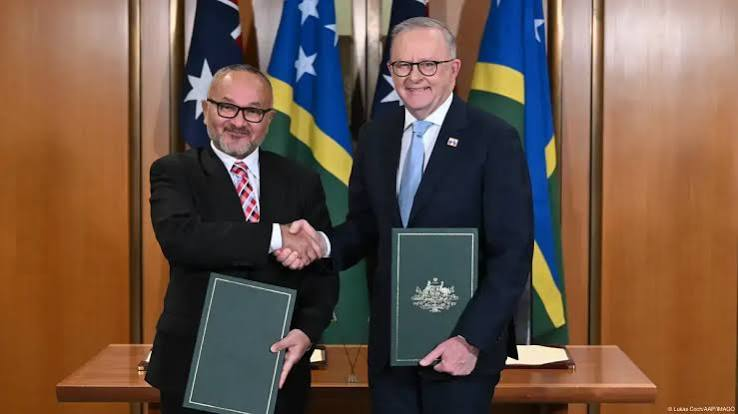
- The signing of the new security agreement between Australia and the Solomon Islands is another significant geopolitical move in the South Pacific region, considering that Canberra is increasingly working towards consolidating its strategic influence in response to China’s increasing influence in the region.
- The current agreement is a result of the effort of Australia to challenge the growing strategic presence of China in the Pacific.
- The deal is a good example of the dilemma which occurs frequently in international politics where small countries may benefit from the economic and security cooperation with large countries but at the same time become dependent on them.
- The key problem for the Solomon Islands will be turning geopolitical rivalry into concrete benefits for itself, all the while maintaining strategic autonomy.
The signing of the new security agreement between Australia and the Solomon Islands is another significant geopolitical move in the South Pacific region, considering that Canberra is increasingly working towards consolidating its strategic influence in response to China’s increasing influence in the region. By making Australia its main security partner, the agreement clearly shows the change in the diplomatic course that Honiara is taking.
Building Australia’s Strategic Presence in the Pacific
In this agreement, Canberra will offer the Solomon Islands up to 740 million Australian dollars over the coming ten years, which will go into education, infrastructure, policing and community development programs in the Solomon Islands. Additionally, the agreement calls for improvement of the security and law enforcement capabilities of the Solomon Islands and banning of foreign military and security bases in the Solomon Islands. Lastly, Honiara will be bound to seek advice from Canberra before it signs any agreement on critical infrastructure and security cooperation outside the Pacific Islands Forum countries.
Challenging the Growing Chinese Presence: The Balance of Power Perspective
From an International Relations point of view, the agreement is based on the logic of balance-of-power politics. The expanding presence of China in diplomatic, economic, and military terms in Pacific Island states has led to security worries for Australia, given its perception that the South Pacific region is a vital part of its national security considerations. The security agreement signed by Beijing and Honiara in 2022 had caused concerns for Canberra and Washington regarding the potential expansion of Chinese security presence in the region, which had historically been under the sway of Western nations. The current agreement is a result of Australia’s efforts to challenge the growing strategic presence of China in the Pacific.
Indo-Pacific: A New Stage of Strategic Competition
This development further accentuates the importance of the Indo-Pacific as a theatre for strategic rivalry. Relations between China and the Solomon Islands escalated after the Solomon Islands recognised Beijing diplomatically and severed ties with Taiwan in 2019. Through investment in infrastructure, development aid, and security collaboration, China has been trying to consolidate its diplomatic networks in the Pacific. Australia’s new deal, therefore, cannot be considered simply a bilateral security deal; it is rather a regional effort on the part of Australia to avoid the creation of any competing strategic outposts in its own backyard.
Strategic Autonomy of Small Island States
Yet an approach based solely on competition between the two great powers fails to account for the agency of small Pacific Island states. In the case of the Solomon Islands, the diplomatic recalibration of relations by Prime Minister Wale shows how smaller states manage competition between bigger states for their own benefit in terms of economic and development assistance as well as security assurances.
Security Cooperation and National Sovereignty
However, the deal does pose some interesting issues in relation to the link between security cooperation and national sovereignty. While Australia has insisted that its involvement in the deal would respect Solomon Islands’ sovereignty in decision-making, clauses which require consultation with Canberra regarding security and infrastructure matters raise the possibility of unequal influence. The deal is a good example of the dilemma which occurs frequently in international politics where small countries may benefit from the economic and security cooperation with large countries but at the same time become dependent on them.
Australia’s Regional Security Strategy
From Australia’s point of view, the deal helps strengthen its regional engagement strategy and further confirms its intention to become the preferred security partner for the Pacific Island states. It seems to be an example of a wider approach of Canberra towards building institutionalised partnerships with regional countries and not just through diplomatic declarations. The importance of using economic aid, education, infrastructure projects and people-to-people contacts as the means of regional influence is also evident.
China’s Reaction and the Geostrategic Dynamics in the Pacific Ocean
The reaction of China will play an important role in defining the broader implications of the agreement. China has claimed that its partnership with the Pacific states is built upon respect and is not against any other country. Nevertheless, the geostrategic consequences of the new agreement may cause difficulties for China in expanding its security presence in the region, especially in light of the expiration of the former agreement between China and Honiara.
Conclusion: Redrawing the Indo-Pacific Balance of Power
In the end, the agreement between Australia and the Solomon Islands indicates far more than just a diplomatic reorientation of bilateral relations. This agreement is indicative of the way that strategic rivalry between existing and rising powers is reconfiguring the nature of regional relationships within the Indo-Pacific region. However, the success of Australia’s strategy in the coming years will rely not only on containing the influence of China but on tackling the development and security needs of Pacific Island nations. The key problem for the Solomon Islands will be turning geopolitical rivalry into concrete benefits for itself, all the while maintaining strategic autonomy.

Anjali Singh is a postgraduate student of Political Science and International Relations, a Social Media Analyst, and a former Research Intern at the Indian Council of World Affairs. Views expressed are the author’s own.
 Archita Gaur
 Hridbina Chatterjee