|
Getting your Trinity Audio player ready...
|
- Macron’s visit to South Korea focused on energy cooperation, economic collaboration, and strengthening bilateral ties.
- The two countries agreed to strengthen defence production cooperation as France is a leading defence power in Europe, while South Korea has emerged as a major global defence manufacturer.
- The growing divide between Europe and the US is increasingly visible, as Europe seeks closer ties with countries beyond the traditional Western bloc.
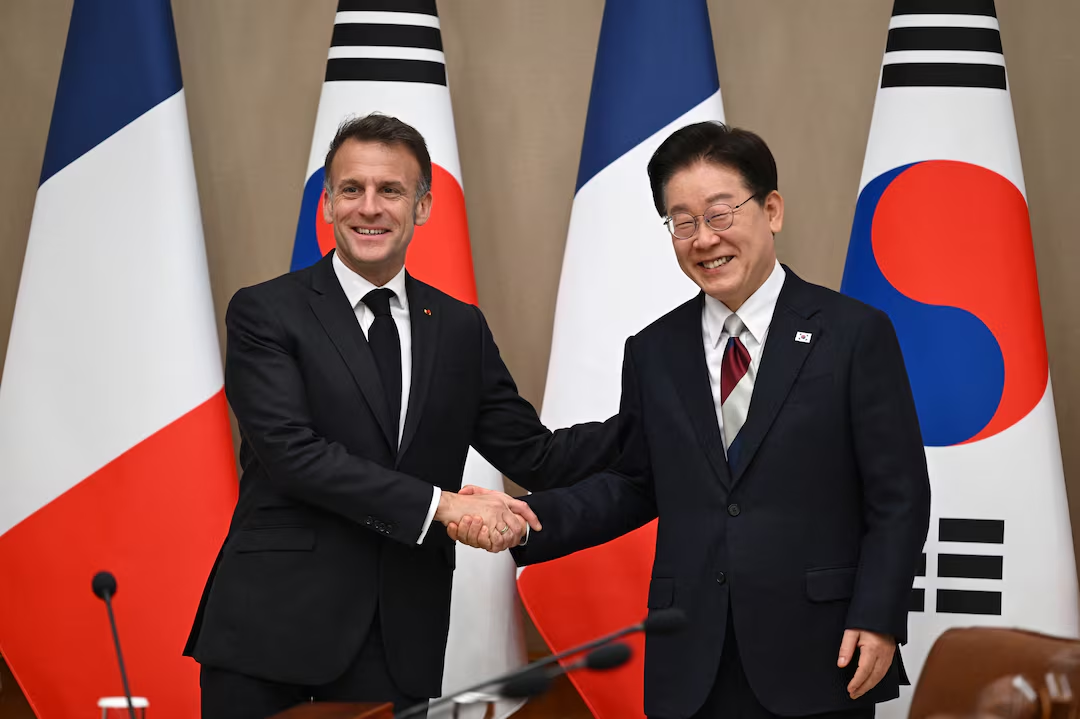
In a major diplomatic move, French President Emmanuel Macron visited the East Asian nation of South Korea for a two-day visit last week. The visit began on Thursday, and with this, President Macron became the first French President to visit South Korea since 2015. During his visit, he met with the newly elected South Korean leadership, including President Lee Jae Myung.
The agenda of the visit focused on energy cooperation, economic collaboration, and strengthening bilateral ties. This comes at a time when both countries are facing challenges due to escalating tensions in West Asia and the disruption around the Strait of Hormuz, which has significantly impacted the global economy and triggered concerns of an emerging economic crisis. South Korea, in particular, remains highly vulnerable as it imports a large share of its energy through the Strait of Hormuz.
Addressing the situation, the South Korean leadership emphasised the importance of free movement and secure maritime mobility in the Strait of Hormuz. In response, President Macron stated that reopening the Strait through military means is unrealistic and stressed that diplomacy must be given priority in resolving the conflict.
This development is significant as France has become the first Western country whose vessels have been allowed by Iran to pass through the Strait of Hormuz under current tensions. Alongside this, France and South Korea agreed to strengthen defence production cooperation. France remains a leading defence power in Europe, while South Korea has emerged as a major global defence manufacturing player. The growing synergy between the two is expected to benefit both sides strategically.
Both countries also agreed to increase bilateral trade from the current 15 billion dollars to 20 billion dollars by 2030. A memorandum of understanding was signed between Korea Hydro and Nuclear Power, a state-owned South Korean company, and the French firm Framatome, focusing on nuclear energy cooperation.
For both France and South Korea, this partnership holds importance in the context of evolving global alignments. Differences between the United States and Europe have widened, particularly over NATO commitments and the ongoing Iran conflict. Europe increasingly finds itself bearing greater strategic responsibility amid declining direct support from the United States in areas such as Ukraine.
This situation has been further aggravated by political rhetoric from President Trump, who has been openly critical of European leadership and has even referred to Europe as a “paper tiger”. Such remarks have deepened transatlantic tensions and contributed to Europe’s strategic uncertainty.
At this critical geopolitical juncture, Europe is attempting to maintain its strategic autonomy. This is where countries like South Korea become important partners. Europe is increasingly engaging with the Indo-Pacific, recognising its centrality to 21st-century geopolitics. This is evident from recent high-level visits, including the Italian Prime Minister’s visit to Japan in March, followed by President Macron’s visit to South Korea. These developments indicate a clear effort to strengthen partnerships in Asia.
The visit also comes amid personal tensions between President Macron and President Trump. President Trump has repeatedly made personal remarks against Macron. In response, while speaking at Yonsei University, President Macron indirectly addressed such rhetoric by emphasising that Europe must not become overly dependent on either of the two major power blocs, namely China and the United States. He called for countries such as India, Australia, Canada, France, and Japan to work together and maintain an independent strategic course. Many have praised Macron for taking a firm stance against American dominance, interpreting his remarks as a signal that Europe is unwilling to submit to external pressure.
However, such responses also risk further straining the broader alliance between the United States and Europe. The growing divide is increasingly visible, as Europe seeks closer ties with countries beyond the traditional Western bloc. Macron’s visit to South Korea reflects this shift, highlighting Europe’s effort to diversify its strategic partnerships in an increasingly multipolar world.

Aayush Pal is a freelance writer on contemporary geopolitical developments. The views expressed in his work are entirely his own.
 Anusreeta Dutta
  Hridbina Chatterjee
  Mohmmad Rizwan