

- The technologies of Artificial Intelligence (AI) are changing the tools of power more and more in the twenty-first century, which makes competition over the dynamics of power balance more intense.
- In the context of Central Asia, the study represents the advancement and application of AI as a strategic tool for youth empowerment.
- The absence of high-quality local language datasets needed to train Large Language Models (LLMs) could pose challenges to the development of domestic solutions, especially for all public administrators of Central Asian countries.
- In the upcoming years, the nation that can transform ambitious AI strategies towards real economic and technological advancement will be exposed as competition ramps up.
Introduction
The technologies of Artificial Intelligence (AI) are changing the tools of power more and more in the twenty-first century, which makes competition over the dynamics of power balance more intense. The development of AI technologies contributes to Central Asia’s economic growth and national power in the geopolitical context. The potential use of AI technologies in military, economic, and political contexts is discussed in the paper, along with any potential ramifications for the future of regional systemic dynamics. Thus, in the context of Central Asia, the study represents the advancement and application of AI as a strategic tool for youth empowerment.
The Central Asian nations’ state policies are increasingly prioritising the development of artificial intelligence. Kazakhstan, Uzbekistan, Kyrgyzstan, Tajikistan, and Turkmenistan all exhibit a methodical approach to AI development by establishing the required infrastructure, educating their workforce, and fostering an environment that encourages innovation. Kazakhstan ranks first in the region for responsible AI and has the most government initiatives about responsible AI among Central Asian nations. Social security for platform workers utilising AI tools is a part of Kazakhstan’s initiative. Furthermore, with three presidential orders addressing the accelerated introduction and development of artificial intelligence, Uzbekistan has the best score for responsible AI in Central Asia.
When it comes to responsible AI government frameworks, Uzbekistan is also at the forefront of the region. Then, owing largely to its impressive results in the non-governmental sector, Kyrgyzstan ranks third in Central Asia for responsible AI. Since there aren’t many government frameworks or initiatives pertaining to responsible AI, Kyrgyzstan received a lower score. Tajikistan also has a national strategy document for AI, but it only covers five of the GIRAI’s nineteen thematic areas. Although Tajikistan has the least engaged non-governmental sector, it scores fairly highly on the Responsible AI Governance scale. Last but not least, Turkmenistan has the lowest overall rating in the entire region for responsible AI due to a lack of government frameworks and a dearth of non-governmental sector endeavours and operations.
The absence of high-quality local language datasets needed to train Large Language Models (LLMs) could pose challenges to the development of domestic solutions, especially for all public administrators of Central Asian countries.[1] The fact that every nation has set its own goals and priorities in the field of artificial intelligence shows how strategically important this field is to the region’s growth.
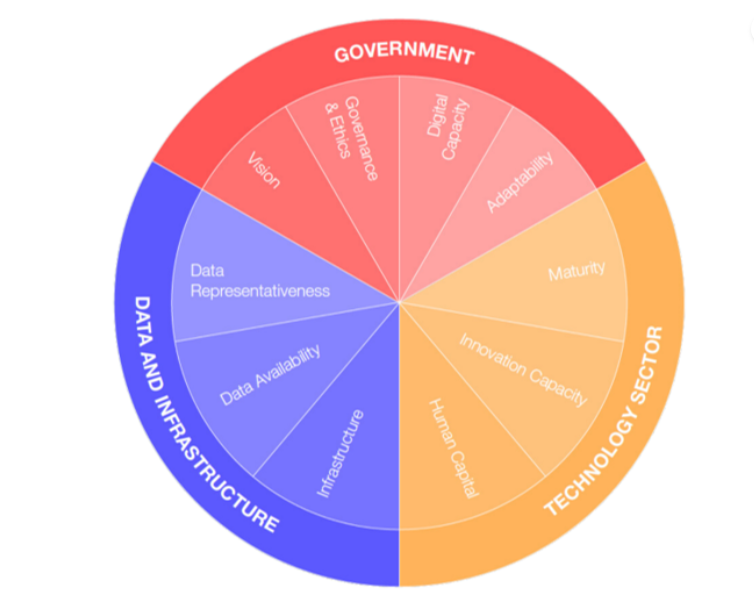
Figure 1: The Pillars of The AI Government Readiness Index (Source: Our Insights- Oxford Institution. (2024))
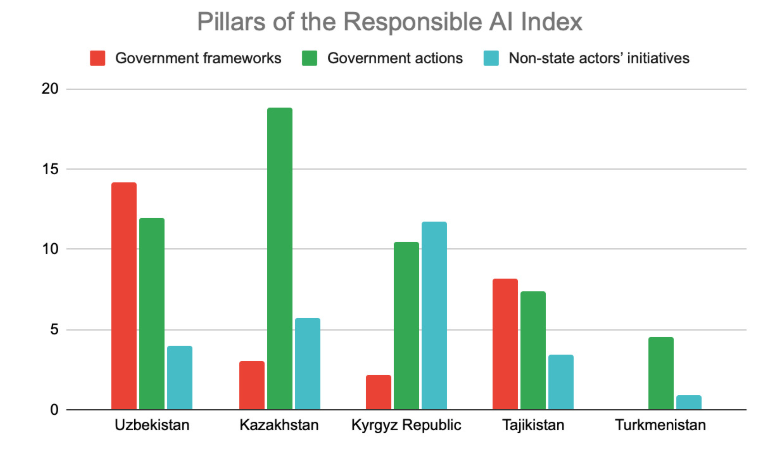
Figure 2: Pillars of Responsible AI Index, Central Asia. (Source: Our Insights- Institute for Development of Freedom of Information. (2024)
Kazakhstan
Based on new data from the International Monetary Fund (IMF), Kazakhstan is now the most prepared country in Central Asia for artificial intelligence (AI).[3] The nation is more prepared for AI than other regional states, ranking 48th in the world, according to The Times of Central Asia. Based on data from the International Labour Organisation, World Bank, and other sources, the index emphasises Kazakhstan’s regional comparative advantage. Since 2022, when advancements in China and the United States made artificial intelligence (AI) synonymous with technological dominance, Kazakh President Kassym-Jomart Tokayev has been a strong advocate for AI projects. The government approved the “Concept for the Development of Artificial Intelligence for 2024-2029” in the summer of 2023. As of right now, a number of Kazakh AI startups are valued at $100 million. An important illustration of Kazakhstan’s AI-driven strategy is the implementation of a statistical model that evaluates the infrastructure requirements of 6,293 villages by integrating economic, demographic, and geographic data. Using this tool, 3,500 villages with high development potential—representing 90% of Kazakhstan’s rural population—were identified.[4]
Kazakhstan will become home to the Alem.ai International Centre for Artificial Intelligence. During his speech at the international digital forum “Digital Almaty 2025,” Prime Minister Olzhas Bektenov made this claim. This year, the training facility for youth development in Astana will open. It will bring together top IT firms, research labs, startups, and academic institutions on a single platform for collaborative solution development, Bektenov said. The Ministry of Digital Development, Innovation, and Aerospace Industry claims that the Centre will also help build an AI ecosystem that will draw in capital and assist new businesses. The Centre aims to make Astana the premier hub for AI technologies in Central Asia, boost Kazakhstani AI exports to $5 billion by 2029, and use AI development to fuel a new wave in scientific and financial development. Every year, the project hopes to draw in roughly 10,000 talent from a variety of industries, train not less than 1,000 AI experts, launch roughly 100 AI startups, and carry out roughly ten AI-related research investigations.[5]
Uzbekistan
Uzbekistan adopted its “Strategy for the Development of Artificial Intelligence Technologies ” until 2030 on October 14, 2024, outlining several ambitious goals. The AI development strategy was approved by Uzbekistan through 2030. The strategy estimates that AI-based service and software development will be worth $1.5 billion. The development of an outstanding durability server infrastructure for big data analytics and the establishment of ten specialised laboratory spaces for artificial intelligence exploration are planned. A strategic objective is for Uzbekistan to rank among the top 50 nations in the Government’s AI Readiness Index.[5] Human resource development receives particular attention. One million developers will be trained in the field of artificial intelligence through a massive program being launched as part of the cooperation with the United Arab Emirates. Through this partnership, the nation will have access to skilled workers to carry out its plans. Uzbekistan has already used AI technologies in over 20 projects. These consist of the “AI assistants from the Tax Committee and the E-government portal, the digital identification of MyID and FaceID in mobile applications, the PalmPay system for making payments in the subway, and the LexAI legal platform”.[5] A new system for funding creative AI projects has currently in place in the nation since 2025. Startup development is intended to be facilitated by venture financing and accelerated programs.
Kazakhstan ranks first in the region for responsible AI and has the most government initiatives about responsible AI among Central Asian nations.
Kyrgyzstan
Kyrgyzstan is the second-highest rated country in the region for Responsible AI Governance, after Uzbekistan. Artificial intelligence (AI) integration is something Kyrgyzstan is actively working to integrate both domestically and within the Eurasian Economic Union (EAEU). They’ve prepared: The Global Index on Responsible AI offers a thorough assessment of 19 thematic areas of responsible AI, divided into three categories: ‘Responsible AI Governance, Human Rights and AI, and Responsible AI Capabilities’. ‘ Government frameworks, government actions, and non-state actors’ initiatives’ are the three essential pillars of the responsible AI ecosystem that are evaluated in each theme domain. In order to oversee regional initiatives and coordinate plans, Kyrgyzstan suggests establishing a single coordinating organisation. By establishing a “National Council on Artificial Intelligence”, Kyrgyzstan has already taken action to improve its domestic AI capabilities. [5] A “National Strategy on Artificial Intelligence”, which will enhance inter-sectoral cooperation within the economy and give priority to the development of home-grown AI-based products, is also being prepared for approval. Head of Kyrgyzstan’s Presidential Administration and Chairman of the Cabinet of Ministers, Adylbek Kasymaliev, announced the country’s plan to create a Regional AI Hub at the “Digital Almaty 2025” international forum. This program seeks to promote extensive AI collaboration among EAEU member states. Kyrgyzstan’s head of the Cabinet of Ministers stated that enhancing digital skills, assisting startups, including innovations, and cybersecurity are all important areas to concentrate on for the EAEU countries’ effective digital evolution.[6]
Tajikistan
In Tajikistan, systemic issues with AI implementation affect education at all levels, from primary school to university. Only 41% of Tajik fourth graders and 55% of Tajik second graders meet the minimum reading standards, according to a different World Bank assessment. According to the bank brief, a sizable portion of Tajikistani businesses cited a workforce with insufficient education as a major barrier to satisfying both regional and local market demands.[7] University learning environments, including curricula, staff competencies, equipment, and technologies, are primarily to blame for the skills gap. The country’s ten schools are included in the AI-study pilot program. At first, five schools—”Dushanbe International School, Contofield International School, Navovar School, Kafolat Gymnasium, and the Tajik-Russian Boarding Lyceum Hotam and PV”—were instructed on the fundamentals of artificial intelligence. Numerous private schools have since gotten involved in the initiative as a result of the strong interest. Groups of 15 to 20 students are currently investigating contemporary technological advances at every partner school. In-depth training on AI pedagogy, which focused on how these technologies are changing a variety of industries, including healthcare and education, was provided to teachers prior to this curriculum. In order to improve their critical thinking abilities and comprehension of the real-world advantages of innovation for society, students will need to create their own projects after completing the introductory course.[7] The goal of Tajikistan’s “National Strategy for the Development of AI” is to have advanced technologies account for up to 5% of the nation’s GDP by 2040, and this initiative fits with that goal.
Turkmenistan
A groundbreaking seminar on digital transformation was recently held in the field of public administration by the President of Turkmenistan’s Academy of Public Administration. Government representatives researched the evolution of e-government and civil society, as well as the role of artificial intelligence and contemporary digital tools. In order to implement the Smartclass system, the Turkmenistan Ministry of Education expressed interest in the equipment and services of the Huawei partner company ULearning. This artificial intelligence (AI) system is intended to analyse academic performance, produce educational content, and assess the efficacy of teaching. A total of 200 users will be granted access during the course of the pilot scheme so that the system can be tested. In addition, Turkmenistan is creating its own IT program. A ranking system promoting universities and vocational schools, an information system for higher education, and the e-mekdep (e-school) platform are examples of recent developments.[8] Through the use of cutting-edge artificial intelligence technologies, these initiatives show the nation’s dedication to modernising and transforming different economic sectors through digital transformation.
One million developers will be trained in the field of artificial intelligence through a massive program being launched as part of the cooperation with the United Arab Emirates.
The Road Ahead
In Central Asia, Kazakhstan and Uzbekistan are spearheading the AI movement, but Tajikistan, Turkmenistan and Kyrgyzstan are also implementing AI in industry, education, and governance. Nevertheless, regulatory obstacles continue to exist, and actual implementation is ongoing. A bold economic vision is shown by Uzbekistan’s AI investment targets, while Kazakhstan’s proposed AI law may establish a regional precedent. The different approaches to AI development in Central Asia are further highlighted by Tajikistan’s sluggish progress and Kyrgyzstan’s dependence on Russian expertise, as well as Turkmenistan’s lack of expertise. In the upcoming years, the nation that can transform ambitious AI strategies towards real economic and technological advancement will be exposed as competition ramps up.
References:
- Bland, Stephen. Central Asia’s AI Pursuit: A Tale of Ambition and Progress// The Times of Central Asia. 2025. https://timesca.com/central-asias-ai-pursuit-a-tale-of-ambition-and-progress/
- Our Insights. CCA: AI Ambitions and Realities// Outpost Eurasia. 2024. https://outposteurasia.com/insights/tpost/p4zfdtx341-cca-ai-ambitions-and-realities
- Haidar, Aida. IMF Sheds Light on Global AI Trends, Encourages Central Asia to Invest More in AI// The Astana Times. 2025. https://astanatimes.com/2025/02/imf-sheds-light-on-global-ai-trends-encourages-central-asia-to-invest-more-in-ai/
- Yousafzai, F. Kazakhstan Tops Central Asia in AI// Diplomatic Insight. 2024. https://thediplomaticinsight.com/kazakhstan-tops-central-asia-in-ai/
- Admin. Artificial Intelligence in Central Asia: strategies, initiatives, prospects// News Central Asia. 2025. https://www.newscentralasia.net/2025/02/03/artificial-intelligence-in-central-asia-strategies-initiatives-prospects/
- Anonymous. Central Asia on the Global Index for Responsible Artificial Intelligence// Internet Society-Kyrgyzstan Chapter. 2024. https://isoc.kg/news/centralasia-on-the-global-index-for-responsible-artificial-intelligence-2024/
- Anonymous. Tajikistan aspires to be an AI development hub. Magical thinking from a parallel universe// EurasiaNet. 2025. https://eurasianet.org/tajikistan-aspires-to-be-an-ai-development-hub
- Younas, A., Zeng, Y. Proposing Central Asian AI ethics principles: a multilevel approach for responsible AI// AI Ethics. 2024. https://doi.org/10.1007/s43681-024-00505-7

Dr. Lakshmi Karlekar is an Assistant Professor at the School of Humanities – Political Science and International Relations, Ramaiah College of Arts, Science and Commerce, Bengaluru. She holds a PhD in International Studies and has consistently ranked at the top during her academic journey at the Department of International Relations, Political Science, and History at CHRIST (Deemed to be) University, Bengaluru. Views expressed are the author’s own.
 Hridbina Chatterjee
  Mohmmad Rizwan
  Daljeet Singh