
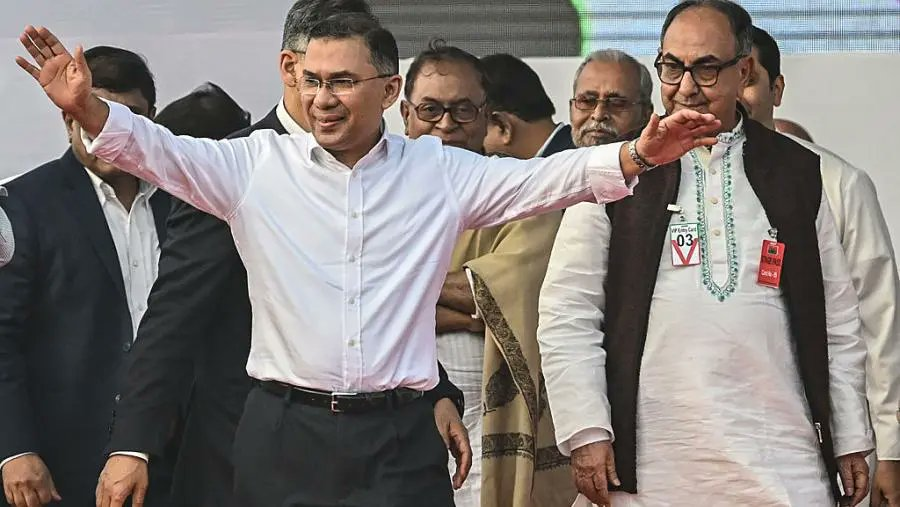
- While PM Modi has congratulated BNP and Tarique Rahman for the win, it is to be noted that the Bangladesh Nationalist Party has always maintained an antagonistic stance toward India.
- Khaleda Zia opposed allowing any connectivity routes to India’s Northeast through Bangladesh, and her government was accused of harbouring Northeast insurgents inside Bangladesh.
- India must remain cautious because the Bangladesh Nationalist Party has a history of interfering in India’s political matters.
- The growing cooperation of China and Pakistan inside Bangladesh could create an axis of influence that threatens India’s overall interests in the region.
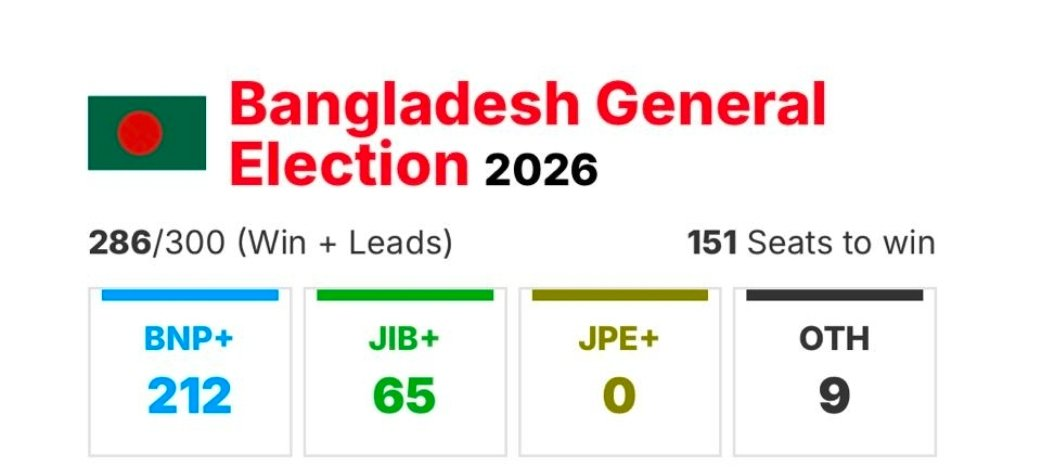
Bangladesh Nationalist Party ( BNP ), headed by its leader Tarique Rahman, the son of late former Prime Minister Khaleda Zia, has won an important election in Bangladesh in a landslide. This was Bangladesh’s first general election since the Gen Z protests that ousted former Prime Minister Sheikh Hasina. In this important election, Prime Minister Modi went on to congratulate Bangladesh Nationalist Party leader Tarique Rahman for his thumping win in Bangladesh and called for good ties between India and Bangladesh.
However, the Bangladesh Nationalist Party has always maintained an antagonistic stance toward India. When his late mother, Khaleda Zia, became Prime Minister for the first time between 1991 and 1996, she shared big differences with India over water sharing, border insurgencies, and trade imbalances. When she became Prime Minister for the second time between 2001 and 2006, she went further and interfered in Indian political matters by calling the United Liberation Front of Assam(ULFA) and the National Democratic Front of Bodoland (NDFB), Northeast insurgent groups, freedom fighters. She went one step ahead by saying that they were fighting for their rights in India. More importantly, she strongly opposed allowing any sort of connectivity to India’s Northeast through Bangladesh. She rejected several transportation routes to the Northeast, and her government was accused of harbouring Northeast insurgents inside Bangladesh, which created a serious security threat for India.
Now that her son is most likely to become Prime Minister, a larger question arises as to how the Bangladesh Nationalist Party will shape its relations with India. Early signs suggest that BNP is likely to adopt an even more militant posture toward New Delhi, particularly over India’s decision to provide refuge to its arch-rival, Awami League leader and former Prime Minister Sheikh Hasina. The party could well link future bilateral cooperation to India’s “co-operation” in extraditing what BNP describes as a “fugitive” from Bangladeshi law. Sheikh Hasina’s presence in India is therefore set to become a persistent and emotionally charged flashpoint in bilateral ties.
In order to understand this, we need to look at the manifesto released by the party in the general election. In the manifesto titled “Bangladesh Before All,” the Bangladesh Nationalist Party stated that Bangladesh is surrounded by friends, not masters, and that it would do everything to uphold its independence, sovereignty, and dignity. It also said that it would take strong action to stop the so-called border killings of Bangladeshi civilians by India’s Border Security Force. The party called for fair and equitable distribution of the waters of the rivers Teesta and Padma. It further stated that Bangladesh is for all and that the protection of minorities must be ensured.
At the same time, BNP has increasingly sought to distance itself from the historical legacy of Sheikh Mujibur Rahman, Bangladesh’s founding father, who spearheaded the country’s liberation struggle and led its emergence as an independent nation in 1971. By denouncing what it calls the “heroic legacy” of Sheikh Mujib, BNP signals a deeper ideological break from the secular-nationalist foundations of modern Bangladesh. This ideological repositioning opens the door to improved relations with Pakistan and potentially the consolidation of a broader axis of influence involving China, which already has deeply entrenched economic and strategic stakes in Bangladesh.
However, India must remain cautious because the Bangladesh Nationalist Party has a history of interfering in India’s political matters. The Northeast insurgency, which was significantly curtailed due to Sheikh Hasina’s close cooperation with India, may see renewed activity. This concern is sharpened by the fact that Tarique Rahman himself has been accused in the past of running a weapons-smuggling network supplying arms to the ULFA separatist group in Assam. With such a background, BNP under Tarique Rahman—unlike even his late mother Khaleda Zia—appears less likely to pander to India’s core interests and security concerns. For New Delhi, this means that hard-won counter-insurgency gains in the Northeast cannot be taken for granted.
An additional worrying development is the emergence of Jamaat-e-Islami as the principal opposition force in the new political landscape, marking a dangerous flirtation with once-shunned Islamist politics in Bangladesh and reflecting the growing religious parochialism within segments of Bangladeshi society.
This ideological drift creates fertile ground for Pakistan to reinsert itself into Bangladeshi politics, particularly as the Bangladesh Nationalist Party may move closer to Islamabad in response to its long-standing differences with India. With India being accused by BNP of providing shelter to former Prime Minister Sheikh Hasina, a key political adversary of the party, her continued presence in India is likely to remain a bone of contention in bilateral ties—one that Pakistan will seek to actively leverage. In such a scenario, the possibility of Bangladesh gradually becoming a staging ground for Islamist radicals, potentially primed and supported by Pakistan’s Inter-Services Intelligence (ISI), cannot be dismissed.
More importantly, the Bangladesh Nationalist Party may also maintain closer economic relations with China. The growing cooperation of China and Pakistan inside Bangladesh could create an axis of influence that threatens India’s overall interests in the region. Taken together, these trends point to a more volatile and adversarial phase in India-Bangladesh relations. While India must keep diplomatic channels open, it would be prudent for New Delhi to prepare for a harder, more transactional relationship with a BNP-led Bangladesh.

Aayush Pal is a freelance writer on contemporary geopolitical developments. The views expressed in his work are entirely his own.
 Piyush Anand
  Anusreeta Dutta