
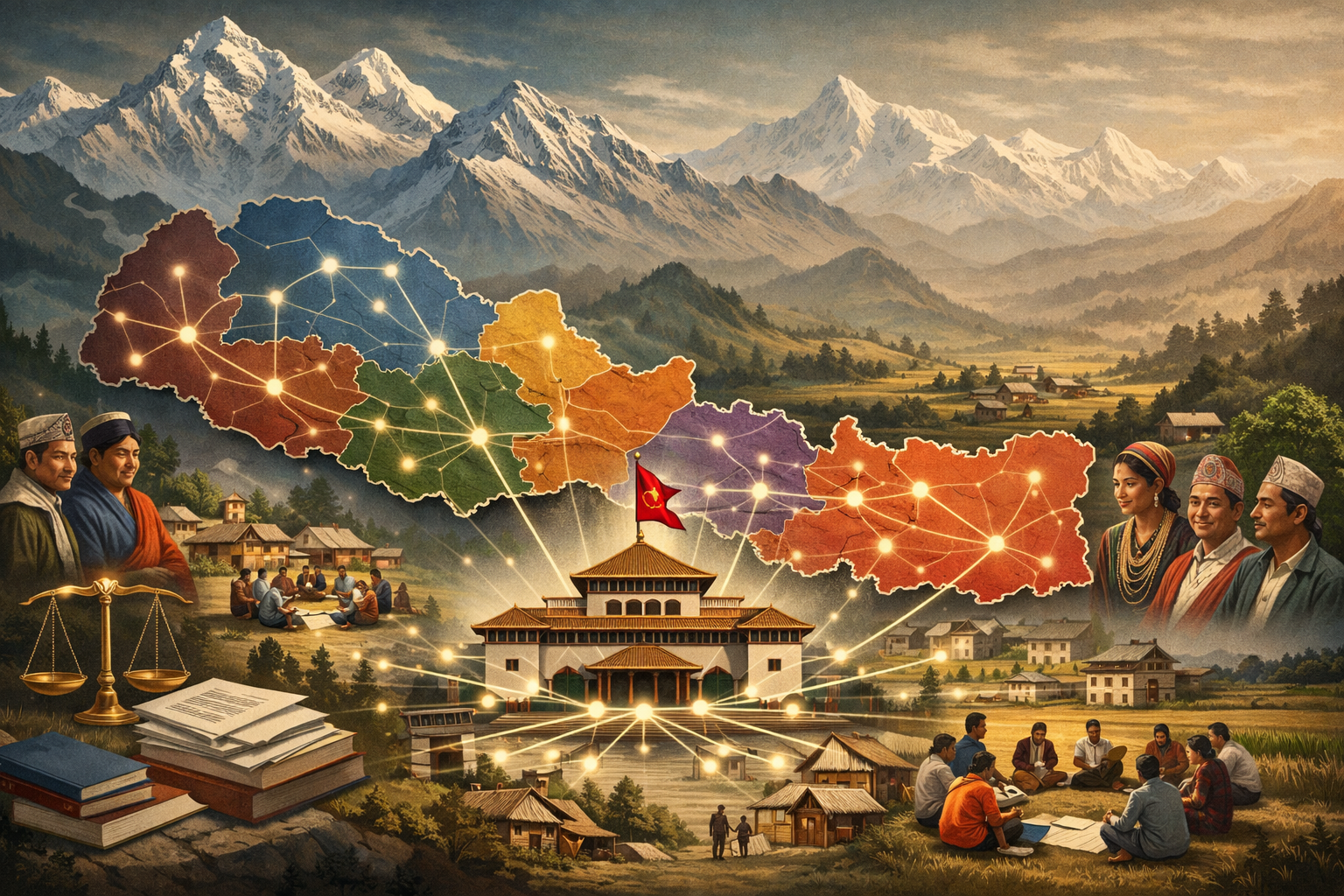
- Federalism in Nepal was introduced not merely as an administrative reform but as a peace-building mechanism following a decade-long Maoist insurgency, aiming to address ethnic diversity and demands for local self-government.
- Although decentralisation has granted local governments constitutional authority over sectors such as education, health, and infrastructure, the imbalance between political powers and fiscal resources continues to weaken effective implementation.
- Nepal’s federal experience demonstrates that constitutional restructuring alone cannot guarantee stability or equitable development without strong institutions, fiscal autonomy for local governments, and sustained civic participation.
Nepal is a salient case study in the academic study of federalism and decentralisation, particularly in light of its transition from a unitary monarchy to a federal democratic republic. The 2015 constitution represents a restoring stage in the political reorganisation of the country, and there were clear intentions to deal with ethnic heterogeneity and geographical differences, as well as rooted demands to promote local self-government. Federalism in Nepal was also planned not only as an administrative reform but as a peace-making tool after a decade of Maoist rebellion. When compared with established democracies such as India, Nepal’s relatively nascent federal experience offers a contemporary perspective on the opportunities and challenges inherent in decentralisation within an emerging democratic environment.
Among the lessons that are salient is that federalism can be used as an efficient tool for dealing with ethnic and regional diversity in case the institutional arrangements are intentionally inclusive. The demographic mosaic of Nepal consists of a great number of ethnic groups that are scattered on the mountains, hilly areas, and Terai plains. Decentralisation hasenabledd the local government to be able to respond to the developmental needs that are region-specific in a more effective manner. Local governments have constitutional authority over areas like education, health services, infrastructure, etc. Nevertheless, there are still gaps in implementation due to the lack of administrative resources at the provincial and municipal levels. Political decentralisation has outpaced fiscal decentralisation, resulting in local bodies bearing significant responsibilities without possessing commensurate revenue-generating capacity. Consequently, centralised fiscal authority continues to prevail despite constitutional proclamations of local autonomy.
The other important observation made is that federalism is not necessarily a guarantee of political stability and even equitable development. Parties in Nepal have misused federal restructuring by, at times,s using it as a means of contesting elections instead ofpractisingg real developmental politics. The coalition governments have changed hands frequently, which has slowed down the continuity of policies. Furthermore, the conflict concerning the provincial boundaries and sharing of resources has periodically fueled ethnic feelings instead of defusing them. The same hurdles can be observed in the other democracies, where elite bargaining sometimes prevents the implementation of the decentralisation reforms. In turn, federalism should be successful not only because of the constitutional prescriptions but also because of the strong institutions, open governance and civic engagement on the local level.
Geography has a conclusive role to play in the effects of decentralisation in Nepal. The rough mountainous topography of the country presents significant logistical challenges in the development of infrastructure and service delivery. In principle, decentralisation must provide the local governments with leeway so that they can adopt policies to their local geographic conditions. As an example, isolated mountainous areas may focus on road access, telecommunication, and climate resiliency projects. However, inequalities between urban regions like Kathmandu Valley and marginal rural areas still exist, which reflect the urban-rural gap existing in emerging democracies, whereby capital cities tend to accumulate economic and political authority. Effective decentralisation thus requires specific development funds being allocated to marginalised areas.
Nepal also supports the necessity of constitutional clarity in the architecture of federalism. Jurisdictional conflicts may arise because of ambiguity in the allocation of powers between the federal, provincial and local governments. Accurate legal systems are necessary to avoid overlapping jurisdiction and administrative dislocation. Emerging democracies can also follow the example of Nepal and strengthen constitutional dispute-resolution institutions by empowering independent constitutional oversight institutions. Civic education is also paramount because citizens must understand how their daily lives are determined by the federal government. Without the people being informed, the reforms of decentralisation may just turn out to be mere gestures instead of real changes.
Finally, the history of Nepal shows that federalism is a long political process as opposed to a single constitutional amendment. Social trust between the central and local authorities should be built gradually based on exemplary governance performance. Emerging democracies, considering the idea of decentralisation, must put institutional capacity building, local government fiscal autonomy and inclusive representation. Even though Nepal continues to face significant difficulties, its innovative federal experiment is a worthy democratic test-tube in the region. Decentralisation, when implemented carefully, can strengthen democratic governance, improve service delivery and reduce inequalities in regions. However, in the absence of strong institutions and a cooperative political culture, federalism can be a source of the threat of fragmentation. Based on this, countries pursuing decentralisation reforms need to strike a balance between local autonomy and national unity to achieve effective democratic decentralisation.

Kumar Sheni is an Assistant Professor of Political Science at the School of Geopolitics and Public Policy, REVA University, Bengaluru. Views expressed are the author’s own.
 Anjali Singh
  Aayush Pal
  Piyush Anand