- Throughout the history of bilateral relations, Washington has consistently prioritised military interests over moral norms and democratic principles to achieve its geopolitical objectives.
- Pakistan and the United States established a collaboration based on their interests rather than a shared interest.
- These transactional relationships have consistently shown fragility, with their stability contingent upon U.S. strategic goals.
- The recent strengthening of relations between Islamabad and Washington is a result of Trump’s preoccupation with agreements and geopolitical negotiations.
Pakistan’s relationship with Washington has historically been transactional. During the Cold War, the United States extended economic and military aid to Islamabad in return for its participation in U.S.-led military alliances such as SEATO and CENTO. These coalitions aimed to curb the Soviet Union’s rise in Asia. Regarding international dangers, however, the two nations never agreed. For Pakistan, India, its larger eastern neighbour, represented a significant security threat; nevertheless, the United States did not perceive India as a security issue.
Allying with the U.S. was crucial for Pakistan to obtain essential economic and military support to counter India militarily. Pakistan’s geostrategic position and Islamic identity were significant factors in the U.S. geopolitical assessment. However, these transactional relationships have consistently shown fragility, with their stability contingent upon U.S. strategic goals. Pakistan was abandoned when it ceased to serve the U.S. strategic interests.
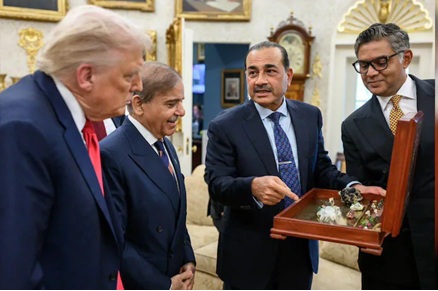
U.S. President Donald Trump conducted two significant meetings with Pakistani Field Marshal Asim Munir last year, one in July and the other in September. These meetings symbolised his preference for the military strongman over the elected civilian prime minister of Pakistan, Shahbaz Sharif. And someone acquainted with the history of U.S.-Pakistan relations may readily perceive it as a resurgence of transactional ties between Islamabad and Washington. Throughout the history of bilateral relations, Washington has consistently subordinated moral norms and democratic principles to military despots to achieve its geopolitical interests.
The United States and Pakistan’s relationship has remained precarious since Osama Bin Laden was assassinated in Pakistan in 2011. President Biden, Trump’s predecessor, also neglected to focus on Pakistan. He declined to accept a congratulatory call from his Pakistani counterpart, Prime Minister Imran Khan, and regarded Pakistan as one of the most perilous nations globally. The newfound warmth in bilateral relations was seen in U.S. President Trump’s evident preference for Munir in the bilateral dialogues. The move does not represent a significant shift in bilateral relations; instead, it represents the reestablishment of transactional connections between the two nations. Pakistan plays a crucial role in President Trump’s policies on the West Asian region, Afghanistan, and the quest for natural resources.
Pakistan has become a crucial factor in the U.S. geopolitical considerations about Afghanistan. Trump openly expressed his intention to reclaim Bagram Air Base in Afghanistan, which Washington vacated following its withdrawal from the country in 2021. President Trump cautioned that adverse consequences would ensue for Afghanistan if the U.S. were denied access to the base. However, he is hesitant to redeploy U.S. troops to Afghanistan. Consequently, the U.S. is relying on Rawalpindi because of its influence over Kabul. The situation is complex, as Russia, China, and Iran are all unlikely to acquiesce to the U.S. presence in Afghanistan. On 7 October 2025, China, Russia, India, Iran, and Pakistan released a unified statement during the Moscow format discussions, condemning the U.S. military involvement in Afghanistan. The inclusion of Pakistan in this joint statement was merely for public perception. Trump identifies Munir as the primary intermediary for gaining access to Bagram Air Base.
The recent Pakistani engagement in U.S. policy regarding Gaza and Afghanistan has faced criticism. The previous Pakistani High Commissioner to India regarded Pakistan’s endorsement of the U.S. peace plan as ‘a total capitulation by the Muslim world.’ Fatima Bhutto, an activist and author, deemed Islamabad’s support for President Trump’s peace plan an ’embarrassment and disgrace.’ The esteemed leader of Jamat-e-Islami regarded this action as a betrayal of the Palestinians. Notwithstanding these objections, Pakistan will persist in endorsing U.S. foreign policy as long as it receives American support.
Pakistan will no longer continue to receive economic and military assistance from the United States. However, there are additional motivations for Pakistan to support U.S. policies in the region; Firstly, it hopes that this revival of relations under Trump 2.0 may assist Islamabad in internationalising the Kashmir issue. During the Sharm el-Sheikh summit, Pakistani Prime Minister Shahbaz Sharif expressed gratitude to President Trump for his involvement in resolving the armed conflict between India and Pakistan. Secondly, during the U.S. war on terror in Afghanistan, Pakistan supported the Afghan Taliban. However, increasing attacks by TTP in Pakistan have strained Islamabad’s relations with the Afghan Taliban and driven it to ally with Washington. Speculations suggest that both Pakistan and the United States are colluding for regime change in the country. Third, this facilitates Pakistan’s cessation of diplomatic isolation by positioning it as an active collaborator with the U.S. in its policy initiatives.
Numerous voices assert that India has become inconsequential to U.S. strategy owing to the increasing significance of Pakistan. New Delhi perceives Trump’s strategy to re-engage with Pakistan as a betrayal. However, we must recognise that the United States’ relationship with India and its differences with Pakistan will not abruptly disappear. The recent strengthening of relations between Islamabad and Washington is a result of Trump’s preoccupation with agreements and geopolitical negotiations, rather than any enduring convergence of values, democratic alignment, or long-term strategic trust.

Mohmmad Rizwan is a PhD scholar in Political Science at Jamia Millia Islamia and is currently awaiting his final defence. His doctoral research examines Pakistan’s relations with key global powers. Views expressed are the author’s own.
 Faareha Usmani
  Archita Gaur
  Hridbina Chatterjee