
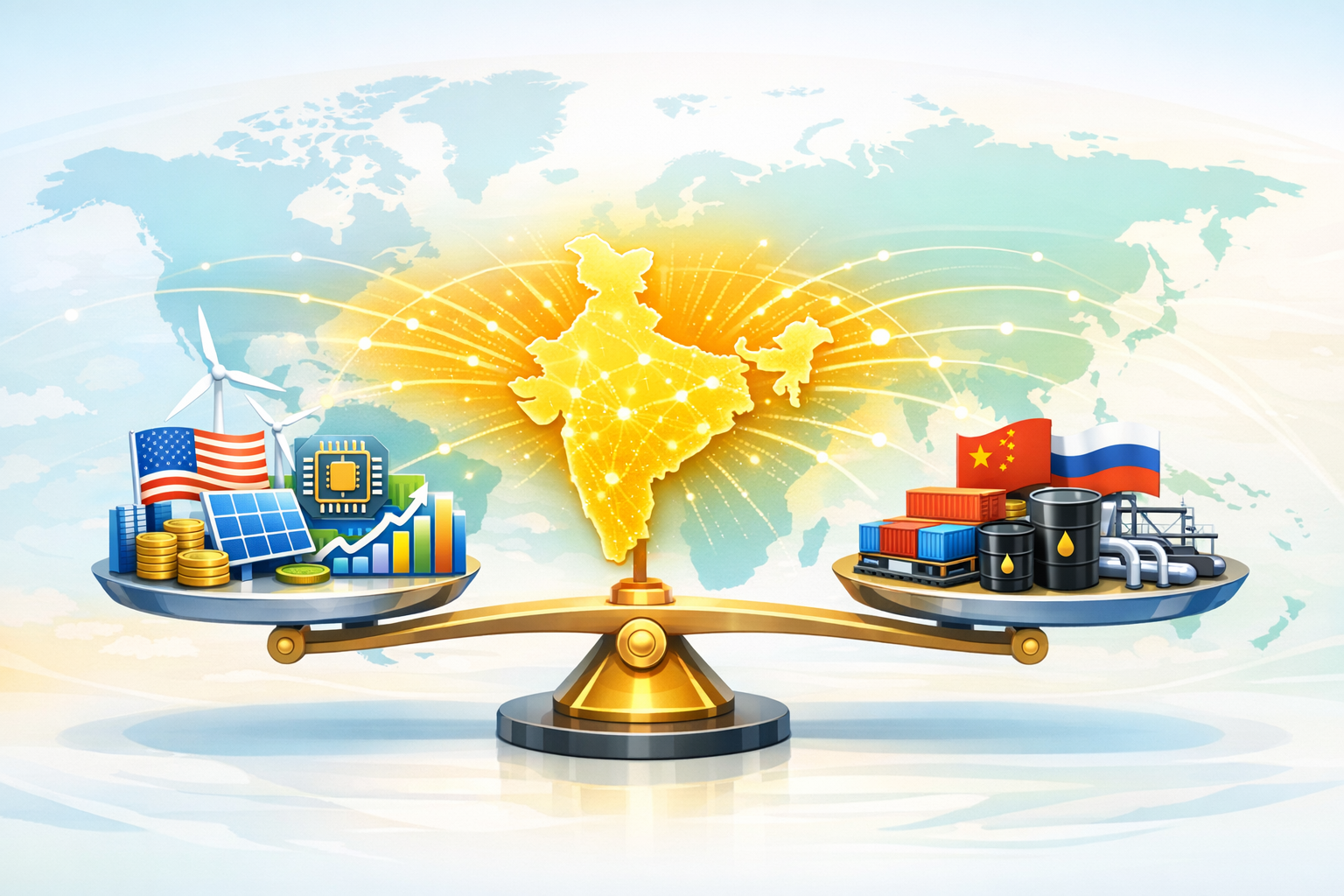
- Economic analysts see India as a ‘geo-economic swing state’, a country that can shape outcomes by engaging selectively with competing power blocs while preserving its strategic economy.
- India today is no longer a dependent actor in the global economic order.
- China remains India’s most complex geoeconomic interlocutor, and its largest trading partner, even as strategic rivalry persists.
- Whether India’s economic strategy succeeds or fails will depend on how effectively external opportunities are converted into internal capacity building.
In the current scenario, where the international order is increasingly shaped by great power rivalry. The weaponisation of trade and fragmentation of global supply chains and geoeconomics have emerged as an efficient instrument of statecraft. Economic powers now operate not only as facilitators of growth, but also as strategic levers capable of influencing political alignments and constraining sovereign choices. Within the evolving landscape, India’s position has assumed growing value and significance. India is no longer viewed simply as a large emerging economy by the analysts, but as an increasingly pragmatic economy. They view India as a geo-economic swing state, which means a country that can shape outcomes by engaging selectively with competing power blocs while preserving its strategic economic interests.
This characterisation reflects a decisive break from early patterns of external engagement going back to a time when a warning from Washington was sufficient for India. A threatened tariff, a diplomatically phrased concern, or a subtle signal that would be embedded in a joint statement would prompt swift recalibration in New Delhi. The trade positions were softened. The energy decisions were reconsidered, and strategic state autonomy was exercised with caution. But now that India does not exist.
When the United States President Donald Trump recently warned the Indian state that it could face higher tariffs if it failed to make him happy, the response was notably restrained. The markets remained stable. Exporters did not recover from trade, and policymakers displayed neither haste nor anxiety. The absence of disruption in this condition was instructive, and it signalled confidence, not complacency.
India today is no longer a dependent actor when it comes to the global economic order. It has emerged as a swing state economically resilient enough to withstand pressure that is strategically flexible enough to engage across rival blocks and politically assured enough to prioritise national interest over alignment compulsion. This evolution does not represent a return to Cold War non-alignment, but a shift towards pragmatic multi-alignment, which is anchored in economic statecraft and sustained by domestic reform.
What Makes a Geoeconomic Swing State?
The term swing state traditionally was used to describe an actor whose choices can decisively influence outcomes. But in terms of geo-economics, it refers to a country whose market size, growth, trajectory, location and policy framework allows it to shape trade, genes, supply chains, investment flows and standard-setting processes.
With a huge consumer base and a growing manufacturing footprint, which is supported by policymakers who describe the current population as a once-in-a-generation demographic dividend, Indian choices today matter to all major power centres. India’s appeal lies not only in scale, but also in the predictability of its democratic institutions and policy continuity, which has reassured long-term investors.
India’s position has been reinforced majorly by three factors: first, its expanding role as a producer and market. Secondly, its certainty in the Indo-Pacific region and thirdly. It’s protection as a democratic alternative in an era of competing growth models.
The USA – A Partner in Tech, Trust and Supply Chain
The deep bond of India and the USA is described as a techno-economic convergence. The cooperation now spans semiconductors, defence manufacturing, critical and emerging technologies, clean energy and resilient supply chains. Initiatives, such as the ICT framework and a steady rise in American FDI, have been cited by officials as evidence of growing confidence in India as a trusted node in de-risked, global value chains. India’s calibrated engagement with Washington, aligning on Indo-Pacific stability and technology standards while retaining flexibility in technology and digital policy, has allowed New Delhi to attract capital without diluting strategic autonomy, like in the past. This balance is central to India’s broader ambition of becoming a global manufacturing and innovation hub.
China – A Competitive Coexistence
China remains India’s most complex geoeconomics interlocutor, and its largest trading partner, even as strategic rivalry persists. In recent years, the government has tightened scrutiny of Chinese investments in sensitive sectors, and pushed diversification in areas such as electronics, telecom and pharmaceuticals. Looking at the current scenario, policymakers have avoided full-scale decoupling. Instead, India’s approach has been framed as a competitive coexistence, reducing critical dependencies through schemes like production-linked incentives while keeping trade channels open to avoid disruption of domestic industry and consumers. By building alternatives without abrupt rupture, India seeks to retain leverage even as it repositions supply chains.
Russia – An Energy, Security and Strategic Partner
India’s continued engagement with Russia and an age-old partnership, particularly after the Ukraine conflict, has drawn attention to its geoeconomic pragmatism. The import of discounted crude oil has been repeatedly credited with helping contain inflationary pressures and protect growth at a time when global volatility defines the current era. Defence cooperation and civil nuclear projects have also continued even after constant bickering from the West. The relationship is guided by national interest and the pursuit of a multipolar balance rather than alignment with any single bloc. Experiments with the rupee-based trade and alternative payment mechanisms are also seen as a part of a long-term effort to build financial resilience and reduce exposure to external shocks.
The EU – A Trade Partner Beseiged by Green Transition
The European Union has emerged as a key partner in India’s push for high-value trade, sustainable development and growth. The ongoing FTA negotiations alongside cooperation on green hydrogen, climate financing and digital governance reflect a growing convergence between the two states. India has voiced concerns over regulatory measures such as the European Union carbon border taxes and data regimes, which have often received a critical view from policymakers, fearing that they could constrain developmental space. As a swing state, India ought to engage Europe for market access and technology, while contesting rules that may embed asymmetry for emerging and developing economies.
The Developments in the Global South as Statecraft
Perhaps India’s most distinct character trait is its geoeconomic leverage and its outreach to the global south. Through lines of credit, capacity building programs, digital public infrastructural exports such as UPI, vaccine supplies during the pandemic and platforms like Voice of Global South Summit that took place in New Delhi, projected India as a developmental partner rather than a hegemon. Critics have frequently opined this approach with debt-heavy infrastructure models elsewhere, emphasizing demand, driven and human-centric cooperation. This strategy has helped India build political capital across Africa, South Asia and Latin America, reinforcing its claim to act as a bridge between developed and developing worlds, a role which was highlighted during India’s G20 presidency.
Instruments of a Swing Strategy
India’s emergence as a swing state is being operationalised through a carefully calibrated set of policy instruments that combine external engagement with domestic capacity building. New Delhi has adopted a strategy of multi-alignment where it engages with rival power blocs without binding itself to exclusive alliances. This approach allows India to cooperate extensively through geopolitical divides while preserving decision-making autonomy in technology, trade and security.
In the economic domain, the posture is reflected as a selective approach to trade liberation. Rather than pursuing broad ideologically driven agreements, India has prioritised targeted trade partnerships with economies, such as the United Arab Emirates, Australia, and the European Free Trade Association. These agreements are designed to secure market access and integrate supply chains to reduce vulnerability to unilateral trade pressures, at the same time retaining policy space for domestic priorities.
India has also invested inalternativef connectivity framework to diversify trade routes and reduce dependence. Corridors, such as the India Middle East Europe economic corridor(IMEC) and the International North South Transport Corridor (INSTC) conceived as complements and in some cases alternatives to existing current roots, which promptly reflects a broader effort to shape regional economic geography rather than its mere adaptation.
These efforts are cautious but deliberate experimentation in financial statecraft. The promotion of rrupee-denominatedtrade settlements and the internationalisation of digital payment systems signals an attempt to reduce transactional frictions and currency dependence at the same time, stopping short of disruptive decoupling from the global financial system. Finally, India has started exercising normative influence in global forums by advocating principles of climate equity and diffusion of digital public goods. Senior policy makers have argued that these initiatives are intended to ensure that external partnerships are translated into tangible domestic gains, particularly in manufacturing, logistics and technology, aligning India’s external engagements with its long-term developmental objectives.
Opportunities and Dividends
India’s position as a swing state offers tangible dividends, access to diversified sources of capital and technology, which offers a greater leverage in negotiations and a growing role in shaping norms in the current scenario of digital governance, climate action and development finance. Supporters of the government strategy say that this has already reduced vulnerability to cohesive economic practices while positioning India as a reliable partner in an uncertain world. If sustained, they argue, it could accelerate India’s transition into a manufacturing hub and a technology-driven economy. This flexibility has enhanced New Delhi’s bargaining power in trade negotiations and standard-setting forums. The growing participation in shaping norms, particularly in digital public infrastructure, climate financing and development cooperation, reflects an ambition to move from rule taker to rule shaper in the global economy. India has reduced its exposure to coercive economic practices by broadening energy suppliers, diversifying export markets and embedding itself with multiple connectivity frameworks. At the same time, the policy initiatives aimed at manufacturing scale, technology absorption, and innovation ecosystems are beginning to align external partnerships with in-house priorities.
Risk and Constraints
Analysts, however, question whether swing statehood is not without significant constraints. As great power rivalries intensify, external pressure on India to align more explicitly with one bloc or another is likely to grow, particularly in areas such as technology standards, sanction regimes anddefencee supply chains. Managing this pressure without diluting strategic autonomy will test both diplomatic discipline and policy support. At the same time, there is also a risk of overstretching where expanding partnerships simultaneously across competing economic and security frameworks, demand, administrative clarity and sustained political focus.
Domestic constraints remain equally consequential. Infrastructural gaps, logistical inefficiencies and persistent skill mismatches continue to limit the speed at which external opportunities can be translated into productive in-house capacity. Despite improvements in manufacturing output and export diversification, India’s share in global manufacturing remains below 3%, which is a challenge. Credibility will depend on whether India’s autonomy is perceived as principled and predictable rather than transactional. Without continued domestic reform and institutional strengthening, the external leverage may ultimately outpace internal capacity, which will erode the very advantages that swing statehood is meant to confer.
A Bit For Centrality
India’s emergence as a geoeconomic swing state marks a significant transformation in its external engagement. It is no longer defined by ideological non-alignment. The country we live in today practices interest-based multi-alignment, deploying markets, technology, energy ties and development partnerships as tools of statecraft.
Whether this strategy succeeds or fails, the observers suggest, will depend on how effectively external opportunities are converted into internal capacity building. If the domestic growth story is able to keep pace with its expanding global role, India may consolidate its place as one of the principal architects of 21st century geoeconomics not by dominance, but by centrality.

Sanhita Pandey is an Advocate specialising in international law and constitutional jurisprudence. Her work explores global governance, sovereignty, and the legal dimensions of geopolitics, and has been published on platforms such as Eurasia Review. Views expressed are the author’s own.
 Raghvendra Tripathi
  Pranav S
  Ajith Shetty Heranje