
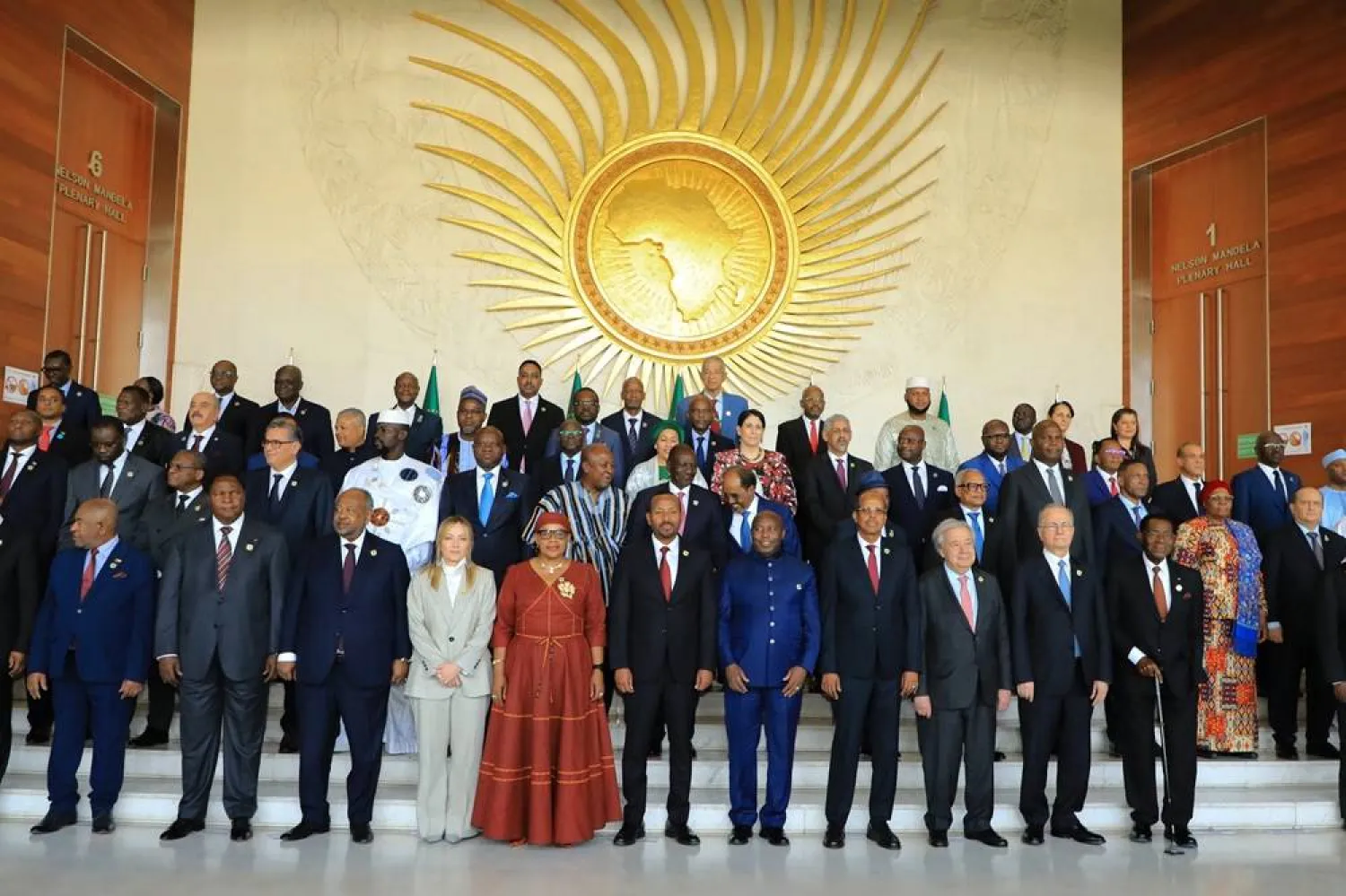
- The AU summit, with the theme Water and Sanitation, attended by leaders from all 55 AU member states, addressed governance, security, and climate-related challenges.
- The summit’s geopolitical tone was reinforced by UN Secretary-General António Guterres, who described the AU as a “flagship for multilateralism” in a world marked by division and mistrust.
- The AU’s remarks on Gaza reflect both solidarity with Palestinians and a deeper unease in many African capitals about what they see as the uneven application of international law.
At the 39th African Union (AU) Summit in Addis Ababa, the organisation’s leadership delivered one of its strongest collective statements on the Israel-Palestine war, linking the crisis in Palestine to broader questions of global justice, international law, and the role of the Global South. The summit, attended by leaders from all 55 AU member states, also has Italian Prime Minister Georgia Meloni as a guest of honour. While this year’s theme is water and sanitation, the talk also addressed governance, security, and climate-related challenges.
AU Commission Chairperson Mahmoud Ali Youssouf declared that the “extermination” of the Palestinian people must stop, arguing that the suffering in Gaza challenges the moral conscience of the international community. He emphasised that international humanitarian law must remain the foundation of global order and called for the lifting of the blockade on humanitarian aid to the besieged territory. His remarks placed the AU firmly among voices in the Global South that are demanding accountability and a rules-based response to the conflict.
The scale of the crisis was underscored by figures cited at the summit. The war in Gaza, ongoing since October 2023, has reportedly caused more than 72,000 deaths and over 170,000 injuries, making it one of the most devastating episodes in the long-running Israeli-Palestinian conflict. Youssouf warned that multiple conflicts across Africa—from Sudan and the Sahel to eastern Democratic Republic of Congo and Somalia- continue to inflict high costs on civilians. His call to “silence the guns” across the continent reflected a dual agenda: addressing external injustices while confronting Africa’s own security crises.
The summit’s geopolitical tone was reinforced by UN Secretary-General António Guterres, who described the AU as a “flagship for multilateralism” in a world marked by division and mistrust. Additionally, he reaffirmed calls for Africa to have a permanent seat on the UN Security Council, claiming that the current international order no longer justifies Africa’s exclusion.
Taken together, the summit underscored a widening convergence among Global South countries on questions of fairness and accountability in international affairs. The AU’s remarks on Gaza reflect both solidarity with Palestinians and a deeper unease in many African capitals about what they see as the uneven application of international law. At the same time, the focus on conflicts within Africa suggests that the continent’s leaders are trying to pair external advocacy with efforts to stabilise their own regions, blending political pragmatism with a more assertive form of South-South engagement.
References:
- https://www.aljazeera.com/news/2026/2/14/au-calls-for-end-to-extermination-of-palestinians-decries-african-wars
- https://english.aawsat.com/arab-world/5241034-gazas-nasser-hospital-condemns-move-msf-suspend-most-services
- https://www.theafricareport.com/408867/au-commission-chair-youssouf-calls-for-israel-to-end-extermination-of-palestinians/
- https://www.arabnews.com/node/2632984/middle-east

Anshika Agrawal is a research scholar at the Centre for Russian and Central Asian Studies, Jawaharlal Nehru University, with a strong interest in current affairs, bilateral and multilateral relations, and public policy. Views expressed are the author’s own.
 Faareha Usmani
  Archita Gaur
  Hridbina Chatterjee