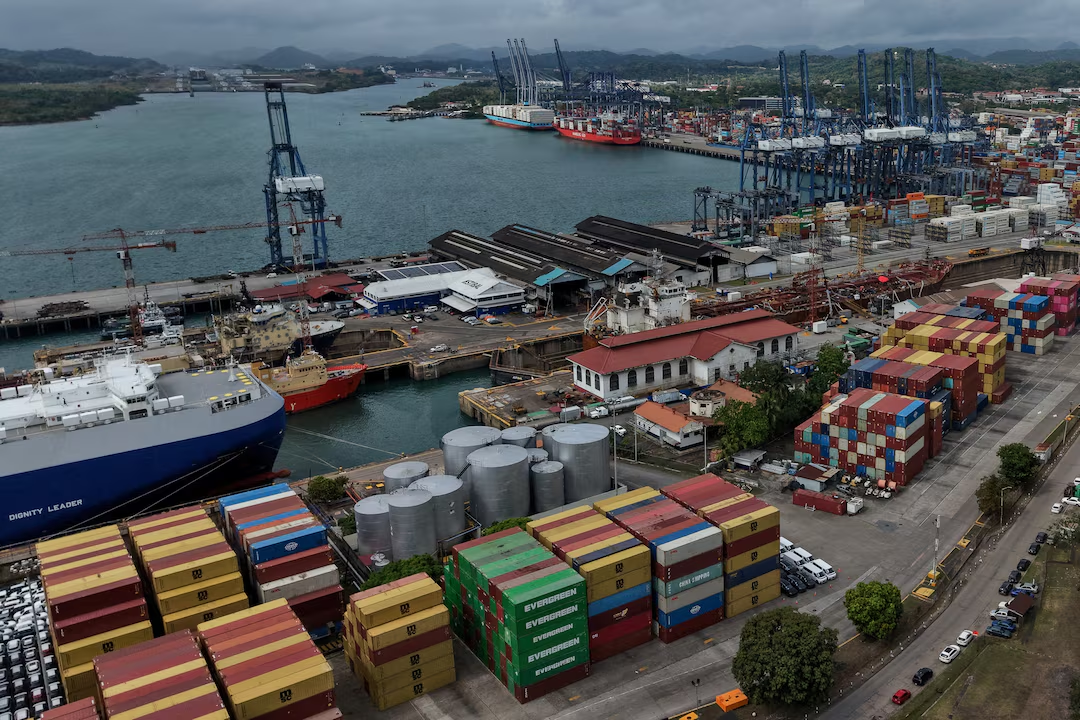
- Panama’s Supreme Court annulled the long-term port operating contract with a Hong Kong–linked subsidiary of CK Hutchison, ruling it unconstitutional due to exclusive privileges and regulatory violations.
- The decision is being welcomed in Washington and opposed in Beijing and Hong Kong, underscoring intensifying US–China competition over control of critical global trade routes.
- Panama’s move follows its withdrawal from China’s Belt and Road Initiative, signalling a strategic realignment toward the United States.
The Supreme Court of Panama ruled that the long- term contract between Panama and the Hong Kong company’s subsidiary, CK Hutchison as unconstitutional. The Supreme Court stated that Hong Kong had violated Panama’s constitution by granting exclusive rights and exemptions to the company’s operator. The SC also ruled that the company violated other requirement such as environmental impact assessment, and hence cancelled the company’s contract to operate two Panama Canal Ports.
Panama’s President Jose Raul Mulino Quinteno said that once the deal is formally ended, a subsidiary of the Danish logistics would operate the ports in a transitional phase until a new bidding process is launched with revised terms. But for now, the ruling is unclear about what happens next. This ruling comes amid the tussle between the US and China for control of the world’s most important trade routes.
The Hong Kong government firmly opposed this ruling by saying that this is a violation of business contracts and it harms the business interests of the Hong Kong enterprises. It said that the government of Panama should respect the spirit of the contract. In Beijing, the foreign ministry spokesperson, Guo Jiakun, said that China would take all necessary steps to safeguard the interests of the Chinese company.
The court decision is welcomed by the US administration. The chair of the US House Select Committee on China called it a “win for America”. Trump argued that China’s growing presence over the Canal poses a security threat to canal operations. He also said that almost 40% of the USA ships passing through the canal are overcharged. He continuously expresses his desire to regain control over Panam canal, which the USA previously controlled till 1999. The Torrijos – Carter treaty of 1977 ended the ownership of the USA over the canal, which it exercised since 1903.
Last year, Panama became the first Latin American country to withdraw from China’s Belt and Road Initiative project (BRI), hence signalling a shift towards the USA.
References:
- https://www.theguardian.com/world/2026/jan/30/court-ends-hong-kong-china-panama-canal-contracts
- https://theepochtimes.sg/119059-2/
- https://www.cfr.org/articles/who-controls-panama-canal
- https://www.reuters.com/world/asia-pacific/implications-panama-court-ruling-quash-ck-hutchison-port-concessions-2026-02-02/

Anshika Agrawal is a research scholar at the Centre for Russian and Central Asian Studies, Jawaharlal Nehru University, with a strong interest in current affairs, bilateral and multilateral relations, and public policy. Views expressed are the author’s own.
 Joy Aditya Phookan