
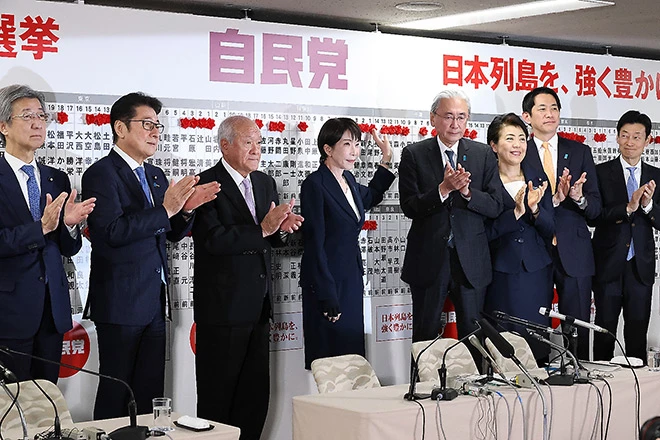
- Sanae Takaichi’s party won more than two-thirds of the Diet (parliament) seats needed for a supermajority.
- This is the first time in Japan’s post-war history that a single party has won a supermajority.
- Relations between Tokyo and Beijing have deteriorated since Takaichi suggested Japan might become involved if China attacked Taiwan.
Just eight months ago, Japan’s ruling party, the Liberal Democratic Party (LDP), had lost a parliamentary majority for the second time in 15 months. There were allegations against the MPs for a long-running “slush fund” scandal involving undisclosed political donations. This led to the resignation of PM Fumio Kishida and, later, his successor, Shigeru Ishiba, who lost majorities in both the 2024 lower house and 2025 upper house elections. Just over a week to go in October last year, when LDP lawmakers cast their votes, Shinzo Koizumi, the son of Junichiro Koizumi, the former PM, was expected to become Japan’s youngest post-war Prime Minister. But the popular name Sanae Takaichi won the battle and became the first female Prime Minister. On 21 October 2025, she was elected as prime minister by the lawmakers. She wanted to seek a public mandate in the House of Representatives, the most powerful house in Japan.
Despite all the odds, she has emerged as the LDP’s most famous leader and has become the object of a cult personality revolving around everything from her choice of outfits to her journey snacks to the pink pen she uses to write. Since the day she took office, Takaichi said, she has been “constantly concerned that the Takaichi cabinet has not yet been tested in an election where the public chooses the government”.
Takaichi has dissolved parliament in just three months and announced a snap election on 8 February 2026. She has been in office for only three months, but she has the highest approval rating at about 70%. Takaichi won a landslide victory, securing 316 of 465 seats in the 8 February 2026 poll. This is the record seat for the LDP in the general election. She won more than two-thirds of the Diet (parliament) seats needed for a supermajority. This is the first time in Japan’s post-war history that a single party has won a supermajority.
Key issues in Japan and Takaichi’s agenda
The rising cost of living is the central issue of this election. Japan is facing a long-standing problem of slow economic growth. According to the IMF, the economy grew 1.1% last year, and it is on track to grow by just 0.7% in 2026. Consumer prices were rising, and real wages were lagging, leading to inflation. Another concern for some political parties is the growing role of foreigners in a rapidly ageing society. They are filling the major gaps in employment.
Sanae Takaichi, having strengthened her domestic political position, is expected to move forward with her conservative agenda. The election campaign lasted only 16 days and offered limited policy detail, allowing the ruling Liberal Democratic Party to rely heavily on her personal popularity, which exceeded that of the party itself. Her campaign, however, emphasised strengthening Japan’s resilience to growing external threats. She is likely to accelerate security reforms, including easing restrictions on defence exports, introducing an anti-espionage law, and advancing the planned revision of the 2022 National Security Strategy. Economic security is also set to become a major priority. Takaichi hopes that higher defence spending will stimulate economic growth, a strategy some describe as defence-led Keynesianism. Although she has pledged an active fiscal policy, concerns over Japan’s heavy public debt, rising bond yields, a weakening yen, and public frustration over living costs may limit her fiscal flexibility.
Bilateral relations with the USA and China
Takaichi has reached out to the US president as Tokyo looks to steady its ties with Washington, its closest ally, following Trump’s tariffs. Donald Trump has endorsed Japan’s Prime Minister Sanae Takaichi ahead of a snap election in her country on Sunday
Relations between Tokyo and Beijing have deteriorated since Takaichi’s remarks in November, when she suggested Japan might become involved if China launched military action against Taiwan, a self-governing island claimed by Beijing. In response, China has stepped up economic and diplomatic pressure on Japan, adding further strain to an already fragile relationship and making the management of bilateral ties a key challenge for the next government.
References:
- https://www.aljazeera.com/news/2026/1/23/japan-pm-takaichi-dissolves-parliament-paving-way-for-snap-election
- https://www.nytimes.com/live/2026/02/08/world/japan-election-takaichi
- https://www.aljazeera.com/news/2026/2/8/pm-sanae-takaichis-party-set-for-majority-in-japan-parliamentary-elections
- https://www.reuters.com/world/china/japan-pms-big-election-win-could-mean-more-beef-with-beijing-2026-02-09/
- https://www.theguardian.com/world/2026/feb/09/japanese-shares-hit-record-high-as-sanae-takaichi-wins-landslide-election-victory

Anshika Agrawal is a research scholar at the Centre for Russian and Central Asian Studies, Jawaharlal Nehru University, with a strong interest in current affairs, bilateral and multilateral relations, and public policy. Views expressed are the author’s own.
 Mohmmad Rizwan
  Pranav S
  Daljeet Singh