- The USA’s takeover of Venezuela and its control over its oil reserves indirectly pose a threat to China’s financial investment worth $100 billion and to China’s growing economic influence in Latin America through Venezuela.
- As of 2025, Venezuela is the top ally of China in Latin America, a major supporter of China’s Belt and Road Initiative, which aims to promote better trade connectivity with Latin American countries.
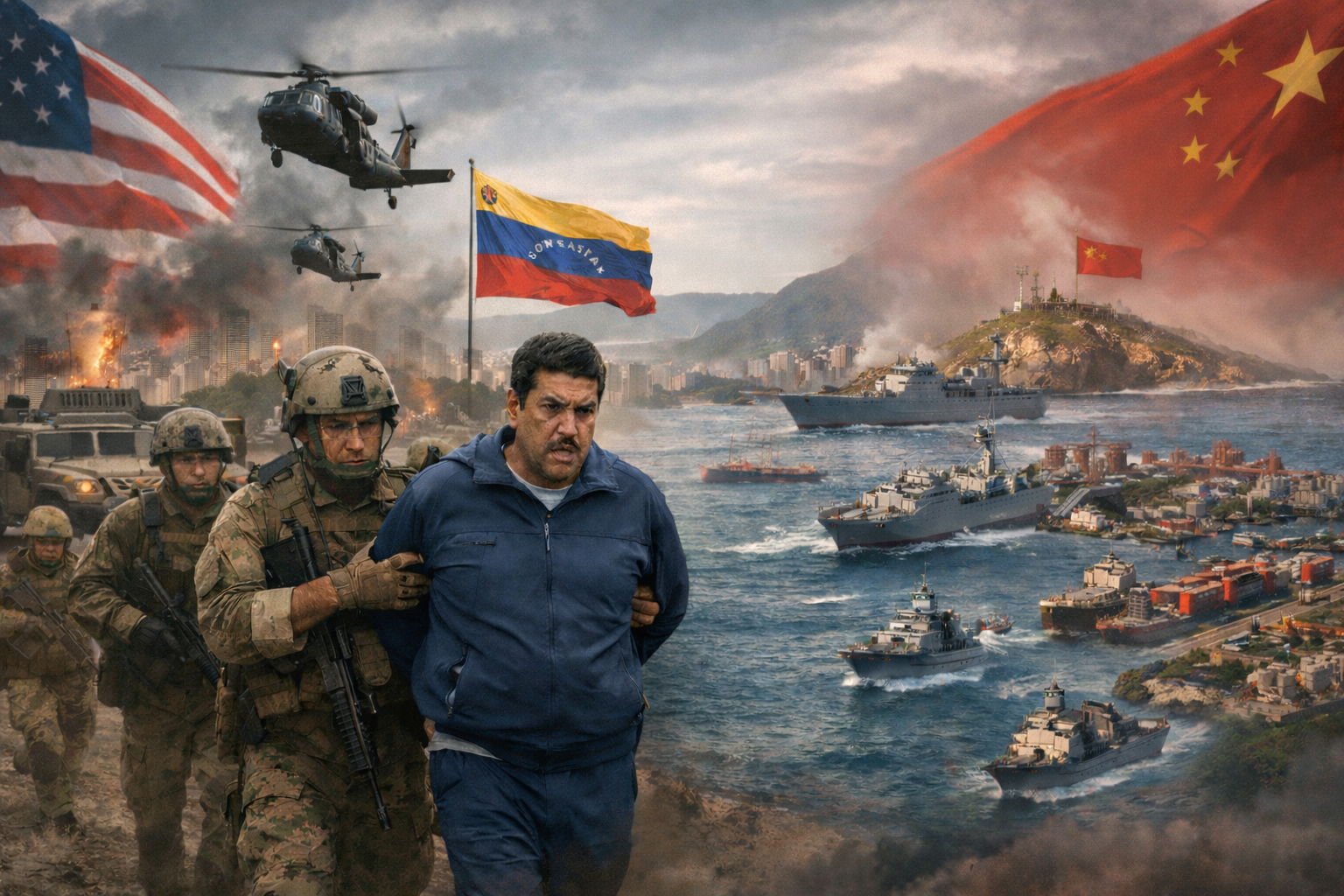
The United States of America, on 3rd January, 2026, attacked and captured Nicolas Maduro and First Lady Cilia Flores via Operation Absolute Resolve. More than 150 United States Armed Forces personnel landed in the Capital City of Caracas to execute the operation. However, the detention and capture of Maduro have been justified on the grounds of narco-terrorism. Nicolas Maduro will be presented before the Manhattan Federal Court on 5th January, 2026.
The Chinese response has been on expected grounds. U.S. strategic bombing and intervention into the internal affairs of Venezuela and non-compliance with the UN Charter have been condemned by Chinese Officials. China’s Foreign Ministry criticised the U.S invasion of a sovereign state and the illegal arrest of its president. It is to be noted that USA’s takeover of Venezuela and its control over its oil reserves indirectly pose a threat to China’s financial investment worth $100 billion and to China’s growing economic influence in Latin America through Venezuela.
China and Venezuela’s diplomatic relations were established in August 1944, and cooperation grew under the leadership of Hugo Chávez of Venezuela and Jiang Zemin and Hu Jintao, former General Secretaries of the Chinese Communist Party. Currently, China and Venezuela’s bilateral trade accounts for $425M in exports and $120M in imports. Between October 2024 and October 2025, there was a 1.97% increase from $417M to $425M while imports increased by $66.1M (a 123% increase) from $53.9M to $120M. The diplomatic relations grew after Venezuela became the first Hispanic country to enter a strategic development partnership with China.
The two countries established the China-Venezuela Development Fund in 2007. China signed a $15billion deal with Venezuela to drill for oil in a joint venture with PDVSA to produce 450,000 barrels per day of extra-heavy crude. Venezuela decided to double its joint investment fund to $12 billion, which led to the signing of agreements to boost co-operation, including increasing oil exports from Venezuela, which was China’s fourth-largest oil producer. Under Maduro’s regime, Venezuela promised to raise oil exports to China and Russia to one million barrels per day.
As of 2025, Venezuela is the top ally of China in Latin America, a major supporter of China’s Belt and Road Initiative, which aims to promote better trade connectivity with Latin American countries such as Venezuela, Brazil, Argentina, etc. The BRI not only gave China access to Latin America’s natural resources but also supported development in various countries across the continent, such as Panama, which became the first nation of the continent to sign the Belt and Road Initiative. However, China’s growing influence in the region posed a great challenge to the USA, as most countries in Latin America still believe in the Communist ideology. Another problem that arose was that both the United States and the European Union were unable to expand trade investments with Latin American countries, which led to a loss of their importance in the region.
Hence, the USA’s takeover of Venezuela would not only threaten the trade relations between Venezuela and China but would also impose various restrictions on Venezuela’s oil exports. China was the top buyer of Venezuelan oil, with 768,000 bpd last year. Maduro’s fall will limit China’s access to Venezuela’s oil, and the new administration might place restrictions on Chinese loans to Venezuela and other countries in the region for development, disrupting bilateral trade relations.
The USA and China have been rivals, pushing each other to maintain global economic dominance in the world. Venezuela’s control by the USA can bring changes in both the U.S.-China and Venezuela-China relationships. The latest developments will also force China to strengthen its influence in the South China Sea to counter US control in the region, as the U.S. is an ally of the Philippines.

Antara Deka is a student of Political Science at North Eastern Hill University and History at Indira Gandhi National Open University. Her interests include political awareness and civic engagement, and she has been actively involved in initiatives promoting informed participation among youth. Views expressed are the author’s own.
 Anjali Singh
  Aayush Pal
  Piyush Anand