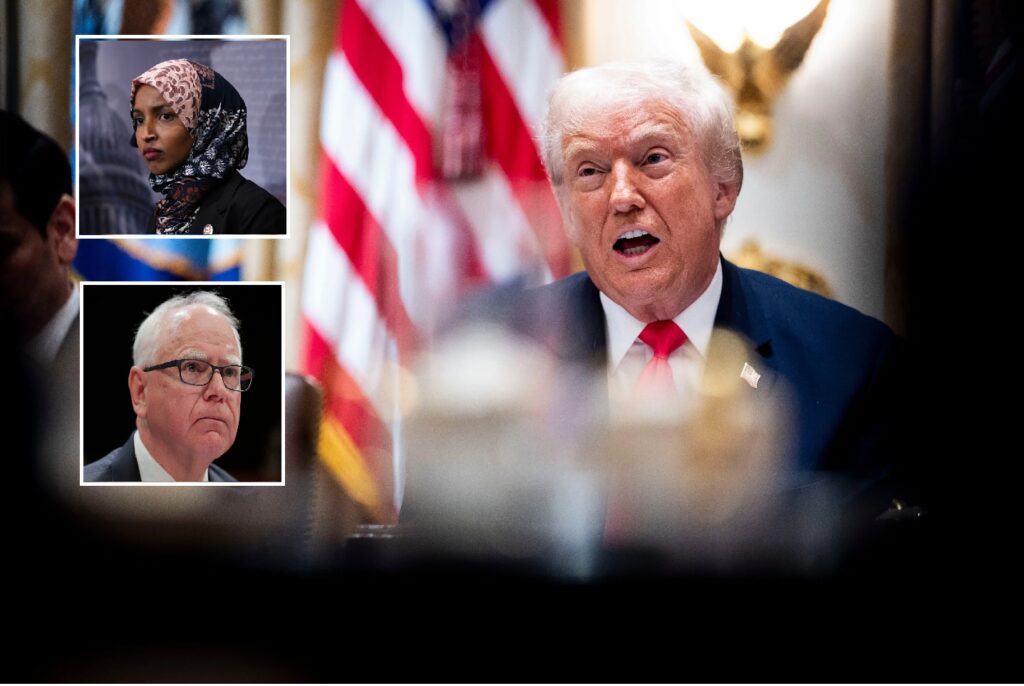
- On December 2, 2025, Trump launched a volley against Somali immigrants and escalated his criticism of Ilhan Omar, calling her and her supporters “garbage.”
- The rhetoric intensifies Trump’s immigration crackdown and builds on his plan to end TPS for thousands of Somalis in Minnesota, with ICE preparing a massive action in Minneapolis.
- Analytically, the comments highlight Trump’s nativist approach as he leverages anti-immigrant sentiment to rally his base and avoid domestic issues, drawing condemnation and placing the administration in legal jeopardy.
On December 2, 2025, at a White House Cabinet meeting, President Donald Trump launched a volley against Somali immigrants, stating, “Their country is no good for a reason. Your country stinks, and we don’t want them in our country.” Also, Trump escalated his criticism of Ilhan Omar, a Somali American Democrat, saying, “Ilhan Omar is garbage, she’s garbage, her friends are garbage.” This incident, which was recorded on video and widely shared, was directed at Minnesota’s large Somali population, who were accused of welfare dependency, gang activity, and fraud. Trump targeted their representative, Ilhan Omar, further escalating his previous attacks on the community.
This rhetoric intensifies Trump’s immigration crackdown and builds on his November 2025 announcement to end Temporary Protected Status (TPS) for thousands of Somalis in Minnesota. ICE is planning a massive action in Minneapolis, the epicentre of the largest Somali diaspora in the United States, with the intention of deporting residents using expanded enforcement of powers. Trump defended these actions by claiming that Somali immigrants send all their money home and do not integrate, reinforcing narratives of untested criminality.
Analytically, the comments highlight Trump’s nativist approach, as he leveraged anti-immigrant sentiment to rally his base at a time when the economic climate was strained, and his standing ahead of the midterm elections was weakening. His use of Somalia as an existential threat allows him to avoid focusing on domestic issues while delivering on campaign promises of mass deportations.
The language was condemned by critics such as Minnesota Governor Tim Walz and Rep. Omar, who warned of community trauma and economic fallout in a state where Somalis play important roles in sectors such as logistics and healthcare.
The episode also places the administration in legal jeopardy, as TPS revocations often face lawsuits, and further deepens political rifts. However, it strengthens Trump’s influence over GOP immigration politics, potentially pressuring swing-state voters. As deportations increase, this situation may test federal-state relations and U.S. humanitarian commitments and making it a defining issue of his second-term agenda.
But the implications of Trump’s rant extend beyond domestic politics. U.S.–Somalia relations, already delicate due to counterterrorism cooperation and diaspora-driven remittances, will be strained. TPS has historically been a soft-power instrument, signalling America’s capacity to protect people fleeing instability. Curtailing it risks undermining Washington’s moral authority not only in Africa but in the broader Global South, where migration policy is increasingly read as an indicator of geopolitical posture.

Shrivara Mahajan is pursuing an International Relations major with a minor in Public Policy at OP Jindal Global University. He is a Senior Intern at the Jindal Centre for the Global South and has priorly interned with The Spread Smile Foundation. Views expressed are the author’s own.
 Anusreeta Dutta
  Daljeet Singh
  Aayush Pal