
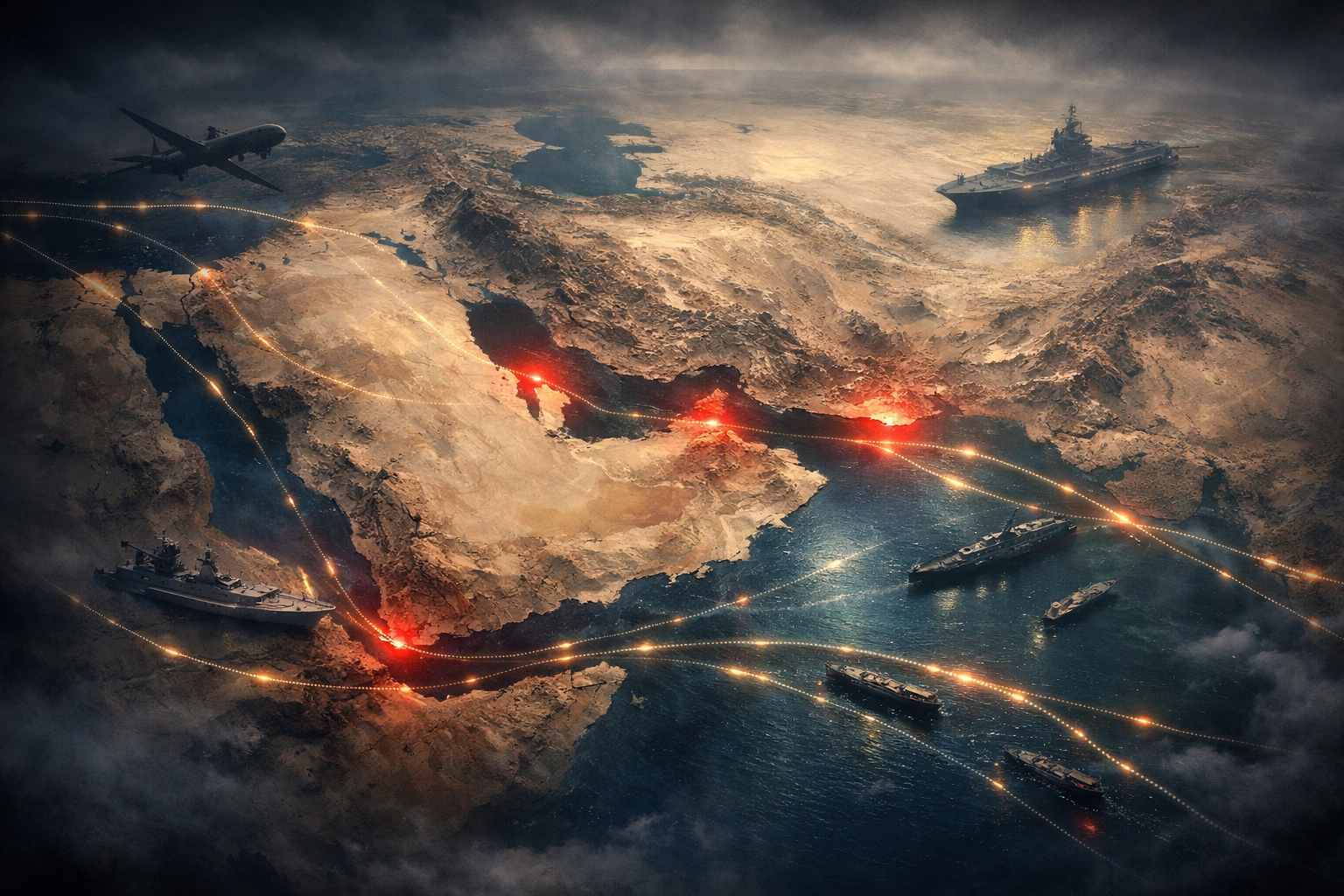
- West Asia is thus entering uncharted territory: more autonomous, less predictable, and certainly more hazardous.
- Multipolarity sounds democratic, but in a region riddled with sectarian fault lines and authoritarian politics, it frequently translates into a plethora of firearms pointed in all directions.
- The regional middle powers are entering a fluid battlefield, each believing that history has them a rare opportunity.
- What was once a marginal conflict is now threatening the heart of global trade.
West Asia is beginning to emerge from the lengthy shadow cast by America. For three decades, the region was dominated by US might, including bases, aircraft carriers, and the ability to punish or defend at pleasure. That period is coming to an end, not in a dramatic way, but gradually. What is emerging in its stead is a complex marketplace of opposing goals in which local actors, supported selectively by Russia and China, test each other’s limitations. The recent conflict between Saudi Arabia and the UAE over Yemen, which has given Iran-backed Houthis new ground to threaten Red Sea shipping, is merely the most recent indication of a larger trend.[1]
America Steps Back, Conditions Apply
Trump’s second term has formalised what was always clear. The 2025 National Security Strategy asserts unequivocally that America will no longer police every desert conflict.[2] The objective is narrower: prevent any hostile power from dominating Gulf energy or the Hormuz and Bab-el-Mandeb chokepoints, strike decisively if Iran exceeds nuclear red lines, and delegate daily stability to regional partners. The United States has fewer soldiers, shorter deployments, and more transactional alliances.[3] Friends are supposed to pay, fight, and administer their respective areas. The message is clear: the American umbrella is folding.
This retrenchment has not resulted in peace. Instead, it has heightened rivalry among the very allies that Washington formerly kept together. The Saudi-UAE disagreement over Yemen is illustrative. For years, the regimes formed a united front against the Houthis. Today, Riyadh seeks direct control through the Presidential Leadership Council and substantial money for southern Yemen, whilst Abu Dhabi depends on proxies such as the Southern Transitional Council and limits its own involvement. The end effect is a fragmented anti-Houthi camp.[4]
Predictably, the Houthis take advantage of the gap, resuming missile and drone strikes on Red Sea shipping at a time when tensions between Iran and the United States are growing anew.
Iran’s Strategy of Disorder
Iran lives in confusion. Even after Israeli bombings and US operations harmed parts of Tehran’s nuclear program, its most valuable asset has never been centrifuges, but networks. From Lebanon to Iraq and Yemen, its proxies provide inexpensive influence. This method works particularly well with multipolar disorder. When Arab rivals fight, Iran wins without firing a shot. The Houthis’ increased aggressiveness is more than just a Yemeni issue; it serves as a warning that asymmetric players benefit the most when large countries disengage.
Russia: Limited Footprint, Sharp Influence
Russia, despite being strained by Ukraine, has learned to be prudent. Moscow does not intend to control West Asia; rather, it seeks to be indispensable in specific areas. Arms sales, energy coordination with OPEC+ members, and diplomatic brokerage in post-Assad Syria keep the country’s flag visible.[5] Russia indirectly supports Iran while also maintaining good relations with Israel and the Gulf. It capitalises on America’s dwindling presence without incurring the cost of replacing it.
China’s Quiet Advance
China’s approach is more subtle and consequential. Beijing is not interested in sending marines to Basra. It wants safe energy channels and markets for its infrastructural giants. Ports, rail links, and industrial parks under the Belt and Road Initiative are gradually connecting the Gulf to East Asia. The Chinese presence in Djibouti, the brokering of the Saudi-Iran détente in 2023, and the expansion of trade with every regional centre all point to a new type of influence: economic first, security latter.[6] China provides money without lessons on democracy, and many dictators like that deal.
The Rise of Assertive Middle Powers
The regional middle powers enter this fluid battlefield, each believing that history has given them a rare opportunity. Saudi Arabia employs both economic diplomacy and military deployments in an attempt to influence Yemen and the Arab world in its image. The UAE functions like a modern trade state, supporting nimble militias from Sudan to Somalia and diversifying away from oil. Turkey promotes its defence exports, constructs bases from Qatar to the Horn of Africa, and strikes a balance between NATO commitments and friendly relations with Moscow and Tehran.[7]
Israel, bolstered by the Abraham Accords with unparalleled military technology, launches preemptive strikes on Iranian assets while strengthening intelligence collaboration with Gulf partners. These goals cross rather than align. The lack of a single arbiter multiplies errors. Every actor believes it can handle escalation, but the region’s history undermines such confidence. Chokepoints such as the Red Sea or the Strait of Hormuz can quickly escalate local conflicts into global disasters. A drone launched by the Houthis or a shadowy militia in Iraq has the potential to disrupt energy markets from Mumbai to Milan.[8]
More Poles, More Peril
Is the new order more stable than the previous American-led system? The evidence supports the contrary. Multipolarity sounds democratic, but in a region riddled with sectarian fault lines and authoritarian politics, it frequently translates into a plethora of firearms pointed in all directions. Transactional alliances change depending on the price of oil or the attitude of the crown prince. Without a hegemon to enforce the laws, deterrence becomes guesswork.[9]
There are several faint positives. Burden sharing has compelled Gulf states to spend heavily on their own security. China’s business interests provide incentives to maintain sea passages open. Israel’s integration with Arab economies has lowered the risk of traditional interstate conflict. However, these advantages are unstable, relying on individuals and profits rather than institutions.
Yemen as the Warning Bell
The Yemen fracture captures the dilemma. Instead of a coordinated campaign to terminate the crisis and safeguard the Red Sea, rival patrons vie for power while the Houthis, the least responsible actor, become more brazen. What was once a marginal conflict is now threatening the heart of global trade. When you multiply this trend across Syria, Iraq, and Lebanon, the picture becomes darker.[10]
An Unsettled Horizon
West Asia is thus entering uncharted territory: more autonomous, less predictable, and certainly more hazardous. America’s partial exit has not delivered on the promised self-reliance; rather, it has revealed how flimsy the regional consensus was. Unless big stakeholders create means for genuine collaboration, the vacuum will continue to benefit innovators.
For India and the rest of the world, the message is grim. Energy security, diaspora safety, and maritime trade cannot be relied on a single protector. Engagement with all facets of this new system is required, but illusions must be shed. Multipolarity without common rules is not balanced. It’s a bustling bazaar where the loudest hawker frequently wins, and the consequences of poor judgment extend well beyond the sandy sands.
References:
- [1] The Gulf States in the Multipolar Transition
- [2] The official 2025 National Security Strategy
- [3] Iran Conflict and the Strait of Hormuz: Oil and Gas Market Impacts
- [4] Saudi-UAE split fractures anti-Houthi coalition as Iran-US tension threatens Red Sea – analysis
- [5] Explainer: What Russia wants inthe Middle East, North Africa, a year after Assad
- [6] China’s First Overseas Base in Djibouti, An Enabler of its Middle East Policy
- [7] Somalia Says UAE Aid Bypassed Government, Fuelled Local Militias
- [8] What Iran’s attack on Israel means for global energy
- [9] Accessing the Multipolarity and Instability in the Middle East
- [10] From coalition to confrontation: Saudi-UAE rivalry in Yemen and its regional implications

Pranav S is a Project Assistant at the Energy Department, Government of Karnataka with an MA in Public Policy. Views expressed are the author’s own.
 Hridbina Chatterjee
  Mohmmad Rizwan
  Daljeet Singh