
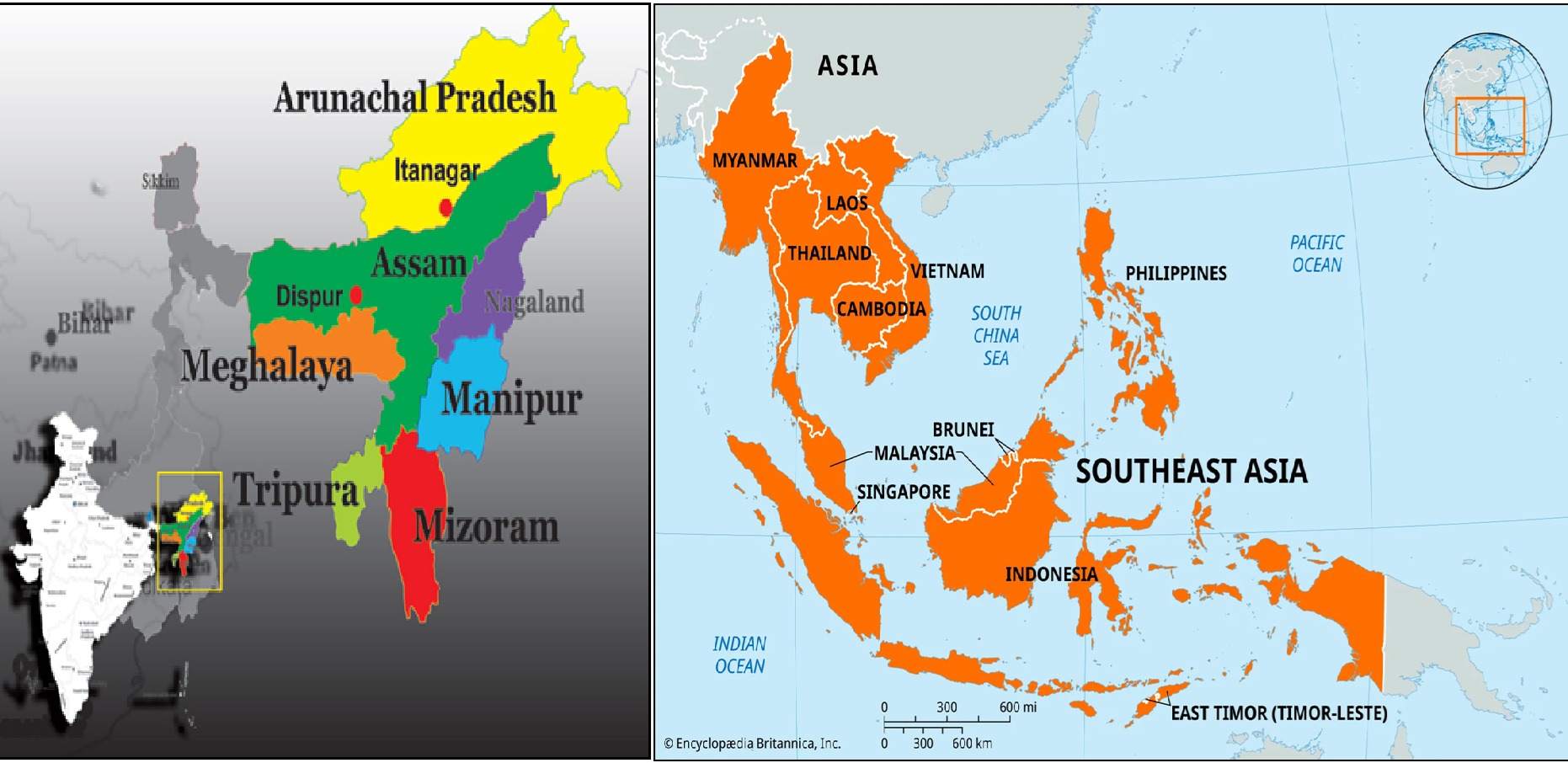
- The Northeast’s change from a remote border area to a diplomatic centre shows how India’s foreign policy priorities have changed in general.
- Northeast diplomacy works through highways, river ports, bridges, and transit corridors, not naval presence like maritime Indo-Pacific policies do.
- Connectivity is both a way to grow and a way to stop things from happening.
- The North East is no longer just a border area; it is now a geopolitical pivot.
For many years, India’s Northeast was only thought of in terms of domestic security and lack of development. Today, it is being redefined as a strategic gateway—a land bridge between the Indian subcontinent and Southeast Asia, as well as a key part of New Delhi’s growing Indo-Pacific agenda. “Northeast diplomacy” is not a known school of thought. But in reality, it has become a complex policy that includes things like connectivity, border management, counter-insurgency stability, regional trade, and strategic competition with China. The Northeast’s change from a remote border area to a diplomatic centre shows how India’s foreign policy priorities have changed in general.
From Look East to Act East: A Change in Structure
India’s changing relationships with other countries must be taken into account when looking at the Northeast’s diplomatic repositioning. India’s eastward expansion has long depended on the Association of Southeast Asian Nations. But the first “Look East Policy” from the 1990s was mostly about the economy and talk. It didn’t have the infrastructure needed to link India’s eastern states to markets in Southeast Asia.
The move to the Act East Policy showed a desire to go beyond symbols and start doing things. This method’s physical centre moved to the Northeast. Connectivity projects, border trading posts, and cross-border energy cooperation started to matter on a global scale. Northeast diplomacy works through highways, river ports, bridges, and transit corridors, not naval presence like maritime Indo-Pacific policies do. It is foreign policy in the form of infrastructure.
Connectivity as a Plan
The most well-known example of this approach is the connection projects that link India’s northeast to Myanmar and Bangladesh. The India-Myanmar-Thailand Trilateral Highway will link Moreh, Manipur, to Mae Sot, Thailand, through Myanmar. If it is finished and works well, it would connect India to the road networks of Southeast Asia’s mainland. These efforts aren’t just about making money. They meet three important goals:
- Getting more connections away from the weak Siliguri Corridor.
- Making India a part of Southeast Asia’s economy.
- Balancing China’s growth of infrastructure in Bangladesh and Myanmar.
In this case, connectivity is both a way to grow and a way to stop things from happening. The Kaladan Multi-Modal Transit Transport Project also connects Kolkata to Myanmar’s Sittwe port. From there, it goes by river and road to Mizoram. This makes India less dependent on the small Siliguri Corridor, which is also called the “Chicken’s Neck,” and gives it more options when it comes to logistics.
The Maitri Setu bridge between Tripura and Bangladesh makes it easier for goods to get to Chattogram port by lowering the distance and cost of moving them.
China Factor: Competition on the Borderlands
One can’t understand diplomacy in the Northeast without thinking about how China affects it. The Belt and Road Initiative (BRI) from China has made it easier for Myanmar and Bangladesh to connect their infrastructure and energy systems. China’s access to the Bay of Bengal through Myanmar’s Kyaukpyu port has a big impact on strategy.
Simultaneously, the unresolved boundary issue between India and China, notably with the 2020 Galwan conflict, has increased the strategic emphasis on border infrastructure. Roads, advanced landing fields, and logistics infrastructure in Arunachal Pradesh and other frontier territories are now regarded from two perspectives: development and defence.
China refers to Arunachal Pradesh as “South Tibet,” and it periodically issues diplomatic objections to Indian infrastructure projects. Accelerating development in the Northeast is a way for New Delhi to show its sovereignty while also instilling trust in the local community. Thus, Northeast diplomacy is linked to continental deterrence.
Myanmar: The Most Important Factor
Myanmar is different from India’s other eastern neighbours. It is India’s only ASEAN neighbour that shares a land border. After the military coup in 2021, it is also politically unstable. New Delhi’s approach to Myanmar is a careful mix of democratic values and strategic needs. India needs Myanmar’s help to finish projects that connect the two countries and deal with militant groups that operate across borders that aren’t very strong. In the past, insurgency networks took advantage of hard-to-reach areas and safe havens across borders. Some militant movements have been slowed down by coordinated security operations between Indian and Myanmar forces. But the instability in Myanmar makes it hard to plan for the long term.
India can’t just walk away. Myanmar’s stability is important for the Northeast to be able to join Southeast Asia. So, dealing with Naypyidaw diplomatically means being both practical and careful.
From Periphery to Pivot
For a long time, people thought that India’s North East was “remote” from the rest of the country. But in terms of strategy, it is not at all far away. It is at the crossroads of South and Southeast Asia, continental and maritime Asia, and in the shadow of the growing rivalry between India and China.
Three structural forces make it important for diplomacy:
- ASEAN encourages working together in the region.
- Finding a strategic balance with China.
- Connecting corridors to change the economy.
With the right management, the Northeast could go from being a dangerous border to a bustling economic bridge. If no one pays attention to it, it could stay a weak theatre.
So, India’s eastern diplomacy is not an option. It is important for its goals in the Indo-Pacific. The North East is no longer just a border area; it is now a geopolitical pivot. India’s regional strategy may depend on how well it uses this border as a pivot point in the coming decades.

Anusreeta Dutta is a columnist and climate researcher with experience in political analysis, ESG research, and energy policy. Views expressed are the author’s own.
 Anjali Singh
  Aayush Pal
  Piyush Anand