
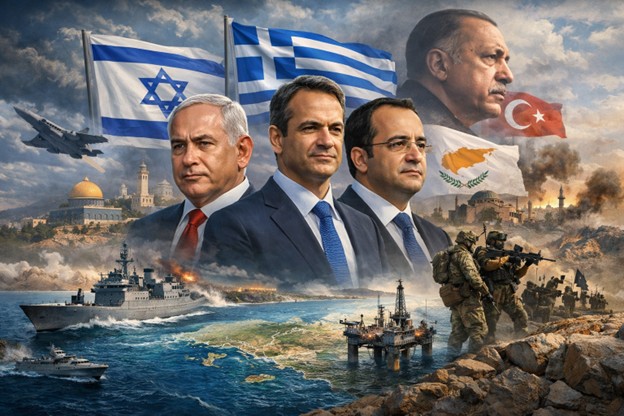
- The summit aimed to strengthen cooperation, and the three countries agreed to deepen further collaboration in the fields of security, defence, and military cooperation.
- Israeli Prime Minister Netanyahu strongly criticised Turkish President Erdogan, stating that “those who fantasise they can reestablish their empires and their dominion over our lands” should “forget it.”
- Turkey has been accused of supporting armed groups such as Hayat Tahrir al-Sham (HTS) to overthrow the former Syrian President Assad and reestablish Turkish influence in Syria.
- The countries agreed on the need for a ceasefire and emphasised that the territorial integrity of states in the Eastern Mediterranean must be respected.
Israel, Greece, and Cyprus held a trilateral Jerusalem Summit last week. This was an attempt by the three countries of the Eastern Mediterranean to boost cooperation and unity in a region that has increasingly emerged as a major geopolitical focal point.
The summit took place in Israel and was represented by Greek Prime Minister Kyriakos Mitsotakis and Cypriot President Nikos Christodoulides. The summit aimed to strengthen cooperation, and the three countries agreed to deepen further collaboration in the fields of security, defence, and military cooperation. This initiative is largely driven by Israel to unify common interests among Eastern Mediterranean partners amid the ongoing belligerence by Turkey, which Israel considers a security threat.
Israeli Prime Minister Netanyahu strongly criticised Turkish President Erdogan during the summit, stating that “those who fantasise they can reestablish their empires and their dominion over our lands” should “forget it.” This was a clear, indirect message aimed at Turkey, which has controlled the northern part of Cyprus since 1974. Northern Cyprus is strategically important due to its offshore oil and gas reserves, and Turkey has used its presence there to conduct drilling and exploration activities.
It was also agreed ahead of the meeting that the three countries will aim to create a rapid response mechanism, particularly in the defence and military domains. While a formal framework is still under development, the intent was clearly articulated. A joint statement was issued in which the countries agreed to safeguard sea lanes, enhance maritime cooperation, and protect critical infrastructure located in the Eastern Mediterranean.
Key Agreements Signed
The countries also agreed on the need for a ceasefire and emphasised that the territorial integrity of states in the Eastern Mediterranean must be respected. The sides further stated that Lebanon’s territorial integrity should be respected, the non-state actors should be discouraged, and recognition and respect for Lebanon’s national institutions and sovereign state structure should be upheld.
The key question is why Israel has agreed to further strengthen its relationship with Cyprus and Greece. One of the main reasons is the shared geopolitical interests and strategic realities faced by these countries. Israel has significantly curtailed most diplomatic ties with Turkey, especially after October 7, 2023. Turkey has criticised Israel’s actions and accused Prime Minister Netanyahu of committing genocide and mass killings.
As a result, both countries restricted their airspace for each other’s national airlines. Turkey also imposed sanctions on Israeli state officials, including Prime Minister Netanyahu. Additionally, Turkey supported South Africa’s move at the International Court of Justice to pursue genocide related claims against Israel. The relationship further deteriorated after President Erdogan publicly stated that Netanyahu was no less than Hitler. Since then, relations between the two sides have remained severely strained.
Israel- Turkiye Geopolitical Rivalry
Beyond diplomatic tensions, there is a broader geopolitical rivalry. The strategic objectives of Israel and Turkey are fundamentally misaligned. Turkey seeks to solidify its presence and influence across the region, with President Erdogan openly promoting the idea of reviving imperial-era influence. This ambition is visible in Turkey’s role in the South Caucasus, particularly its growing influence over Azerbaijan, as well as its involvement in Syria.
It is important to note that Turkish leadership and nationalist groups have repeatedly claimed that Mosul is historically Ottoman land and should be returned to Turkish influence. Turkey has also been accused of supporting armed groups such as Hayat Tahrir al-Sham (HTS) to overthrow the former Syrian President Assad and reestablish Turkish influence in Syria. This attempt to reshape the regional balance of power directly conflicts with Israeli interests.
Syria is a direct neighbour of Israel, and the two countries have an ongoing territorial dispute over the Golan Heights. More importantly, Israel strongly opposes the increasing militarisation of southern Syria, as it believes such developments pose a direct security threat. Israel sees Turkey’s growing role in Syria as an attempt to use the country as a buffer zone to expand its influence closer to Israeli borders, further intensifying security concerns.
In addition to this, Israel is concerned about Turkey’s improving relationship with the United States. Multiple reports indicate that Turkey is seeking to rejoin the F-35 program and is pursuing the removal of American sanctions imposed after Ankara purchased the Russian S-400 missile system. If these sanctions are lifted, Turkey could regain access to advanced military technology, which Israel perceives as a strategic challenge.
Israel is also uneasy about Turkey’s growing influence in Gaza. Turkey has emerged as one of the most vocal supporters of the Palestinian cause. Behind the scenes, diplomatic efforts involving Turkey, Egypt, and Qatar have contributed to ceasefire negotiations in Gaza. This Turkish involvement has further widened differences between Ankara and Tel Aviv.
Greece – Cyprus Geopolitical rivalry with Israel
Similar tensions exist between Turkey and Greece, primarily due to long-standing maritime disputes. Greece has repeatedly accused Turkey of violating its maritime sovereignty and creating instability in the Eastern Mediterranean. There are differences, particularly on the issue of the Exclusive Economic Zone. Greece’s largest islands are situated in proximity to the Turkish mainland, which limits Turkey’s direct access to the Aegean Sea. This has been a major point of contention between the two countries. There is also disagreement regarding the extraction of maritime resources in the Aegean Sea, as maritime boundaries between Greece and Turkey are not clearly or mutually demarcated. Because of this lack of agreed boundaries, there are frequent disputes over resource exploration and ownership between the two countries.
Likewise, Cyprus continues to face challenges due to Turkey’s continued military presence in its northern territory since 1974. This shared geopolitical reality among Israel, Greece, and Cyprus has created a natural convergence of strategic interests. Israel views this as an opportunity to institutionalise trilateral cooperation and build a joint framework to counter Turkish assertiveness in the region.
India & the eastern Mediterranean
The strong economic relationship among the three countries is also strategically relevant for India. India has become increasingly engaged in the Eastern Mediterranean, with the Modi administration making sustained diplomatic efforts with both Greece and Cyprus. The Greek Prime Minister visited India in 2024, and several initiatives were launched to deepen bilateral relations. Similarly, India’s External Affairs Minister S Jaishankar recently visited Cyprus to further strengthen bilateral engagement.
India already enjoys strong relations with Israel, and the growing strategic alignment among Israel, Greece, and Cyprus indirectly enables India to expand its strategic space and engagement in the Eastern Mediterranean region.

Aayush Pal is a freelance writer on contemporary geopolitical developments. The views expressed in his work are entirely his own.
 Ajith Shetty Heranje
  Atri Patel
  Anusreeta Dutta