
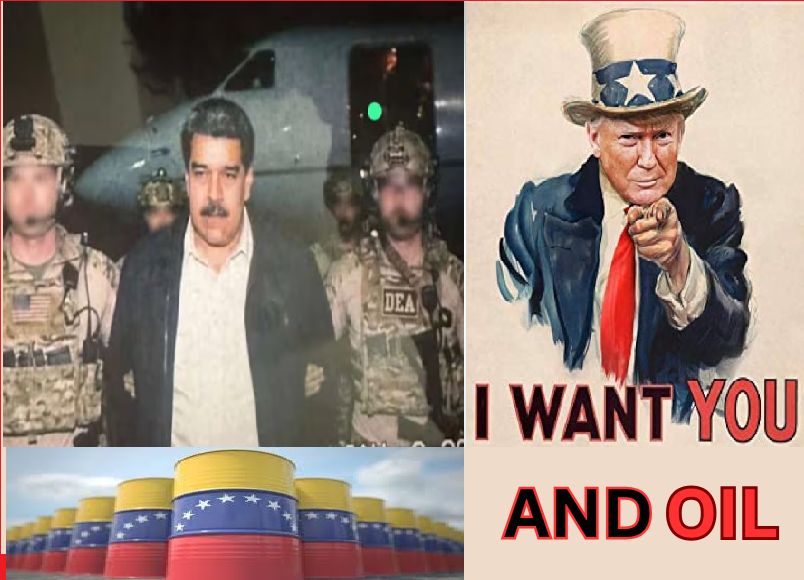
- A United States-led special military operation has resulted in the overthrow of Venezuelan President Nicolás Maduro.
- By facilitating US oil companies’ entry into Venezuela, Washington aims to reduce its dependence on West Asian oil and strengthen its energy security.
- With Venezuelan oil now effectively under US control, countries such as India and China may face difficulties in securing alternative energy supplies.
One of the most significant political developments has unfolded in Latin America in recent times. A continent already known for revolutions and political instability has witnessed its biggest geopolitical shock in over a decade. A United States-led special military operation has resulted in the overthrow of Venezuelan President Nicolás Maduro.
The operation was conducted as a limited but decisive military action by the United States. American forces entered Venezuela, targeted key military infrastructure, stormed the presidential palace in Caracas, and captured President Maduro along with his wife. Following their capture, both were transported out of Venezuela and taken to the United States. According to the confirmation by US Attorney General Bondi, they were brought to New York and placed under US custody.
This development has shaken not only the Latin American region but also global geopolitics. Countries across the world are sharply divided over the US action.
US Allegations Against the Maduro Government
President Donald Trump has long been critical of Nicolás Maduro. The US administration has accused Maduro of maintaining close links with narco-terrorist networks operating in Venezuela. According to Washington, these networks were responsible for trafficking narcotics into the United States, causing severe social and economic damage.
President Trump claimed that boats carrying drugs from Venezuela were entering US waters and contributing to rising crime and drug addiction. He argued that justice must be delivered against Maduro and his associates.
Escalation Before the Military Action
For nearly two months before the operation, the United States had been carrying out kinetic strikes against boats allegedly transporting narcotics from Venezuela into the Caribbean waters. The US Navy also blocked and seized oil shipments travelling to and from Venezuela.
Alongside these actions, Venezuela was already facing a long-standing economic embargo imposed by the United States. The seizure of oil vessels added further economic pressure on Caracas. While there were attempts at diplomatic engagement, including telephonic conversations, President Trump remained firm that military action was necessary.
Contradictions in President Trump’s Foreign Policy
The military action against Venezuela has exposed major contradictions in President Trump’s political stance. Before returning to the office, Trump frequently criticised previous Democratic administrations for toppling regimes abroad and acting as a global police force instead of focusing on domestic issues.
However, after assuming office, the Trump administration has conducted or supported military actions in Iran, Nigeria, Yemen, Somalia, Syria, and now Venezuela. This has raised questions about the credibility of Trump’s earlier anti-interventionist rhetoric.
History of US regime change operations
It is not the first time that the United States of America has attempted regime change. The belligerent nature of US foreign policy has resulted in multiple regime change operations across the world. One of the most prominent examples is Iraq in 2003, where the Saddam Hussein regime was overthrown. The consequences of that intervention are well known. It led to prolonged instability, the collapse of state institutions, and ultimately contributed to the rise of ISIS, thereby turning Iraq into a prolonged conflict zone.
Similarly, the United States removed Muammar Gaddafi in Libya in 2011. After his removal, Libya collapsed into chaos, resulting in the emergence of two parallel governments and deep economic instability. This episode further reinforced the destructive consequences of US-led regime change operations.
This history clearly shows that regime change has been a consistent feature of American foreign policy. What is particularly notable is that these actions have been carried out by both Republican and Democratic administrations. Even political figures who publicly describe themselves as anti-war, such as Tulsi Gabbard, have supported or aligned with similar policies once they have held positions of national authority.
This highlights a bipartisan consensus in the United States on foreign policy. Regardless of which political party is in power, the core direction of US foreign policy remains largely consistent. This should serve as a lesson to the world that American foreign policy continues on the same path, irrespective of changes in political leadership.
Missed Diplomatic Settlement
According to multiple reports, President Maduro had engaged in diplomatic negotiations with the United States. These discussions reportedly included offers to allow US oil companies access to major Venezuelan oil fields and a phased political transition that would see Maduro eventually step down.
Such a deal could have resulted in economic gains for the United States while avoiding a military confrontation. Despite this, the US administration chose not to pursue the agreement and instead opted for direct military intervention.
Selective Application of Justice
President Trump justified the action against Maduro by citing narcotics trafficking. However, critics have pointed out inconsistencies in this position. Trump previously pardoned former Honduran President Juan Orlando Hernández, who had faced similar allegations related to drug trafficking.
This selective approach has reinforced accusations that Washington is cherry-picking regimes based on strategic convenience rather than legal principles.
Strategic Importance of Venezuelan Oil
Venezuela holds one of the largest proven oil reserves in the world. Control over these reserves offers immense geopolitical and geo-economic leverage. By facilitating US oil companies’ entry into Venezuela, Washington aims to reduce its dependence on West Asian oil and strengthen its energy security.
President Trump made it clear in his address following Maduro’s capture that American companies would operate extensively in Venezuela and generate substantial profits.
It is also important to note that Maduro had earlier restricted American oil companies from operating freely in Venezuela. This decision had strained relations with US energy giants, some of which are known to maintain close ties with the Trump administration.
Role of Marco Rubio and the Monroe Doctrine
A key architect of the new US policy in Latin America is Secretary of State and interim National Security Advisor Marco Rubio. Rubio believes that action against Venezuela could trigger a domino effect across Cuba and Nicaragua, reshaping the region into an American-friendly sphere of influence.
This strategy aligns closely with the revival of the Monroe Doctrine, aimed at reinforcing US dominance in the Western Hemisphere. Rubio’s strong anti communist stance, shaped by his Cuban background, plays a significant role in this approach.
Political Situation Inside Venezuela
Following Maduro’s removal, Vice President Delcy Rodríguez has assumed the presidency under constitutional provisions. Notably, the United States has not dismantled the entire political apparatus of the ruling party. Instead, it has removed only the president while allowing the existing nationalist leadership to remain in place.
The US has issued explicit warnings that any defiance by the new leadership could trigger further military action. This selective removal strategy reflects lessons drawn from past US interventions in Iraq, Libya, and Syria, where complete regime collapse led to chaos and civil war.
By keeping the state structure intact, Washington aims to avoid post-intervention instability while simultaneously securing economic benefits, particularly in the oil sector.
Global Reaction and India’s Position
Major allies of Venezuela, including Russia, China, and Iran, have condemned the US action, calling it a grave violation of international law and demanding the immediate release of President Maduro.
Even several US allies have expressed unease over the move. India has issued a cautious statement through its Ministry of External Affairs, stating that it is closely monitoring the situation and calling for diplomacy and dialogue to prevent escalation.
Impact on Global Energy Markets
This development raises serious concerns for global oil markets. China has been one of the largest importers of Venezuelan oil, and India has also resumed imports in the past two years.
With Venezuelan oil now effectively under US control, countries such as India and China may face difficulties in securing alternative energy supplies. This shift could significantly alter global energy flows and price dynamics in the coming months.

Aayush Pal is a freelance writer on contemporary geopolitical developments. The views expressed in his work are entirely his own.
 Faareha Usmani
  Archita Gaur
  Hridbina Chatterjee