- The capture of Venezuelan President Nicolás Maduro by the US is a direct mockery of the very principles Washington and its European allies have claimed to defend for decades.
- The United Nations, predictably, remains spineless. Designed to prevent precisely such unilateral excesses, it has once again proven incapable of restraining the powerful or protecting the weak.
- The North Korean leadership’s call to more than double the production capacity of tactical guided weapons underscores a regime that sees deterrence, not dialogue, as the currency of survival.
- When rules are bent to the breaking point by those who wrote them, the incentive for others to follow them evaporates.
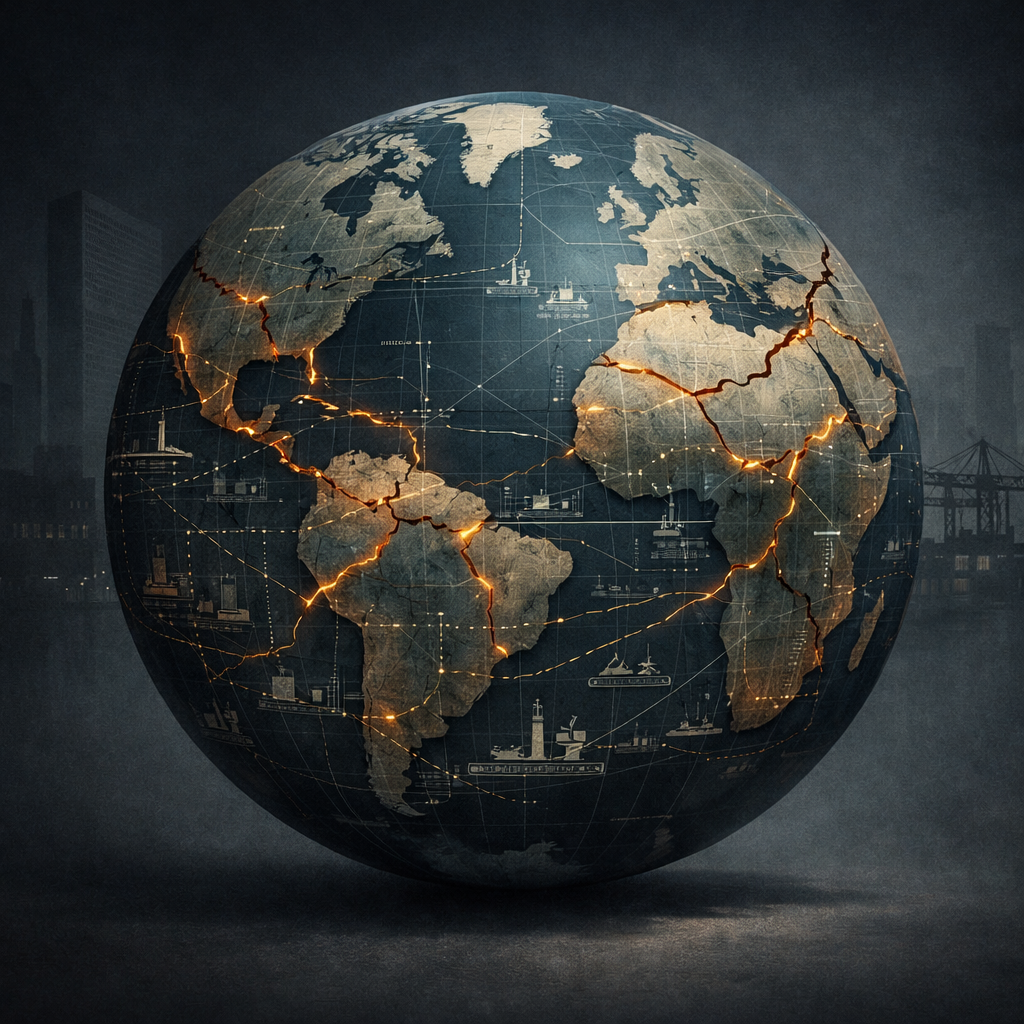
The year 2026 has opened not with cautious hope or diplomatic sobriety, but with a series of geopolitical shocks that strike at the very foundations of what has long been advertised as a rule-based international order. If the first few days of a year are any indication of the months ahead, then the world has reason to be deeply uneasy. What we are witnessing is not merely instability, but a steady erosion of restraint, norms, and moral consistency in global affairs.
The most disturbing signal came from the United States itself. The capture of Venezuelan President Nicolás Maduro by the US is not just an act of coercive power projection. It is a direct mockery of the very principles Washington and its European allies have claimed to defend for decades. Till barely two days ago, and consistently over the last three years, the US and Europe have framed Russia’s actions in Ukraine as a gross violation of sovereignty, international law, and the sanctity of borders. The rhetoric was uncompromising. Sanctions were justified as moral necessities. International institutions were invoked as arbiters of right and wrong. Yet, with one dramatic act, the United States has done precisely what it accused Moscow of doing. Sovereignty has been overridden.
Due process has been ignored. International mechanisms have been bypassed. The question that now confronts the so-called liberal world order is a simple but uncomfortable one. Who enforces the rules when the self-appointed guardian of those rules breaks them? The silence, hedging, and selective outrage from Europe and other liberal democracies have been telling. There has been no emergency session of the UN General Assembly of consequence. No meaningful Security Council action, although everyone is aware of the reasons. No moral sermon delivered with the same fervour reserved for adversaries. This selective application of principles exposes the liberal order for what it has increasingly become. A permissive system where power defines legality, and ideology decides whose violations matter.
The United Nations, predictably, remains spineless. Designed to prevent precisely such unilateral excesses, it has once again proven incapable of restraining the powerful or protecting the weak. This is not a failure of individuals, but of a system hollowed out by veto politics and institutional inertia. The result is a fractured world, divided not only by ideology and region, but by convenience and self-restraint. Ironically, restraint today is exercised more by middle powers than by those who claim global leadership. Behind the US action in Venezuela lies a cold strategic calculus. Control over critical minerals, access to energy resources, and dominance in emerging technologies, particularly artificial intelligence, are no longer secondary objectives. They are central to American grand strategy. Venezuela’s vast reserves of oil and gold make it a prize that Washington cannot afford to leave unattended, especially as competition with China sharpens.
For years, China patiently built economic and political influence across Latin America through infrastructure investments, energy partnerships, and financial diplomacy. The US move in Venezuela is a decisive disruption of those plans. It serves a dual purpose. Contain China’s strategic reach in the Western Hemisphere and secure resources essential for America’s technological and industrial ambitions. In that sense, Venezuela becomes a double-edged sword. A theatre for great power rivalry and a resource base for sustaining US primacy in AI and advanced manufacturing. But such actions come at a cost. They delegitimise the very narrative the US relies upon to mobilise allies and pressure adversaries. When rules are bent to the breaking point by those who wrote them, the incentive for others to follow them evaporates.
As if the Americas were not enough, East Asia has offered its own warning shot. North Korea’s firing of multiple ballistic missiles from Pyongyang towards the sea off its east coast is a reminder that dormant flashpoints never truly sleep. This was the first such launch in two months, and it comes at a politically sensitive moment. South Korean President Lee Jae Myung’s state visit to China, where peace on the Korean Peninsula is officially on the agenda, provided the immediate backdrop. The message from Pyongyang is unmistakable. It will not be sidelined or pressured into silence. The North Korean leadership’s call to more than double the production capacity of tactical guided weapons underscores a regime that sees deterrence, not dialogue, as the currency of survival. The ritual statements from Seoul’s Joint Chiefs of Staff about vigilance and coordination with the US and Japan change little on the ground. The missiles have already fallen. The signal has already been sent.
Meanwhile, West Asia continues to fracture along old and new fault lines. Saudi Arabia’s call for Yemen’s southern factions to attend a dialogue in Riyadh comes amid an extraordinary deterioration of relations with the United Arab Emirates. Once aligned in their intervention on behalf of Yemen’s internationally recognised government, the two Gulf powers now back rival factions with competing visions of Yemen’s future. The declaration of “war” by a UAE-backed force, accusing Saudi-backed ground troops and the Saudi air force of launching attacks, is not merely a localised escalation. It reveals how fragile even close strategic partnerships have become. The push to declare an independent southern Yemeni state threatens to redraw borders and prolong a conflict that has already devastated one of the poorest societies in the region. Taken together, these developments paint a bleak picture. Great powers act unilaterally. Regional powers pursue narrow interests. Institutions watch helplessly. Peace, once again, appears elusive, fragile, and transactional.
Against this backdrop, the question for India in 2026 is not academic. It is existential. How does a rising power protect its national interests in a world where rules are invoked selectively and violated casually? How does it remain committed to a rule-based order without being naïve about power politics? And how does it continue its ambitious journey towards Viksit Bharat 2047 amid global turbulence?
India’s path must be guided by strategic autonomy, not strategic isolation. New Delhi cannot afford to become an appendage of any bloc, nor can it retreat into moral posturing detached from realities. The first imperative is clarity of interests. Energy security, technological sovereignty, supply chain resilience, and territorial integrity must remain non-negotiable. Second, India must actively shape, not merely invoke, a rule-based order. This entails collaborating with like-minded middle powers to reform global institutions, particularly the UN, the Bretton Woods bodies, and emerging frameworks for technology governance. Silence or passivity only reinforces a system dominated by a few. Third, India must deepen diversified partnerships. The US remains an important partner, but not an unquestionable one.
Engagement with Europe, Russia, Japan, ASEAN, Africa, and Latin America must be calibrated, pragmatic, and interest-driven. The Venezuelan episode is a reminder that today’s partner can tomorrow undermine norms that India depends upon. Fourth, India’s technological ambitions demand urgency. Control over critical minerals, leadership in AI, and indigenous innovation are no longer optional. They are strategic necessities. India must invest in research, secure overseas resource partnerships through lawful means, and build resilient domestic ecosystems. Finally, India must retain its civilisational restraint. In a world rushing towards coercion, restraint can be a strength if backed by capability. Moral authority still matters, but only when combined with economic weight and strategic resolve.
As the year begins under dark clouds, it is worth recalling the words of Hans Morgenthau, who warned that “international politics, like all politics, is a power struggle.” Yet, he also cautioned that power divorced from legitimacy invites chaos. Hedley Bull reminded us that order in world politics rests not only on power, but on shared rules and institutions, however imperfect. And Kautilya, writing centuries ago, was brutally honest when he observed that the king who ignores the balance of power courts disaster. 2026 has begun with all the wrong reasons. Whether it ends the same way will depend on whether nations like India can navigate between idealism and realism, between rules and power, and between ambition and responsibility.

Dr. Nanda Kishor M. S. is an Associate Professor at the Department of Politics and International Studies, Pondicherry University, and former Head of Geopolitics and International Relations at Manipal University. His expertise spans India’s foreign policy, conflict resolution, international law, and national security, with several publications and fellowships from institutions including UNHCR, Brookings, and DAAD. The views expressed are the author’s own.
 Archita Gaur
  Hridbina Chatterjee
  Anjali Singh