
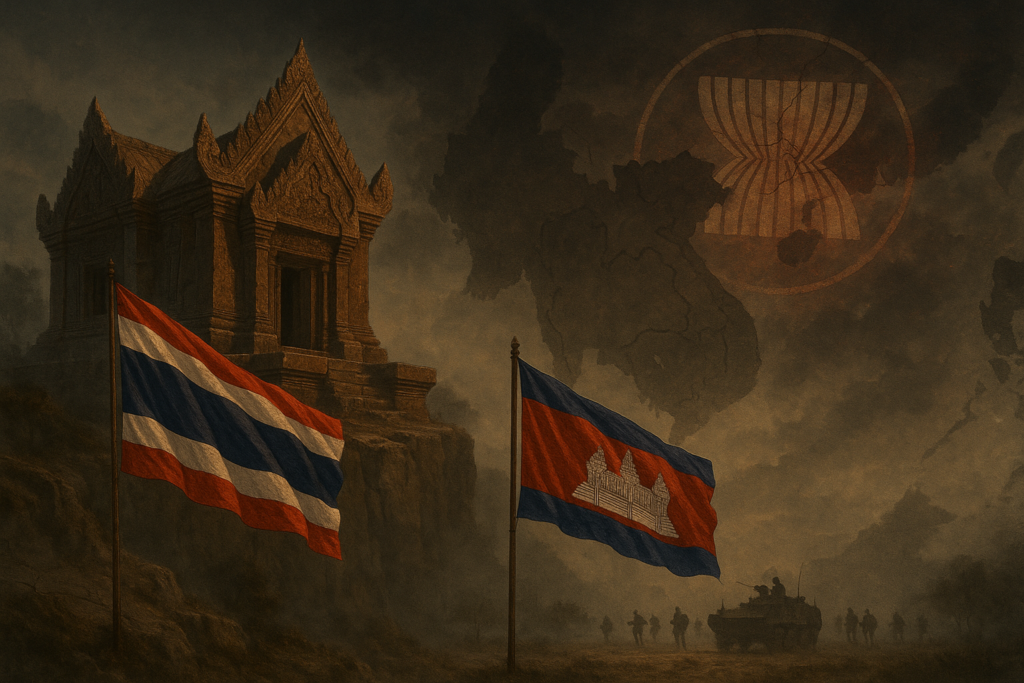
- The Myanmar coup of 2021 marked a turning point that weakened ASEAN’s regional cohesion and exposed the limits of its non-interference doctrine.
- The renewed Thailand–Cambodia conflict around the Preah Vihear Temple has revealed how unresolved historical disputes continue to destabilise mainland Southeast Asia.
- President Trump’s repeated claims of mediating ceasefires—rejected by Thailand just as they were by India—underscore the gap between diplomatic theatrics and real influence on the ground.
- At a time when Southeast Asia is emerging as a global manufacturing alternative to China, persistent geopolitical instability threatens investor confidence and ASEAN’s economic future.
The Association of South East Asian Nations (ASEAN) is a regional grouping consisting of 11 countries in Southeast Asia. It is a political and economic regional organisation that has long been considered a standard model for regional association. ASEAN was created primarily to ensure political and economic stability in the region, especially as a counterbalance to the rising influence of the Soviet Union during the Cold War. Over the years, it emerged as one of the most remarkable success stories of regional cooperation, driven by young demographics, booming economic ideas, strong cooperation, and cultural proximity among member states.
However, the recent developments in Southeast Asia present a sharp contrast to ASEAN’s earlier image. Instead of being known for political and economic stability, ASEAN is now increasingly associated with war, geopolitical rivalries, coups, political uncertainty, and its transformation into a breeding ground for geopolitical hegemony. These developments are sidelining Asia’s immense potential.
The Myanmar Saga
The turning point began in 2021 with the military coup in Myanmar, where the civilian-led government was overthrown by the military junta. Since then, Myanmar has descended into a prolonged civil war, with resistance forces fighting against the military regime. The country has witnessed widespread violence, mass displacement, migration, famine, and humanitarian crises. The impact of Myanmar’s instability has been felt across the region and has weakened ASEAN’s overall regional cohesion and credibility.
Now, another major concern has emerged in mainland Southeast Asia involving Thailand, one of ASEAN’s most prosperous economies. Thailand is known as a prosperity hub of Southeast Asia, with a booming young population and a vibrant tourism industry that contributes significantly to its GDP. It is often regarded as one of the next growth engines of Southeast Asia. Thailand now faces renewed conflict with its neighbour, Cambodia.
Antecedents to the Current Escalation
The border tensions between Thailand and Cambodia are not a new phenomenon. Both countries share an 817-kilometre-long land border, and disputes have existed for centuries. In July, tensions escalated into armed conflict due to territorial disputes, resulting in the death of nearly 48 people and the displacement of around 300,000 civilians. Although the conflict lasted only five days, it exposed deeper unresolved issues between the two nations.
The fighting was reportedly halted through a ceasefire document prepared by Malaysian Prime Minister Anwar Ibrahim. While President Trump publicly claimed credit for mediating the ceasefire, in reality, it was Malaysia’s diplomatic initiative that played a key role. However, this ceasefire has since collapsed. In early December, Thailand accused Cambodia of violating ceasefire norms and targeting Thai positions in the disputed territory.
Hindu Temple at the Centre Stage
The core of the dispute lies around the Preah Vihear Temple, an 11th-century Khmer temple dedicated to Lord Shiva. Cambodia, a former French colony, inherited boundaries drawn by the French administration during colonial rule. In 2008, Cambodia succeeded in having the Preah Vihear Temple declared a UNESCO World Heritage Site, a move strongly contested by Thailand, which claims sovereignty over the surrounding territory. Since then, the temple region has remained a major flashpoint.
In December 2025, Thailand accused Cambodia of launching BM-21 rocket attacks on Thai positions. Thailand has reported its first civilian death in the renewed fighting. As of now, at least 16 Thai soldiers have been killed and 327 injured. Cambodia has not officially released its casualty figures. Both countries continue to blame each other for violating ceasefire commitments.
These developments raise serious questions about the credibility of President Trump’s ceasefire claims. When President Trump announced a ceasefire agreement in September, he stated that both Thailand and Cambodia had agreed to end hostilities. However, Thailand’s newly appointed Prime Minister Anutin Charnvirakul later clarified that no formal ceasefire had been accepted by Thailand. Even after President Trump reiterated last week that both sides had agreed to a ceasefire, the Thai Prime Minister dismissed the claim, stating that the responsibility now lies with Cambodia.

Another Trump’s ‘Ceasefire’ Claim Falls Flat
This situation casts doubt on President Trump’s credibility, especially as he has similarly claimed credit for ceasefires in other conflicts, including India and Pakistan. A common pattern is visible. Countries like India and Thailand do not accept external mediation in their security affairs. India has categorically rejected President Trump’s ceasefire claims in the India-Pakistan context, and Thailand is now doing the same.
This suggests that President Trump’s ceasefire narratives are largely driven by public relations objectives aimed at boosting personal credentials and projecting American influence. In reality, these claims lack credible on-ground influence. The focus appears less on ending human suffering and more on political image-building. This pattern has already been exposed in India and Pakistan, is likely to be exposed in Rwanda and the Democratic Republic of Congo, and is now evident in Thailand and Cambodia.
India’s High Stakes in the Crisis
India also has a direct stake in this crisis. The Preah Vihear Temple is a Lord Shiva temple from the 11th century, representing a deep cultural and civilizational link between India and Southeast Asia. India has undertaken restoration responsibilities for major heritage sites, including the Prohm temple and Angkor Wat. India’s Ministry of External Affairs spokesperson Randhir Jaiswal has clearly stated that the renewed conflict between Thailand and Cambodia is disturbing India’s restoration projects in Southeast Asia. India is concerned about potential damage to the temple due to ongoing hostilities.
The Thailand-Cambodia conflict is not merely a bilateral issue. It carries wider ramifications for ASEAN as a regional bloc. Southeast Asia is currently undergoing a major economic transition. The region possesses all major factors of production and is increasingly seen as a new hub for global manufacturing and investment. With global discussions around decoupling and de-risking from China, many Western investors are shifting focus toward Southeast Asian nations due to their geographical proximity to China and comparable production capabilities.
At such a critical juncture, geopolitical instability is something Southeast Asia cannot afford. Persistent political tensions undermine investor confidence and weaken the region’s economic potential.
Further, India has strong strategic interests in Southeast Asia. Thailand is a member of BIMSTEC, and several Southeast Asian countries share land boundaries with India. Southeast Asia is considered India’s extended neighbourhood. India seeks greater economic engagement, market access, strategic influence, and regional stability to support its own development. Political instability in the region directly undermines India’s aspirations and creates space for external non Asian powers.
Concerns for China
China also has significant interests in Southeast Asia. Cambodia shares a direct land border with China, and Beijing has invested nearly six billion dollars in Cambodia’s railway infrastructure. China views Southeast Asia as its extended neighbourhood and strategic backyard. While China seeks influence in the region, prolonged instability threatens its economic and political ambitions. Conflict disrupts China’s plans to leverage Southeast Asia for regional dominance and economic expansion.
Stakes for the USA in the War
The United States understands the strategic importance of Southeast Asia and the Indo-Pacific, which is widely regarded as the next global growth engine. Historically, the United States has expanded its presence by exploiting regional political differences. The Thailand-Cambodia conflict provides an opportunity for the United States to project itself as a mediator and expand its influence in ASEAN. This influence can then be leveraged to strengthen its overall strategic footprint in the region.

Aayush Pal is a freelance writer on contemporary geopolitical developments. The views expressed in his work are entirely his own.
 Anjali Singh
  Piyush Anand