- Historically, US foreign policy is closely linked to its economics.
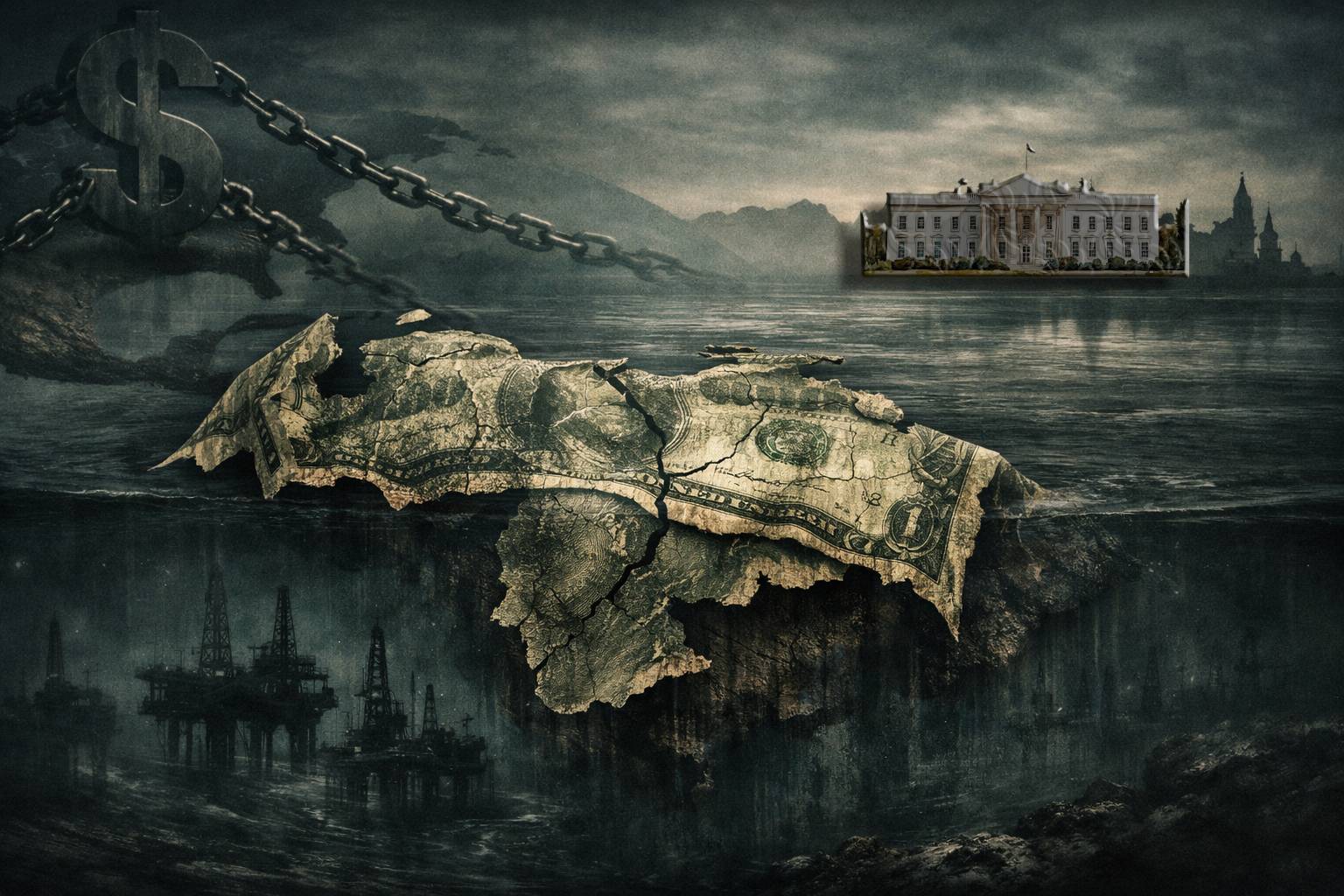
- This was never about oil. Oil could be bought. This is about collateral.
- Venezuela has saved the USD—for now.
- Without Venezuela, USD devaluation or gold revaluation would have been inevitable.
As events in Venezuela unfold, one thing is certain: USD imperialism is back in full force. There is a difference this time. The invasion has no pretences. The gloves are off—no weapons of mass destruction drama, no pointless speeches in the Senate or entertaining TV debates, no involvement of discredited and defunct global bodies like the UN, and most importantly, no so-called consultation with so-called allies, meaning Europe.
From a geopolitical perspective, this is very significant, especially for emerging powers as well as smaller countries across the globe. The geography where this invasion happened and the circumstances leading to it provide multiple inferences.
The reduction of the United States of America from a “sole” superpower status to an “also” power among other powers, notably in Asia, and its emergence as a regional superpower is evident. The signal to its immediate neighbourhood—which includes all of South America, including Brazil, and Canada—is that the USA is the new sheriff in the “region.”
That the USA chose not to engage with discredited bodies such as the UN, which are in fact its own post-WWII creations, indicates a loss of confidence in positioning its view on the world stage. The USA is not in a position to muster this through the UN Security Council, a pointer to the complete breakdown of its foreign policy and its demonstrated inability to influence decisions either by discussion or by coercion.
The complete lack of any consultation with its WWII allies, the Europeans, is a signal of the disdain that the USA holds for Europe, and this justifies the majority opinion the world holds of Europe—as a hypocritical talking shop with no heft. Failed demographics and a sliding economy are hurtling Europe toward chaos.
The broader signal to the world is: welcome to multipolarity. The world is now truly multipolar. It might not be to the liking of one and all, it might be ugly in the short to medium term, but it will be the norm at least for the next three generations to come.
The other powers in this multipolar world will be China, Bharat, and Russia. BRICS may be replaced by URIC in the long run. The invasion is a signal to China, Bharat, and Russia to define their spheres of geographical, political, and most importantly, economic influence. The dirty question is: who takes what? (Why the author is negative on the prospects of Brazil and South Africa would be a digression from the main topic and is therefore avoided here.)
History has a habit of rhyming. About 300 years ago, as the first wave of colonisation in Asia and Africa began, the Christian powers in Europe debated this question among themselves. Now, URIC will debate the same question—unless, of course, it has already been debated and settled.
Historically, US foreign policy is closely linked to its economics. Interventions and invasions have always been part of this policy. Venezuela in 2026 is a gradual continuation, albeit with a difference. The difference is that this time it is not a preventive strike, but one of survival.
The Venezuela invasion is a replica of Panama in 1989—the same pretences, drug mafia narratives, and so on—but the script and the ending are similar. Manuel Noriega was arrested in the same way as Maduro today. He was tried in the USA and continued to serve his sentence in a US prison. Nicolás Maduro will, in all probability, go along the same route. How he personally ends up is not central to the theme.
In 1989, the US secured the Panama Canal, which was being nationalised by the Panamanian government under Manuel Noriega. The USA “appointed” a new Panamanian president who handed over the Panama Canal to US private interests. The last update on the ownership of the Panama Canal is that it is now fully owned by a consortium of US investors led by a very famous holding company.
Iraq was invaded in 1991 to protect the USD, as Saddam Hussein agreed to sell Iraqi oil in local currencies. The war was presented as one against weapons of mass destruction. The charade of European unity and UN voting was achieved easily, as post-Soviet Russia and a pliant China allowed the USA to bulldoze institutions. It must be remembered that in 1991, Russia was still hoping to join NATO.
Libya was bombed and invaded in 2011 by President Obama, for which he was awarded the Nobel Peace Prize. The reason cited was the “protection of civilians in a no-fly zone.” The charade went through the UN and was fully endorsed by the EU. The biggest European cheerleader for this invasion was Angela Merkel, the then German Chancellor.
The fall of Libya led to the mass migration of Middle Eastern refugees into Europe. Angela Merkel took a “moral” position by opening the gates and allowing all immigrants with no background checks. Researchers later pointed out that the real reason Libya was bombed and Gaddafi was killed was because he dreamed of creating an African Economic Union akin to the EU, with a common currency. It was rumoured that he offered to sell Libyan oil to the French denominated in euros. The then-French President Nicolas Sarkozy flirted with this idea.
Had Gaddafi’s dream come to fruition, the exploitation of Africa by Europeans would have ended, and notably African oil (Nigerian, Angolan, and Libyan) would have been sold in currencies other than the USD. It is no coincidence that the only leader of a Western country to be tried and jailed for graft was Nicolas Sarkozy. At the time of writing, he has been “pardoned and released.”
Action in Venezuela has saved the USD from immediate devaluation. In comparison, Libya, Iraq, and Panama were threat-mitigation operations for USD dominance.
To understand this dollar link, a quick primer on USD creation is required.
Since the removal of the gold peg in 1973, the USA has resorted to a standard debt-based currency creation mechanism. Every dollar created is a debt to be serviced by the US Treasury and indirectly by US citizens. The principle is similar to Bharat and many other countries.
What differentiates the USA from the rest of the world is that it is the only country that can create debt/currency and simultaneously export it out of the country, thereby avoiding the inflation normally caused by currency printing.
US debt, due to the usage of the dollar as the reserve currency, is primarily bought by non-American participants such as Japan, China, Saudi Arabia, along with a few large US and European banks.
Once the debt is placed, the USA “imports” manufactured goods from China, talent from across Asia (Indian IT), oil from the Middle East, and everything else from around the world. This means the printed USD leaves the country while creating no domestic inflation.
No other country has this luxury. The USA imported real goods and exported inflation to others. (This should answer those who ask why the West is pollution-free and clean: if everything can be had by printing paper, why manufacture and deal with pollution?) The USA and its allies have financialised their economies. Indian IT success and Chinese manufacturing are both built on freely printed USD.
Returning to Venezuela: today’s USA has been severely constrained by Asian powers, which have effectively blocked its ability to print fresh dollar debt. This should be read twice. The USA did not voluntarily switch off its printing press; it was forced to do so. No drug addict voluntarily goes to rehabilitation.
The first-line sovereign buyers—Japan, China, and Saudi Arabia—are no longer buying US debt. Russians are sanctioned. Bharat, China, and Russia are forcing trading partners to abandon the dollar. The only buyers left are European banks and some large US banks.
For these banks to buy the volumes needed, collateral is required, and collateral is in short supply. Banks pledge assets to the Federal Reserve in exchange for Treasuries, enabling further dollar printing.
Historically, collateral is created through ownership of resource-rich assets in weaker countries. This requires regime change and opaque asset transfers. Russia’s 1990s oligarch episode is a classic example. Putin rose by reversing this process and nationalising assets like Gazprom, making him despised in the West.
Africa remains trapped in this system, explaining its poverty despite its resources. This is the second wave of colonisation—dollar colonisation.
Venezuela fits perfectly into this timeline. Political pressures, midterm elections, economic slowdown, and debt rollover needs converge. About $8 trillion in US debt must be rolled over in 2026. Interest costs are rising. The Ponzi scheme is accelerating.
Without Venezuela, USD devaluation or gold revaluation would have been inevitable. Venezuela postponed that outcome. Drug trafficking was merely a pretext. Regime change enables Venezuelan oil to be booked as collateral. Media narratives followed instantly. Europe applauded. This sets a precedent—for Greenland and beyond.
This was never about oil. Oil could be bought. This is about collateral.
Venezuela has saved the USD—for now. The dollar has mutated into a regional hegemonic currency and will remain dominant for some time.
On a lighter note, a safe bet would be that the next beauty pageant winner will be from Venezuela, thanking Trump for “freeing” the country and praising Ms Machado as her role model.
Mani Bhushan is a Trade & Business Relations Expert. He is a Member of the India Business Forum and an observer of International Relations. Views expressed are the author’s own.
 Faareha Usmani
  Archita Gaur
  Hridbina Chatterjee