
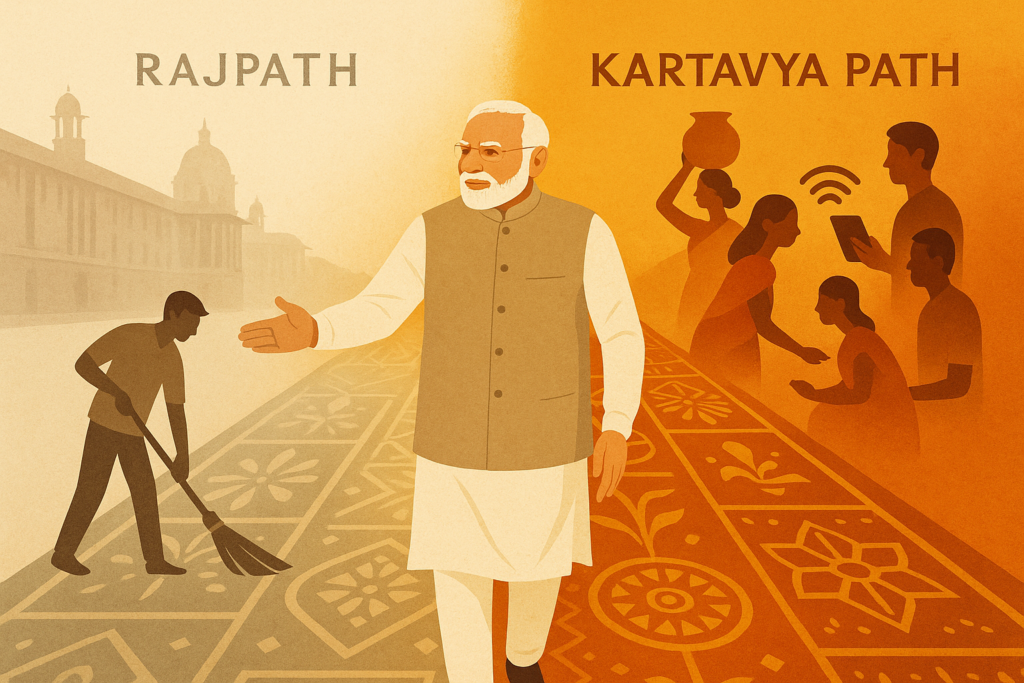
- The renaming of Rajpath to Kartavya Path is perhaps the most direct civilizational statement in post-independence India’s public architecture.
- By constantly invoking India’s ancient wisdom, ethical traditions, and spiritual vocabulary in public governance, PM Modi is attempting to heal the rupture between India’s modern state and its civilizational soul.
- The shift from Rajpath to Kartavya Path represents a decisive symbolic break from colonial glorifications of power, restoring indigenous ethics of service through a civilizational reinterpretation of modern institutions.
In contemporary India, few ideas have been as consistently and powerfully emphasised in political communication as Kartavya (duty) and Seva (service). Under Prime Minister Narendra Modi, these two civilizational concepts have moved from the margins of ethical discourse to the very centre of governance philosophy. From addressing himself publicly as the “Pradhan Sevak” to renaming Rajpath as Kartavya Path and describing the Prime Minister’s Office as a Seva Teerth, Modi has consciously foregrounded duty and service as the moral foundations of public life. This is not merely symbolic politics. It reflects a deeper attempt to re-anchor Indian governance in its civilizational ethos and to challenge the dominance of a rights-centric modern political culture imported through colonial rule and Western modernity. At one level, this project represents an ethical reorientation of state power. At a deeper level, it is part of a broader decolonial civilizational revival.
Kartavya and Seva: Civilizational Meanings
In the Indian civilizational worldview, Kartavya is not a legal obligation imposed by external authority. It is an inner moral responsibility flowing from Dharma. One’s duty arises from one’s location in society, stage of life, role in the community, and relationship with others. The Bhagavad Gita expresses this with exceptional clarity when Krishna tells Arjuna that it is better to perform one’s own duty imperfectly than to imitate another’s duty perfectly. Here, Kartavya is inseparable from the cosmic order (Rita) and social harmony.
Seva, likewise, is not charity in the modern philanthropic sense. It is not transactional. It is an offering. In the Bhakti tradition, Seva is service rendered to God through service to society. The Tirukkural treats service to others as one of the highest human virtues. In Sikh philosophy, Seva is one of the three foundational pillars of spiritual life, along with Naam and Kirat. In each case, service is not secondary to rights or entitlements. It is the core of ethical living.
Together, Kartavya and Seva form a moral ecology where individual freedom is balanced by social responsibility and spiritual humility. This is very different from the modern Western political tradition, which is built fundamentally on the language of rights, contracts, and individual autonomy.
Kartavya and Seva in Ancient Indian Statecraft
India’s classical political thought is firmly rooted in duty-based governance. In the Arthashastra, Kautilya presents the ruler not as a divine monarch but as a trustee of public welfare. The famous injunction that “the happiness of the king lies in the happiness of the subjects” encapsulates the service ethic of governance. The king’s Kartavya is to ensure security, economic prosperity, justice, and moral order. Personal comfort, luxury, and power are subordinated to Rajadharma. The Manusmriti and the Dharmashastra tradition consistently frame governance as duty-bound. The ruler is not above Dharma. He is its instrument. When kings fail in Kartavya, they lose legitimacy. This is a profound idea of moral accountability that predates modern constitutionalism by millennia.
Vidura Niti in the Mahabharata is perhaps the most sophisticated ethical manual for political leadership ever composed. Vidura does not flatter power. He disciplines it. He repeatedly warns Dhritarashtra that power without Dharma leads to ruin. According to Vidura, a true ruler controls his senses, listens to wise counsel, protects the weak, and governs without arrogance. He explicitly states that the king is a servant of the people, not their master. This inversion of power into service is the very essence of Seva-based governance. Even the Ramayana presents kingship as a form of lifelong duty. Rama accepts exile not as a personal tragedy but as the fulfilment of Kartavya. His entire reign as Maryada Purushottama is portrayed as an unbroken chain of service, sacrifice, and moral restraint. Thus, from the Arthashastra to Vidura Niti, from the Gita to the Ramayana, the Indian political imagination is unified by one core idea: rule exists to serve, not to dominate.
By calling himself Pradhan Sevak, he inverted the hierarchy between ruler and ruled. The Prime Minister is not the supreme authority, but the first servant of the nation.
Western Modernity and the Eclipse of Duty
The Western Renaissance, followed by the Enlightenment and modern constitutionalism, radically transformed political thought across the world. These movements introduced revolutionary ideas of individual liberty, equality before the law, human rights, social contracts, and popular sovereignty. These concepts were historically necessary and progressive in their own context, especially against feudal absolutism. However, when this rights-based framework was transplanted into colonised societies through imperial rule, it came detached from indigenous ethical systems. Colonial modernity displaced Kartavya with entitlement. It replaced Seva with bureaucratic distance. The moral language of duty that once bound rulers to people was replaced with procedural authority. Post-independence India adopted a strong rights-based constitutional framework, which was essential to protect diversity and democracy. Yet over time, the culture of rights expanded without a corresponding deepening of duties. Citizenship increasingly came to mean entitlement from the state rather than responsibility towards society. This imbalance gradually produced apathy, civic decay, corruption, and alienation from public institutions. Across South Asia, the results are visible in weak public ethics, normalisation of corruption, declining respect for public property, and a politics often driven solely by grievance and entitlement. The historical severance of rights from duties has hollowed out civic culture.
Modi’s Reintroduction of Kartavya and Seva
It is in this backdrop that Modi’s governance vocabulary marks a decisive departure. From the outset of his prime ministership in 2014, he rejected the traditional symbolism of power. By calling himself Pradhan Sevak, he inverted the hierarchy between ruler and ruled. The Prime Minister is not the supreme authority, but the first servant of the nation. This was not a one-time slogan. It has been a consistent self-description across a decade. The renaming of Rajpath to Kartavya Path is perhaps the most direct civilizational statement in post-independence India’s public architecture. Rajpath symbolised imperial authority and the colonial spectacle of power. Kartavya Path symbolises the ethical burden of responsibility. It tells every citizen and every official that the road to authority runs through duty, not privilege. Similarly, the description of the Prime Minister’s Office as a Seva Teerth is deeply rooted in Indian spiritual imagination. A Teerth is a sacred crossing point between the worldly and the spiritual. By naming a centre of executive power as a site of Seva, Modi symbolically re-sacralizes governance through service. These gestures may appear symbolic, but civilisations are built and reshaped through symbols as much as through laws.
Governance Through Service-Oriented Initiatives
Beyond symbolism, the governance architecture under Modi increasingly reflects the ethic of Seva. Programmes like Swachh Bharat, Jan Dhan Yojana, Ayushman Bharat, Ujjwala, PM Awas Yojana, Jal Jeevan Mission, and Digital India all frame governance as direct service delivery rather than bureaucratic mediation. The state is not presented as a distant authority but as an active Sevak of citizens. Volunteerism and public participation have been actively encouraged through campaigns of cleanliness drives, yoga movements, river rejuvenation, and disaster response. The language of nation-building is repeatedly framed not as a protest against the state but as participation with the state. Even during crises like the COVID-19 pandemic, the Prime Minister consistently invoked collective Kartavya, asking citizens to behave responsibly for the safety of others. The appeal was not only to rights or legal enforcement, but to moral duty.
Beyond symbolism, Modi’s governance architecture increasingly embodies the ethic of Seva, with initiatives such as Swachh Bharat, Jan Dhan, Ayushman Bharat, Ujjwala, PM Awas Yojana, Jal Jeevan Mission, and Digital India recasting the state as a direct provider of service rather than a distant bureaucratic mediator.
Kartavya Before Rights: A Civilizational Reorientation
One of the most important philosophical shifts under Modi is the reassertion that duties precede rights. This does not negate constitutional rights. Rather, it recasts them as flowing from shared responsibility rather than individual demand. In Indian thought, rights are not natural possessions but social trust. A child has rights because parents perform Kartavya. A citizen enjoys freedoms because soldiers perform Kartavya. A democracy survives because voters, officials, judges, and educators perform Kartavya. When duties collapse, rights become hollow claims enforced only by coercion. By placing Kartavya at the centre, Modi’s governance model attempts to reverse decades of moral inversion. The stress is on what citizens give to the nation, not merely what they receive from it. This is not authoritarian moralism. It is civilizational ethics.
Decoloniality and the End of Colonial Mental Slavery
India’s political independence in 1947 did not automatically translate into civilizational decolonisation. Colonial education, governance, legal systems, and elite culture continued to shape Indian self-understanding. Coloniality survived in language, institutions, and even in architecture. The shift from Rajpath to Kartavya Path is one of the clearest symbolic breaks from this inherited mental landscape. It rejects the colonial glorification of power and restores the indigenous ethics of service. This is decoloniality not through rejection of modern institutions, but through civilizational reinterpretation of their moral foundations. By constantly invoking India’s ancient wisdom, ethical traditions, and spiritual vocabulary in public governance, Modi is attempting to heal the rupture between India’s modern state and its civilizational soul.
A Subtle but Profound Message: Kartavya and Seva as the Moral Core of a Civilizational Power
The message embedded in this transformation is both loud and subtle. Loud, because it is publicly articulated through national events, urban redesign, political language, and flagship schemes. Subtle, because many citizens still interpret these changes as mere renaming exercises or image management. In reality, a deep cultural shift is underway. Political culture is gradually moving from entitlement-based mobilisation to service-based legitimacy. Civic culture is slowly being reframed around cleanliness, responsibility, digital participation, and national duty. The very imagination of leadership is being restructured from authority to service. This kind of transformation does not yield immediate results. Civilizational changes unfold over generations. But the direction has clearly been set. Narendra Modi’s elevation of Kartavya and Seva to the centre of governance is not an administrative experiment. It is a civilizational project. By re-rooting the modern Indian state in ancient ethical traditions, he is attempting to restore the moral grammar of public life disrupted by colonial modernity.
In a world exhausted by rights without responsibilities, entitlement without ethics, and power without humility, India’s return to duty and service is not just relevant for itself but offers an alternative moral model for global governance. A civilisation becomes a civilizational power not merely through economic or military strength, but through the ethical coherence of its public life. Kartavya as discipline and Seva as devotion are not relics of the past. They are the foundations of India’s future.

Dr. Nanda Kishor M. S. is an Associate Professor at the Department of Politics and International Studies, Pondicherry University, and former Head of Geopolitics and International Relations at Manipal University. His expertise spans India’s foreign policy, conflict resolution, international law, and national security, with several publications and fellowships from institutions including UNHCR, Brookings, and DAAD. The views expressed are the author’s own.
 Shivendra Shukla
  Archita Gaur
  Anjali Singh