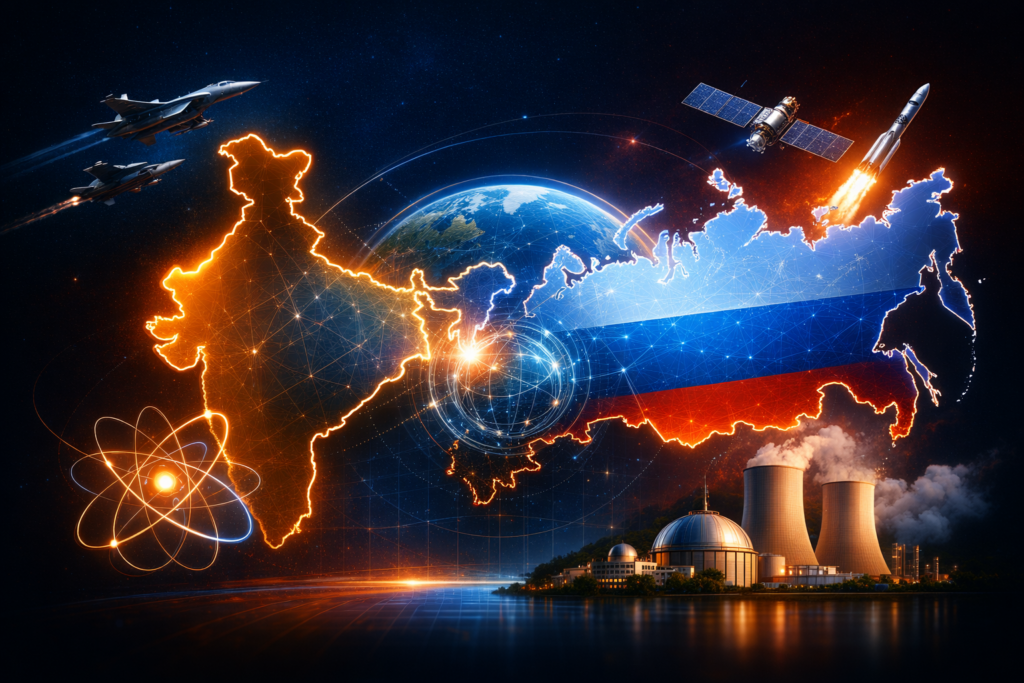
- India and Russia’s “Special and Privileged Strategic Partnership” reflects deep mutual trust, policy alignment on major global and regional issues, and cooperation in defence, nuclear energy, and space.
- Their military-industrial cooperation has shifted from a simple supplier–buyer model to a multidimensional framework involving joint R&D, advanced technology development, licensed production, and co-manufacturing.
- The ‘India–Russia Strategic Area Economic Cooperation Programme for 2030’ seeks to open new channels for bilateral investment and trade and aims for up to $100 billion in annual trade.
- Both countries reaffirm their commitment to multipolarity, sovereignty, national interests, and strategic autonomy, presenting their partnership as a stabilising force in the changing global order.
The India-Russia relationship has a long history of mutual trust, deeply rooted in military cooperation that began in the mid-20th century. In October 2000, the two countries formally institutionalised their bilateral ties through the signing of the “Declaration on the India-Russia Strategic Partnership.” In December 2010, Russian President Dmitry Medvedev of Russia paid an official visit to India, during which the partnership was upgraded and formally recognised as the “Special and Privileged Strategic Partnership”, reflecting the enhanced depth, continuity and strategic importance of bilateral relations.
This designation marks an extraordinary degree of mutual trust between both nations, aligns their policy outlooks on many of the world’s most pressing global and regional issues, and highlights a shared commitment to cooperate across critical sectors such as defence, nuclear energy, and outer space, areas typically reserved for close strategic rather than routine collaborators. The creation of an institutional and comprehensive establishment of comprehensive framework for cooperation through the annual head-of-state summits between both countries demonstrates a sustained and high-level political will to continuously strengthen this relationship, irrespective of shifting global alignments, evolving power balances, and the broader transformation of the global order.
Core Pillar: Defence and Military-Technical Cooperation
Traditionally, the military-industrial sector has been a key foundation for Russia and India’s strategic alliance. Currently, Russia remains among the largest and most critical suppliers of defence equipment to India. The working relationship forged and sustained between Russia and India in the defence sector has evolved from a conventional arms supplier-recepient dynamic into a multidimensional partnership encompassing joint research, advanced technology development, licensed production, and co-manufacturing, particularly under the Make in India initiative, aimed at strengthening indigenous defence capabilities and industrial self-reliance.
Next Generation Collaboration
During their recent 23rd Annual Summit, India and Russia reaffirmed and deepened the current trajectory of their relationship by focusing specifically on the strategic necessity of domestic production of spare parts and components for Russian-origin weapon systems. A landmark development preceding and shaping the summit was the formal ratification, just before the meeting of the RELOS (Reciprocal Exchange of Logistics Support) Agreement. This agreement provides reciprocal access for the armed services of both countries to each other’s bases and ports for refuelling, maintenance, repair and broader logistical support, and significantly enhances operational interoperability, enabling both the Indian Navy and the Indian Air Force to expand and sustain power projection capabilities across the Indo-Pacific Ocean Region, the Arctic Region, and the Eurasian Region. The cooperation on advanced technologies such as the BrahMos cruise missiles continues to serve as an exemplary model of the defensive partnership between the two nations.
Economic Cooperation and Vision 2030
While defence and energy have traditionally dominated the economic profile, the latest summit marked a decisive shift toward broad-based economic diversification, with a strong emphasis on expanding non-traditional sectors, deepening private-sector engagement, and achieving ambitious long-term bilateral trade targets under the Vision 2030 framework.
Program For Economic Cooperation Till 2030
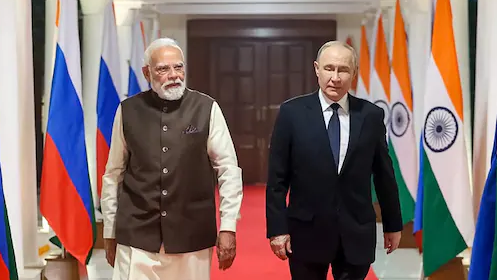
A significant event that occurred at the December 2025 summit was the formal adoption and the launch of the ‘India – Russia Strategic Area Economic Cooperation Programme for 2030.’ The main goals of this programme’s comprehensive road map are to generate new and expanded avenues for bilateral investment and trade, strengthen long-term economic interdependence, and facilitate the achievement of an ambitious annual bilateral trade target of up to $100 billion in the coming years.
Key Areas of Focus
Russia will continue to be a reliable supplier of oil, gas, and coal. The two sides also discussed extending their civil nuclear cooperation by accelerating work on the Kudankulam Nuclear Power Plant and by exploring additional areas of collaboration on Small Modular Reactors (SMRs).
Both sides agreed to strengthen cooperation in non-traditional sectors, including Agriculture, pharmaceuticals, information technology (IT) and critical minerals. This also includes the signing of a Memorandum of Understanding (MoU) to supply long-term fertilisers to India, which will enhance India’s food security goals.
The two countries agreed to work on major connectivity corridor projects, particularly through the International North-South Transport Corridor (INSTC) and the Chennai-Vladivostok Maritime Corridor, to facilitate trade, enhance the movement of goods and reduce supply chain delays. In addition, both sides agreed to train Indian sailors to operate in Polar waters and enhance Arctic cooperation between India and Russia.
National Currencies and Free Trade
To help address persistent trade settlement challenges arising from the evolving geopolitical environment, the leaders agreed to deepen their cooperation regarding the use of national currencies for bilateral trade (the Indian Rupee and the Russian Rouble). Additionally, the two sides agreed to accelerate the Negotiations for a Free Trade Agreement (FTA) with the Eurasian Economic Union (EAEU), which would allow substantially enhanced market access for India’s exports.
Science, Technology, and People-to-People Ties
The partnership retains a “Privileged” character because of the broad level of cooperation between the two nations across both high-tech and non-traditional areas, thereby giving the relationship a distinctly people-centric focus anchored in long-term societal engagement. Both nations will continue to collaborate on space exploration, including the Indian Human Spaceflight Program, and further expand the peaceful use of atomic energy beyond power generation into important domains such as medicine and agriculture.
The summit also provided an opportunity for both nations to sign agreements on healthcare, medical education and food safety, including between FSSAI and Russia’s Ministry of Consumer Protection; additionally, new agreements were signed to assist in the process of migration and mobility of their respective citizens, primarily Indian professionals and students. Both countries also plan to streamline existing visa processes through new facilitative mechanisms, such as the introduction of a free 30-day electronic tourist visa for Russian citizens, and to promote expanded and structured cooperation and exchange in cultural, media and educational fields, thereby solidifying the shared cultural ties between them.
Strategic and Global Convergence
The strategic partnership continues to remain vital to New Delhi and Moscow on the global stage. Russia has consistently reaffirmed its support for India’s efforts to obtain a permanent seat at the UN Security Council (UNSC), and both countries maintain close coordination and policy alignment through key multilateral platforms, including BRICS, the SCO, the G20 and RIC (Russia, India and China), thereby reinforcing their shared interests in shaping global governance structures.
In addition to adopting an agenda focused on addressing major global issues, such as the fight against terrorism and the growing threat of transnational organised crime, the leaders at the summit reiterated their mutual commitment to the creation of a multipolar world and to the principle of mutual respect for sovereignty, national interests and the strategic autonomy of both countries. Additionally, this partnership increasingly functions as a strategic stabiliser and counterweight amid the rising complexity of the global order, particularly for India, and will continue to serve as a core pillar of India’s foreign policy strategy to protect, preserve and expand its strategic autonomy.
The outcomes of the 23rd Annual India-Russia Summit illustrated the strength and depth of the Special and Privileged Strategic Partnership between the two nations. The expansion of partnerships beyond the traditional pillars of defence and energy into emerging and strategically significant domains such as logistics, agriculture, connectivity, and critical minerals coupled with an ambitious Economic Vision to be achieved by 2030, demonstrates that both countries are committed to not only preserving but actively deepening the relationship they have built over time and which has continued to remain one of India’s most durable, resilient, and trusted Strategic Alliances.

Hridbina Chatterjee is a final-year postgraduate student in International Relations at Jadavpur University, Kolkata. She has written for newspapers and think tanks, with interests in South Asian politics, India’s foreign policy, and the Indo-Pacific. Views expressed are the author’s own.
 Aayush Pal
  Anusreeta Dutta
  Archita Gaur