
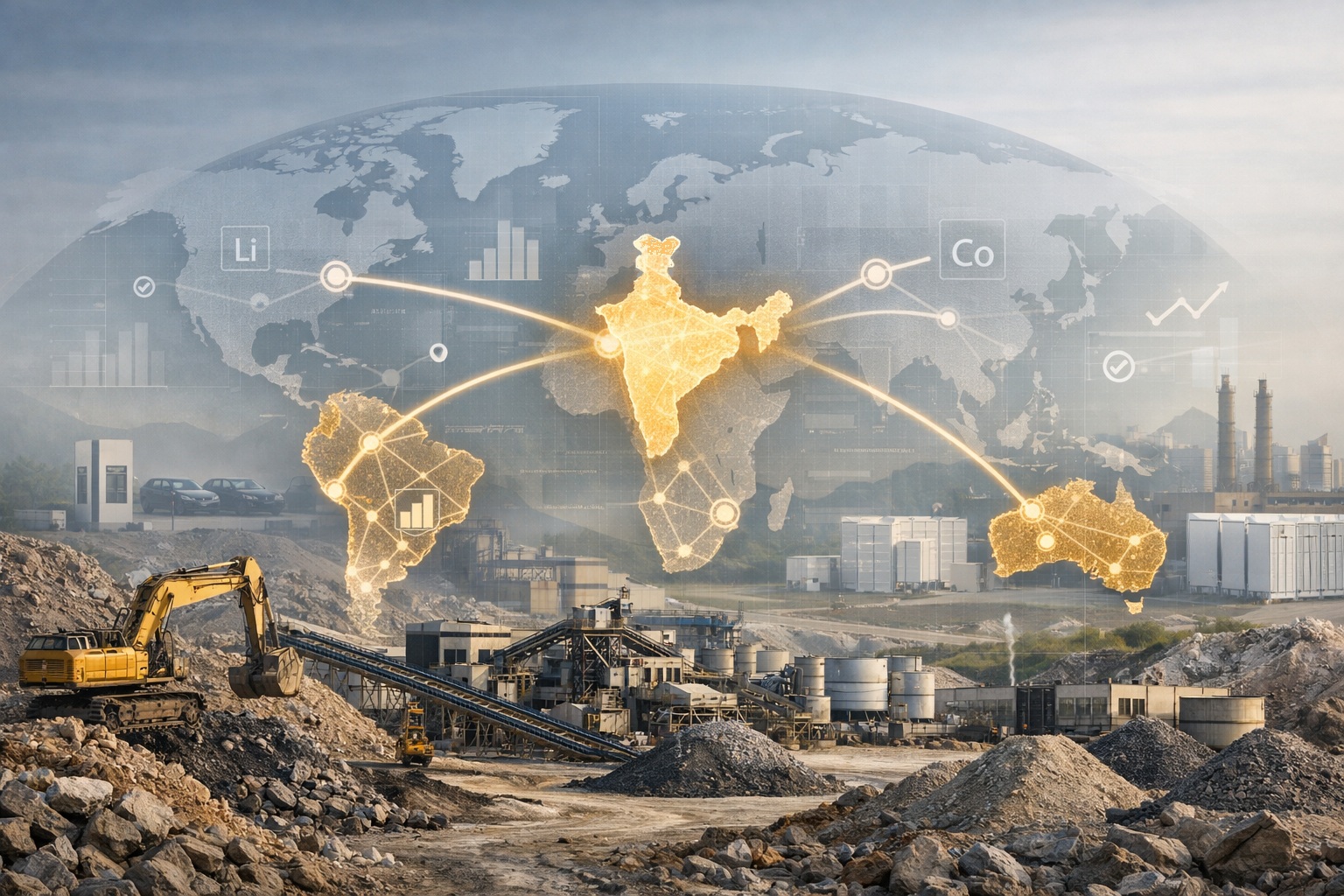
- As the world pushes toward net-zero targets, the concentration of critical minerals resources has created a geopolitical “chokepoint” that Western powers and their allies are now moving to dismantle.
- Presently, China refines more than half of both cobalt and lithium, allowing China to hold a critical “middle-man” position viewed by Western nations as a strategic risk.
- In January 2025, India launched its National Critical Mineral Mission (NCMM), which will work with the MSP’s commitments to secure the 30 Critical Minerals needed by India to support its ‘Make in India’ and Electric Vehicle (EV) industries.
- Critical mineral diplomacy is changing its focus from being primarily the procurement of minerals, by way of physical extraction, to also being about creating an environment of trust among nations.
In 2025, the global race for “green gold”—the critical minerals, such as lithium and cobalt, essential for the energy transition—has shifted beyond simple economics into the realm of high-stakes national security. As the world pushes toward net-zero targets, the concentration of these resources has created a geopolitical “chokepoint” that Western powers and their allies are now moving to dismantle. Central to this strategy is the Minerals Security Partnership (MSP), a US-led multilateral alliance that has redefined critical mineral diplomacy from a mere procurement exercise into a strategic “friend-shoring” firewall.
The Geopolitical Urgency: Lithium and Cobalt
Global demand for lithium and cobalt is driven by the shift to electric vehicles (EVs) and the growing need for large-scale battery storage. Lithium, frequently referred to as “white oil,” serves as the foundation for nearly all of today’s battery chemistries; cobalt is a critical component in high-performance batteries to provide thermal stability and density.
Yet, the supply chains for lithium and cobalt are extremely fragile. As of late 2024 and into 2025, about 70% of the world’s cobalt still comes from the Democratic Republic of Congo (DRC), while lithium production is dominated by the South American “Lithium Triangle” and Australia. However, the main strategic issue is not necessarily extraction but refining. Presently, China refines more than half of both cobalt and lithium, allowing China to hold a critical “middle-man” position viewed by Western nations as a strategic risk.
The Minerals Security Partnership (MSP): A Diplomatic Shield
The Minerals Supply Partnership (MSP), formed in 2022 and rapidly growing through 2025, now includes 14 member countries, as well as the European Union. The countries represented include Canada, the U.S., Australia, Japan, and India. Rather than functioning like traditional trade blocs focused on eliminating tariffs and restrictions, the MSP serves more as a “club” focused on “financing” and setting globally relevant minimum requirements for how to responsibly produce, process, and recycle critical minerals in an environmentally and socially responsible manner (ESG) in contrast to the very poor safety and environmental practices associated with her competitors’ mining operations and supply chains.
1. From Extraction to “Value Addition”
The MSP has also begun shifting away from the colonial historical model of treating the countries of Africa and South America, rich with critical minerals, as nothing more than exporters of raw resources. In 2025, this shift was formalised through the establishment of the MSP Forum, a sub-committee of the MSP focusing on “value-addition” in the host countries, instead of simply extracting metals. Through partnerships with governments in Zambia, Namibia and Argentina, the MSP is positioned to offer truly value-added opportunities rather than simply extraction. These strategies allow the MSP to effectively compete with the “infrastructure-for-minerals” packages offered by China as part of the Belt and Road Initiative.
2. The Mineral Security Finance Network (MSFN)
In recognition of the hesitance of private capital to invest in many mining jurisdictions associated with high-risk, the MSP established the Minerals Security Finance Network (MSFN). The MSFN serves as a conduit between Development Finance Institutions (DFIs) and Export Credit Agencies (ECAs). In 2025, the MSFN will be transformed into multi-billion dollar guarantees to assist in funding initiatives such as the Lobito Corridor, a project designed to facilitate the transportation of mineral resources from the Democratic Republic of Congo (DRC) and Zambia to the Atlantic Ocean by avoiding the Eastern world.
India’s Strategic Pivot
India’s participation in the MSP is an important part of the modern form of mineral diplomacy. As the only large developing country in the MSP, India plays a role as an intermediary between the Global North and the Global South. In January 2025, India launched its National Critical Mineral Mission (NCMM), which will work with the MSP’s commitments to secure the 30 Critical Minerals needed by India to support its ‘Make in India’ and Electric Vehicle (EV) industries.
As a member of the MSP, India will have access to advanced exploration technology and will have an opportunity to be part of the global decision-making process regarding investments. Access to this will be vital to India achieving its goal of reducing its 100% dependence on the importation of certain lithium and cobalt materials, and to achieve this goal, India will be acquiring assets in Australia and South America through its state-owned enterprise, KABIL.
Contemporary Challenges: Volatility and Protectionism
Despite the diplomatic momentum, 2025 has highlighted significant hurdles:
Price Volatility: Earlier in 2025, due to structural oversupply within the cobalt market, many exports from the Democratic Republic of the Congo (DRC) have been banned so as to assist with price controls. The current volatility in the cobalt market will create challen
ges in planning investments for the long-term through Multi-Stakeholder Partnerships (MSPs).
Resource Nationalism: Countries throughout South America, particularly those rich in lithium resources, are now leaning toward the implementation of nationalisation and the establishment of “lithium cartels.” Similarly, MSPs are faced with the need to navigate the complex and sensitive political realities created by sovereign sensitivities while not appearing to be neo-colonial.
ESG Transparency: Although MSPs advocate for high standards, achieving high standards for “clean” cobalt remains unattainable due to ongoing issues associated with small-scale production. The current use of battery “passports” employing blockchain technology for tracking the source of minerals is a work in progress.
The Road Ahead
Critical mineral diplomacy is changing its focus from being primarily the procurement of minerals, by way of physical extraction, to also being about creating an environment of trust among nations. The Mineral Security Partnership approach is evolving away from the idea of globalisation in favour of a model based around regionalisation (i.e. the development of regional mineral supply chains). The objectives of regionalising the supply chains for lithium and cobalt will be to ensure that the implementation of cleaner forms of energy does not create a new dependency on mineral processing from countries in East Asia in place of the existing dependence on fossil fuels sourced from the Middle East.
As we look forward towards 2026 and beyond, it will be the evaluation of the success of the MSP by evaluating the ability of the MSP to not only secure sufficient quantities of the various minerals but also to create and sustain an ethical, multi-dimensional, transparent, and diversified supply chain through which the capacity of that supply chain to withstand geopolitical pressures in the 21st Century can be assessed.
References:
- Official Link: state.gov/minerals-security-partnership
- Official Link: state.gov/strategic-partnership-agreement-drc
- Official Link: mofa.go.kr/eng/msp-principals-meeting-2025
- Official Link: pib.gov.in/PressReleasePage.aspx?PRID=2120525
- Official Link: iea.org/policies/national-critical-mineral-mission-india
- Official Link: iied.org/who-will-benefit-lobito-corridor-revamp
- Official Link: cobaltinstitute.org/market-report-2024
- Official Link: iea.org/reports/global-critical-minerals-outlook-2025

Hridbina Chatterjee is a final-year postgraduate student in International Relations at Jadavpur University, Kolkata. She has written for newspapers and think tanks, with interests in South Asian politics, India’s foreign policy, and the Indo-Pacific. Views expressed are the author’s own.
 Archita Gaur
  Divyanka Tandon