- The rollout of the election process for the 10th UN Secretary-General (SG) holds great significance at the historic milestone of the UN@80.
- Noting with regret that no woman has ever held the position of Secretary General, encourages Member States to strongly consider nominating women as candidates.
- It will not be easy for the successor 10th UNSG to step into the formidable shoes of the 9th UNSG Guterres.
- Notwithstanding all the UN-bashing and personal targeting, the UNSG, as a diplomat par excellence, keeps reminding the UN all the Member States that there is no substitute for the world organisation.
I. INTRODUCTION
As the world ushers into 2026 with a great hope for the humankind, the issuance of the November 25, 2025 joint letter by the Presidents of the United Nations (UN) General Assembly (GA) Annalena Baerbock and the Security Council (SC) Michael Imran Kanu, has triggered the crucial election process for the chief administrative officer of the world organization set up for the “peoples of the United Nations”. The joint letter (November 25, 2025) of the two crucial UN organs took shape after unprecedented consultations, contributions and back-room moves. The rollout of the election process for the 10th UN Secretary-General (SG) holds great significance at the historic milestone of the UN@80 (Samvad; October 22, 2025). The first nomination was quickly made by Argentina as it nominated (November 26, 2025) senior diplomat Rafael Mariano Grossi, currently serving as the Director-General of the International Atomic Energy Agency (Vienna).
With 2026 UN budget (Revised Estimates) is slated at US$3.24 billion, funds 11,594 posts. There is an 18.8 per cent cut compared with 2025 for 13,809 posts (10,667 regular posts plus 3,142 special political mission posts). In the coming year of 2026, the UN literally faces “race to bankruptcy” (UN News; October 17, 2025) in view of the refusal by some countries to provide their contributions based on the UN scale of assessments. By September 2025, only 136 of the 193 Member States had paid their assessments in full. Several contributors, including the United States, China, Russia and Mexico, had yet to complete their payments.
In his 2025 UNSG report “For Humanity”, the UNSG spoke upfront on the “year of headwinds and hope for humanity”. Notwithstanding this, before closure of 2025, two good news came: (i) the UNGA approved (December 30, 2025) for 2026 a US$3.45 Billion regular UN Budget (though as of January 01, 2026, in a major cost-cutting exercise, some 2,900 positions will be abolished); and (ii) the United States reached an MoU (December 29, 2025) in Geneva with the UN Emergency Relief Coordinator Tom Fletcher to provide US$ 2 Billion in humanitarian assistance for relief programs especially for the 17 crisis affected countries. This special US gesture gives a big boost to the UN’s 2026 plan to reach 87 million people with emergency relief and assistance.
II. THE UN CHARTER TEMPLATE
The UN remains the preeminent general political organisation of 193 sovereign States. Hence, the “highest standards of efficiency, competence, and integrity” are required from the chief administrative officer of the UN dedicated to the maintenance of international peace and security. The UNSG heads the UN Secretariat, comprising staff in its offices located in cities of Bonn, Geneva, Vienna, Nairobi and New York, apart from the regional offices and resident missions in almost all the UN Member States.
Article 97 of the UN Charter provides: “The Secretary-General shall be appointed by the General Assembly upon the recommendation of the Security Council”. Traditionally, the selection process for the UNSG was opaque, mysterious and mainly controlled by the five permanent members (P5). Now the UNGA has asserted its role as reflected in the November 25, 2025, joint letter. As a result, the joint letter by the Presidents of the UNGA and UNSC augers well as it reflects both the political organs of the UN spearheading the UNSG election/selection process. It entails the following specifics:
- (a) The selection process should be formally initiated in the last quarter of the year preceding the end of the incumbent’s term through a joint letter of the President of the General Assembly and the President of the Security Council addressed to Member States, announcing the start of the selection process and inviting candidates to be presented, after which nominations of candidates are expected;
- (b) The joint letter should invite nominations from Member States and outline the principles of the selection process and notional events, inviting the nomination of candidates;
- (c) Noting with regret that no woman has ever held the position of Secretary General, encourages Member States to strongly consider nominating women as candidates;
- (d) The candidates should be nominated by one Member State or by a group of Member States; each Member State may nominate only one candidate, individually or jointly with other Member States;
- (e) The President of the General Assembly and the President of the Security Council will jointly inform Member States as candidatures are being submitted.
Thus, the UNGA resolution 79/327 of September 5, 2025, has provided a detailed guideline to bring about transparency in the matter and called for “enhanced coordination”, “strengthened transparency and interaction”, and “selection and appointment of the Secretary-General” between the GA and the SC. There have been efforts in the past to provide written guidelines on the selection process through non-papers. Moreover, since the election process for the 9th UNSG (2016), the UNGA conducted so-called “hearings” for all the candidates in informal dialogue sessions wherein, after presenting their ‘vision statement’, they would answer recorded pre-selected questions from the Civil Society. It remains to be seen if the UNGA follows this practice.
As ordained in the resolution 79/327, the UNGA has spelt out the process, starting with the 80th session (2025-26), for the election of the 10th UNSG. While inviting nominations, the UNGA has flagged the gender dimension and encouraged Member States to “strongly consider nominating women as candidates”, especially since no woman has ever led the UN in the last 80 years. It remains to be seen if the UN Member States, especially the P5, consider it overdue for choosing the successor to Antonio Guterres to be addressed as “Madam Secretary-General.” The process laid down comprises Presidents of the UNGA and the UNSC “jointly” informing all the Member States of nominated candidates along with their vision statements, sources of funding and maintaining a public list of candidates on the UN website. The entire process is expected to last till formal consideration of candidates in the middle of 2026, consultations, and final determination of the selected candidate in the last quarter of 2026. This will make it possible for the SG-designate to assume charge on January 01, 2027.
The proverbial ‘UN System’ (December 31, 2025) comprises over 100 bodies and organisations, including some 30 agencies, funds, commissions and programs. The prevailing situation is grim, wherein 2 billion people (out of a total of 8 billion) live in the world’s conflict zones (SIS Blog: Jan. 23, 2025). Yet the UN can provide material assistance to millions of people by spending over $60 billion (SG Report 2024: Resolve). The 2025 UNSG Report has listed the expenses (total $14.7 billion) incurred by the UN. It comprises peace and security ($7.1 billion); drug control, crime prevention and combating terrorism ($544 million), promotion and protection of human rights ($476 million); promotion of justice and international law ($195 million); development in Africa ($133 million); and disarmament ($46 million). The entire UN system-wide expenses stood at $69 billion (including the specialised agencies, funds and programs).
III. ROLE OF THE UNSG: A VISIONARY CONSCIENCE KEEPER
The Preparatory Commission for negotiating the 1945 UN Charter had sought to endow the Secretary-General with “a quite special right which goes beyond any power previously accorded to the head of an international organisation.” As a result, the Charter underscores the inherent strength and expresses the constitutional position of the UNSG as the preeminent international political organisation of the sovereign states.
The UNSG carries out the herculean task of providing regular briefings, statements and reports on the work of the organisation as well as on specific requests and mandates given by the UNSC, UNGA and the ECOSOC. They provide mandates, authorisations and requests to trigger processes to provide updates that have become a stuff of legends. There are ‘statements’ issued by the UNSG or (on his/her behalf) by the spokesperson. The quantum of these finely crafted, nuanced and to-the-point statements is staggering. During January 3 to October 4, 2024, alone, the UNSG’s statements reached the figure of 298. As of December 29, 2025, the total number of statements of the UNSG stood at 16,333.
When UNSG Guterres walks into the hallowed chamber of the UNSC or the UNGA, his whole lifetime experience as a statesman walks with him. The crisp statements, laden with facts, figures and marshalling of data as well as authentic updates from the ground speak for themselves. We have not seen in recent decades a UNSG speaking with such authenticity, sincerity, candour, power of language, facial expressions and sheer force of personality. It will not be easy for the successor 10th UNSG to step into the formidable shoes of the 9th UNSG Guterres.
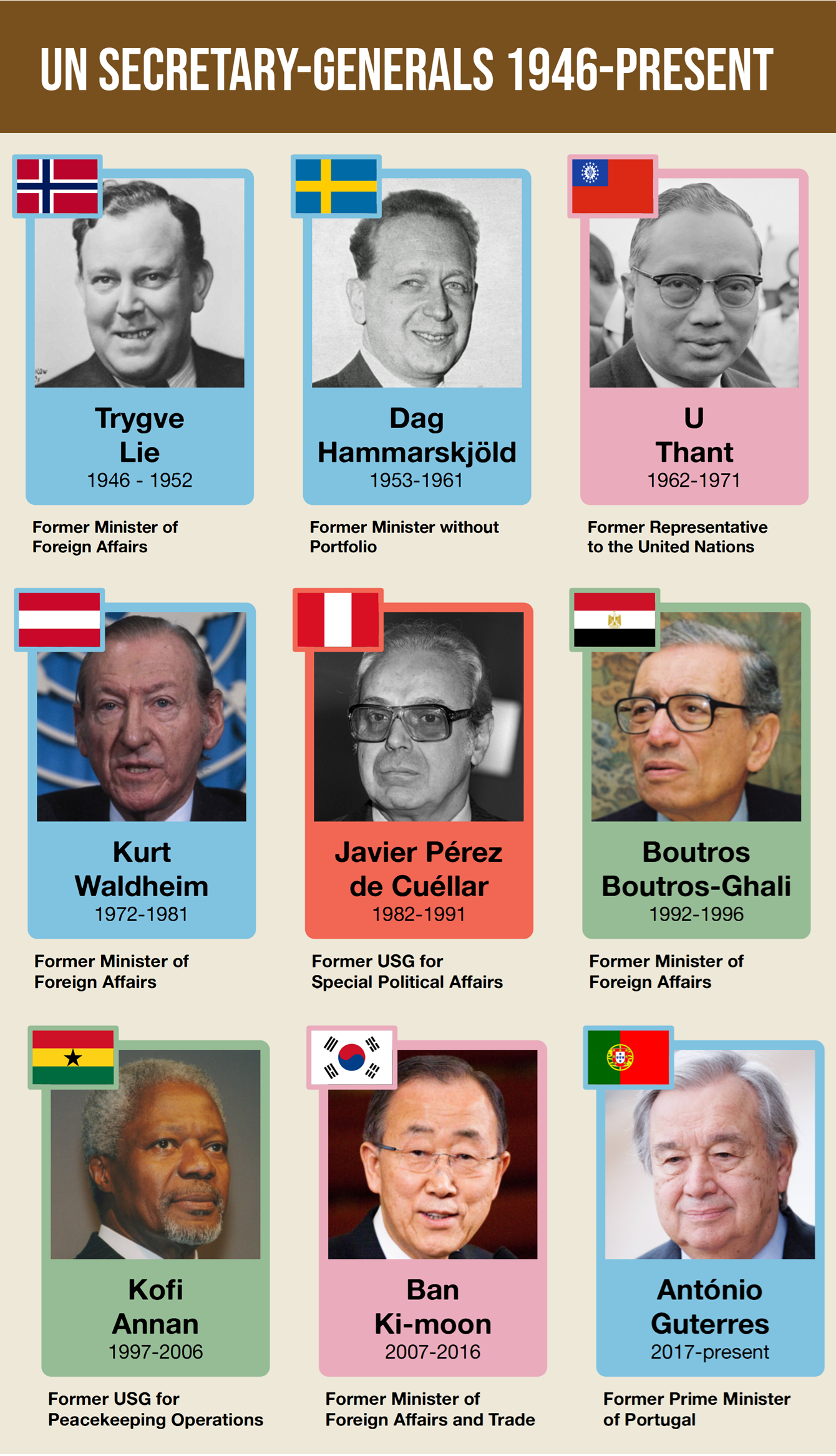
The UNSG conveys non-partisan concern for the escalating ground situation in different parts of the world. “The people of the world are looking to us – and succeeding generations will look back on us. Let them find us on the side of the United Nations Charter…and on the right side of history”, Guterres prophetically said. This sums up the challenge for the 10th UNSG to lead from the front to take the UN to greater heights for its “peoples”. Since January 01, 2017, as the 9th occupant of the post of the UNSG [previous UNSG were: Ban Ki-moon, Republic of Korea (2007-2016); Kofi Annan, Ghana (1997-2006); Boutros Boutros Ghali, Egypt (1992-1996); Javier Pèrez de Cuèllar, Peru (1982-1991); Kurt Waldheim, Austria (1972-1981); U Thant, Burma (1961-1971); Dag Hammarskjöld, Sweden (1953-61); Trygve Lie (Norway (1946-1952)], Antonio Guterres has left an indelible imprint on the organization wherein he has played the role of an elder stateman, a whistle-blower, a guide, a trouble-shooter and a messenger of peace. When Antonio Guterres speaks, as expected of an ace international civil servant, his words ring loud and clear.
The founders of the UN Charter envisaged the role of the ‘secretariat’ (Chapter XV; Articles 97-101), a fulcrum around which the entire edifice of the organisation would revolve. During the last 9 years (since January 2017) as the head of the UN Secretariat, Guterres has been a trailblazer and sought to walk the talk as the principal liaison officer for all the main organs of the UN. Invoking a series of instrumentalities of annual reports, special reports, periodic updates, briefings, statements and as the most visible face of the UN, the SG (along with his team) does the fire-fighting all the time on literally any issue ‘under the sun’. It is the briefings and reports on the ground situation provided by the UNSG that enable the UNSC to provide authorizations (drawing mandates from Chapter VI and VII of the Charter) for the UN Peacekeeping Missions (Author: SIS Blog, September 18, 2024) as well as perform onerous tasks in making available crucial humanitarian assistance (Author: SIS Blog, August 23, 2022) wherever possible in situations of conflicts, misery, mass violence, hunger, droughts, disasters, displacements etc.
If the UNSG is strong enough (like Antonio Guterres), actively seeks to carry out the Charter mandate in letter and spirit (like Dag Hammarskjöld) or even tries to make the UN stronger with radical ideas and proposals (like Butros Butros-Ghali), they are not spared. It seems the rule is: the stronger the Secretary-General, the greater the attack and the outburst! Similarly, for proposing An Agenda for Peace (1992), Boutros-Ghali, a Professor of International Law, was not forgiven by the powerful actors. As a result, Boutros-Ghali remains the only UNSG who was not given a second term. Though very mild-mannered, even Kofi Annan was not spared. Yet the shoulders of the UNSG must be broad enough to receive all the brick backs, and the sheer weight of the office of the UNSG is beyond slights or insults (in the epic Mahabharata, as the Peace Envoy Lord Krishna tells the renegade Kaurava Prince Duryodhana).
All the UNSGs who took their task seriously had to face this professional hazard from ill-tempered heads of government or their representatives. The UN history is replete with stories of such mercurial people. To control the damage, in the wake of a discussion on the situation in the Middle East on October 3, 2024, however, the 15-member UNSC promptly issued a joint statement chiding the State of Israel for a personalised attack on the UNSG. Expressing its full support for the UNSG, the Council said, “any decision not to engage with the U.N. Secretary-General or the United Nations is counterproductive.” Thus, all UN member countries need to exercise restraint and sobriety in consonance with the highest standards of diplomatic etiquette so as not to shoot the messenger but to pay heed to the UNSG’s words of wisdom, concern, sobriety and empathy.
IV. INVOCATION OF ARTICLE 99
The UNSG has drawn power and competence scattered throughout the Charter. The UNSG can invoke ‘implied powers’ (Rahmatullah Khan, Implied Powers of the United Nations: Vikas, 1970), hidden in the Charter. However, the 9th UNSG took an unprecedented step by invoking power expressly contained in Article 99 by sending a December 6, 2023, letter to the President of the UNSC. This audacious letter invoked Article 99 (Chapter XV), a rarely used Charter provision. Under the extraordinary power of Article 99, the UNSG can “bring to the attention of the Security Council any matter which in his opinion may threaten the maintenance of international peace and security”, including appalling conditions of human suffering, physical destruction and collective trauma in any of the UN Member States.
In fact, Article 99 has been regarded as the “most powerful tool” in the arsenal of the UNSG. Since taking office in 2017, it was used for the first time by the 9th UNSG. “I think it’s (Article 99) arguably the most important invocation“, Mr Dujarric told reporters at UN Headquarters, “in my opinion, the most powerful tool that he [the Secretary-General] has.” The nuanced tone and tenor of the graphic letter appeared to sensitise the numbed senses of the 15 members of the UNSC, including the veto-wielding P5 (China, France, the Russian Federation, the UK and the USA). Making the warring parties adhere to the sanctity of International Humanitarian Law has been one of the biggest challenges faced by the UN since its principal ‘enforcement’ organ – UNSC – often remains paralysed due to lack of unanimity among the P5.
V. CONCLUSION: PROSPECTS
For his second term (2022-2026), Antonio Guterres stated, in his 2021 Vision: Restoring Trust and Inspiring Hope (as a candidate), without mincing words as follows: “The Charter perseveres even in the face of profound transformation. Its purposes, principles and provisions epitomise all that we stand for and guide all that we do”. As the 9th UNSG Guterres enters the final year (2017-2026) of the most difficult job in the world, when the UN has also attained the historic milestone of 80 years (1945-2025), everyone knows too well that we have only one UN. Having failed within 20 years (1919-1939), when the Second World War broke out, the League of Nations (emanating from the great peacemaking at the 1919 Treaty of Versailles), provided us “vital lessons to reaffirm the resolve to work for realization of the idealism to eliminate war as an appalling evil.” (Author: “On the Century of Peacemaking at the 1919 Treaty of Versailles: Looking Back to Look Ahead,” International Studies 57(3) 2020 (201–222) at 216). Thus, the advent of the UN became a necessity at the time, to build a new world organisation on the ashes of the League of Nations, to eliminate war as a ‘scourge’ (Preamble to the UN Charter: “to save succeeding generations from the scourge of war, which twice in our lifetime has brought untold sorrow to mankind”). Hence, notwithstanding all the UN-bashing and personal targeting, the UNSG, as a diplomat par excellence, keeps reminding the UN all the Member States that there is no substitute for the world organisation. Pending revitalization of the UN to address the “21st century challenges” (UNSG, Summit of the Future, New York; September 22, 2024), we need to cherish and value the stellar role ‘ordained’ for the UNSG in espousing and symbolizing ideals of the UN and serving as a custodian of the interests of the “peoples of the UN.”
“The people of the world are looking to us – and succeeding generations will look back on us. Let them find us on the side of the United Nations Charter…on the side of our shared values and principles…and on the right side of history”, the 9th UNSG prophetically said (79th UNGA, Sept. 2024). Since there is no alternative to peace, as it came out during the UNSC Open Debate (December 15, 2025) on “Leadership for Peace”, the 10th UNSG would need to navigate today’s global challenges and lead the UN into the future. Hence, it calls for a stellar person with a futuristic vision to become the 10th UNSG, as a worthy successor to the 9th UNSG Guterres. The year 2026 is all set to be most consequential for the election/selection of the 10th UNSG, not only for the future of the UN but also for securing the future of humankind and the planet Earth in this Digital Era of the 21st Century with all its consequential challenges.
****
Humboldt Awardee Professor, Institute of International Law, University of Bonn; Visiting Professor, Faculty of Law, University of Cologne, Germany; formerly Chairperson and Professor of International Law at Jawaharlal Nehru University, India. Email: bharat.intlaw@gmail.com
 Parag Gilada
  Aayush Pal