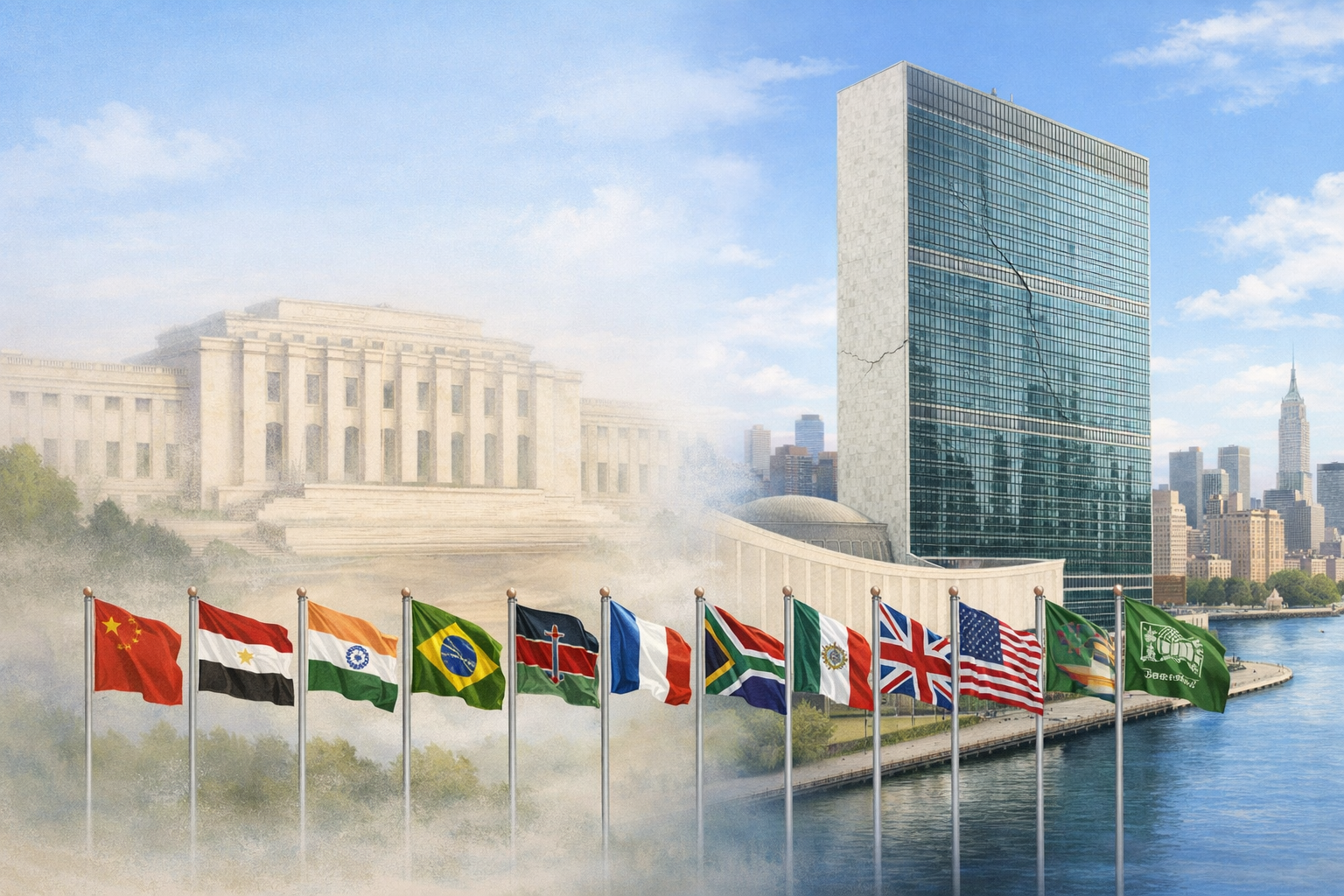
- The United Nations was created to prevent war, yet it now often appears helpless in stopping it.
- When a crisis affects Europe or the West, it is immediately framed as a global problem. The world is expected to take sides, impose sanctions, and make sacrifices.
- History shows that when institutions fail, power replaces principle, and humanity pays the price.
The failure of the League of Nations was not just an institutional failure. It pushed the world toward another massive disaster, the Second World War. Today, many developments suggest that the United Nations may be moving toward a similar moral and political collapse.
Recent global events have made this concern unavoidable. Developments involving Venezuela, rising tensions with Iran, and open statements about territorial ambitions over Greenland have shaken the foundations of the international system. These are not isolated incidents. Together, they force the world to ask a serious question: Is there still a rules-based international order, or is it applied only when it suits powerful Western nations?
After the First World War, humanity promised itself that such destruction would never happen again. The League of Nations was created to replace war with dialogue and power with responsibility. But that promise failed. Powerful nations followed rules only when it suited them. When their interests were threatened, the rules were ignored. The result was chaos and another world war.
After the Second World War, the United Nations was formed with stronger ideals. Peace, sovereignty, human rights, and international law became the pillars of the new global order. For decades, the UN symbolised restraint and cooperation. But today, more than eighty years later, that credibility is under serious stress.
The United Nations was created to prevent war, yet it now often appears helpless in stopping it. Conflicts in Gaza, Ukraine, Yemen, parts of Africa, and Latin America continue despite endless meetings. Statements are issued, resolutions are drafted, but wars go on. Civilian suffering grows, while global action remains weak.
A key reason lies in the behaviour of powerful Western nations, especially the United States and its allies. For decades, they have defined global morality. They have told the world what is right and what is wrong. But today, their actions reveal a clear double standard.
India’s External Affairs Minister S. Jaishankar captured this reality bluntly when he said:
“Europe has to grow out of the mindset that Europe’s problems are the world’s problems, but the world’s problems are not Europe’s problems.”
This single sentence explains much of today’s global disorder.
When a crisis affects Europe or the West, it is immediately framed as a global problem. The world is expected to take sides, impose sanctions, and make sacrifices. But when conflicts devastate Asia, Africa, or Latin America, they are often treated as regional issues, someone else’s burden.
The Greenland issue exposes this hypocrisy clearly. If tensions over Greenland escalate, will it remain a “European or American matter,” or will it suddenly be declared a global security crisis? Will the same countries that preach sovereignty accept international scrutiny when it concerns their own interests? Or will power decide what becomes the world’s problem?
This is the core issue of today’s international order.
As Jaishankar has repeatedly argued, rules and morality in world politics are not applied equally. They often become the burden of weaker nations and a tool of convenience for stronger ones. When rules protect Western interests, they are described as sacred international norms. When those same rules limit Western power, they are quietly or openly broken.
We are now witnessing this openly. Military threats, economic sanctions, regime-change narratives, and territorial claims are made without shame. International institutions are ignored when they are inconvenient. Obligations are discarded when power allows it. As Jaishankar has warned, the world is drifting back to a phase where might is beginning to replace right.
The United Nations Security Council reflects this imbalance clearly. Five permanent members hold veto power. This means justice depends not on principles but on power. For much of the developing world, this system no longer looks like global governance; it looks like legalised inequality.
The world of 1945 no longer exists. Today’s world is multipolar. New powers have emerged. Technology has changed conflict itself. Cyber warfare, economic pressure, and information control have become weapons. Yet global institutions remain stuck in old structures designed to protect the winners of the Second World War.
Another deep problem is “selective morality”. Some human rights violations trigger emergency meetings. Others disappear into silence. This inconsistency has hollowed out the moral authority of the United Nations. A system that speaks of ethics cannot survive with double standards.
History gives a clear warning. When the League of Nations failed, the world did not reform peacefully; it collapsed into war. Are we repeating that mistake? The danger today is far greater. Modern wars destroy economies, food systems, technology networks, and civilian life. The presence of nuclear weapons makes the risk catastrophic.
One possible path forward is serious reform. The United Nations must change. The Security Council must expand. Veto power must be limited. Developing nations must be fairly represented. These demands have been raised repeatedly, including by Indian Prime Minister Narendra Modi. But reform requires powerful nations to surrender privilege, and that remains uncertain.
Another possibility is slow irrelevance. Regional alliances and new groupings are already filling the vacuum left by the UN’s inaction. In such a world, the United Nations may survive only as a talking platform.
The most dangerous possibility is the birth of a new global order through another major conflict. History shows that when institutions fail, power replaces principle, and humanity pays the price.
It is easy to dismiss the United Nations as weak. But it remains the only place where almost all nations meet. The real question is whether it can change before it is too late. Peace cannot survive on speeches. It needs fairness, restraint, and moral consistency, especially from the powerful.
The world today stands at a crossroads. Whether the United Nations reforms or becomes another failed experiment remains uncertain. One truth, however, is unchanging: History does not forgive those who forget it. It returns again and again, to teach its lessons, each time at a higher cost.
Ajith is an active voice in regional and international politics, providing critiques on governance and contemporary social and geopolitical issues. Views expressed are the author’s own.
 Divyanka Tandon
  Aayush Pal
  Anjali Singh