
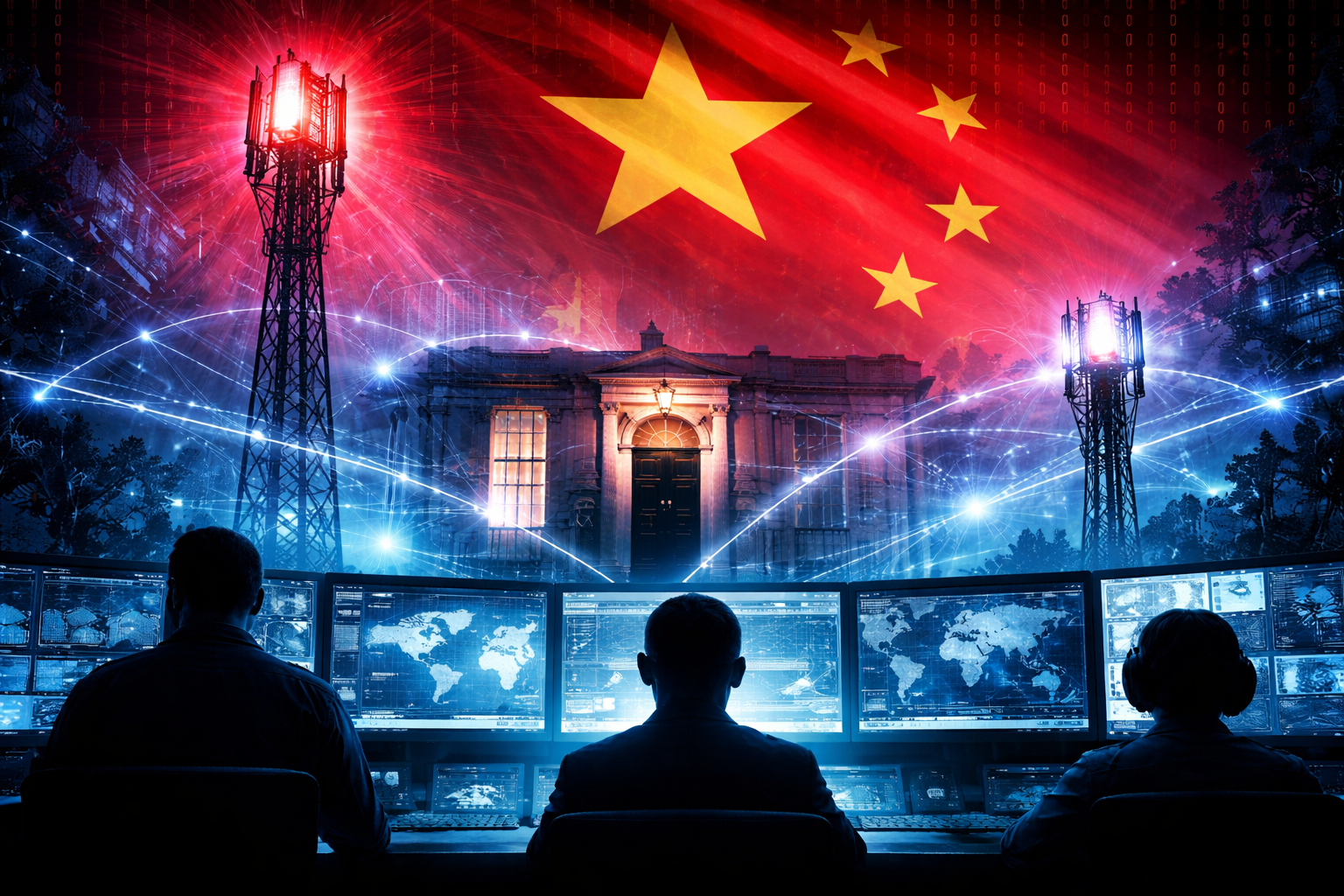
- The breach, centred on the exploitation of lawful intercept systems embedded within telecommunications networks, allowed Chinese operators to access private communications tied to senior British government officials.
- This was not a one-time breach, nor a narrow technical failure. It was a prolonged operation that unfolded over several years, across multiple administrations, and within the core systems that governments themselves rely on for lawful monitoring.
- By operating inside lawful intercept architecture, Chinese actors were positioned not only to collect data but also to understand how Western agencies prioritise targets, structure monitoring, and deploy surveillance resources.
- The contest for power is increasingly fought within infrastructure itself. States that underestimate the intelligence value of their own systems risk surrendering visibility into their political and strategic decision-making.
In January 2026, intelligence revelations exposed a deep and sustained breach of Western communication systems by Chinese state-linked actors. This breach, centred on the exploitation of lawful intercept systems embedded within telecommunications networks, allowed Chinese operators to access private communications tied to senior British government officials. The incident highlights how China leveraged structural vulnerabilities within Western surveillance architecture to gain insight into political communications at the highest levels.
This was not a one-time breach, nor a narrow technical failure. It was a prolonged operation that unfolded over several years, across multiple administrations, and within the core systems that governments themselves rely on for lawful monitoring. This forces a reassessment of how power, surveillance, and vulnerability now intersect in the digital age.
How China Entered the System
The breach did not occur through the hacking of individual phones or the cracking of encryption in the conventional sense. Instead, Chinese operators targeted the lawful intercept mechanisms built into telecommunications networks. These mechanisms exist because governments in the United Kingdom and the United States legally require telecom providers to maintain access points for law enforcement and intelligence agencies, including CALEA-compliant intercept architecture in U.S.-linked systems.
Such systems are designed to allow authorised agencies to intercept communications under legal oversight. They are deeply embedded in network infrastructure and are assumed to be secure because of their sensitive purpose. China identified these access points not as safeguards, but as opportunities.
By gaining access to lawful intercept systems themselves, Chinese actors moved inside the network rather than attacking it from the outside. This provided visibility into communications as they flowed through carrier infrastructure. From this position, operators could access metadata, location data, and potentially unencrypted content, while also gaining insight into which communications were being monitored by Western agencies. Some technical pathways traced back to contractor ecosystems and routing nodes linked to Chinese technology hubs, including firms and research clusters associated with Chengdu, long identified as a centre for cyber and signals intelligence activity.
This approach avoided the risks associated with noisy cyberattacks. It relied on patience, technical familiarity with telecom architecture, and a clear understanding of how surveillance systems are actually implemented in practice.
Compromising the Heart of British Governance
The most politically sensitive outcome of this operation was the compromise of communications associated with Downing Street. Phones used by senior aides to three successive British prime ministers, Boris Johnson, Liz Truss, and Rishi Sunak, were affected over a period of years. These aides were not marginal figures. They were deeply involved in coordinating policy, managing political strategy, and shaping the flow of information within government. Access to their communications offered insight into how decisions were prepared, debated, and executed behind closed doors.
In a network-level intrusion of this kind, direct access to a prime minister’s personal device is unnecessary. Communications can be captured as they pass through compromised infrastructure. The result is the same: foreign intelligence gains visibility into the rhythms and substance of governance.
This access overlapped with periods of sensitive political decision-making, including discussions on trade, telecommunications policy, and diplomatic engagement. The strategic value of such insight is difficult to overstate.
Turning Surveillance into an Intelligence Advantage
What distinguishes this operation is how effectively China inverted the purpose of Western surveillance systems. Tools designed to protect national security became channels through which foreign intelligence could observe both political communications and surveillance activity itself.
By operating inside lawful intercept architecture, Chinese actors were positioned not only to collect data but also to understand how Western agencies prioritise targets, structure monitoring, and deploy surveillance resources. This represents a shift from espionage focused on content to espionage focused on systems.
Such access allows intelligence agencies to operate with greater confidence, knowing where scrutiny exists and where blind spots remain. It also creates the potential to evade detection, mislead monitoring efforts, or simply extract information over long periods without disruption.
State-Linked Coordination and Denial
The activity has been linked to organisations connected to China’s Ministry of State Security, operating through a broader ecosystem of technical contractors and state-aligned firms. These entities provided the capability to sustain operations over time and across jurisdictions.
China has rejected responsibility, framing the allegations as politically motivated. However, the nature of the intrusion, exploiting legally mandated access systems rather than ad hoc vulnerabilities, reflects a level of planning and institutional knowledge consistent with state direction.
This was not opportunistic hacking. It was structured intelligence collection.
Why This Matters Beyond Britain
The significance of this episode extends well beyond the United Kingdom. The same lawful intercept frameworks exist across many countries. Any state that mandates surveillance access into telecom networks potentially exposes itself to similar exploitation.
China’s actions demonstrate that such systems are not neutral. They can be repurposed by capable adversaries to gain a strategic advantage. The lesson is not limited to one country or alliance. It applies globally.
A Warning to the World
China’s exploitation of lawful intercept infrastructure represents a calculated intelligence strategy, not a technical anomaly. By embedding itself within the surveillance systems of other states, China has shown that it is willing to weaponise institutional trust and legal architecture to advance its strategic objectives.
This is not merely a challenge for Western governments. It is a warning to all states that rely on similar communication frameworks. China has demonstrated that access mechanisms, once created, can be turned outward. Surveillance systems designed to protect can be used to penetrate.
For China’s rivals and strategic competitors, the message is clear. The contest for power is increasingly fought within infrastructure itself. States that underestimate the intelligence value of their own systems risk surrendering visibility into their political and strategic decision-making.
The Downing Street breach highlights a decisive transition in contemporary intelligence dynamics. It reveals how modern intelligence operations operate quietly, structurally, and over time. The danger lies not in dramatic cyberattacks, but in persistent access that reshapes who sees, who knows, and who holds the advantage in a connected world.

 Aayush Pal
  Hridbina Chatterjee
  Diksha Bharti