
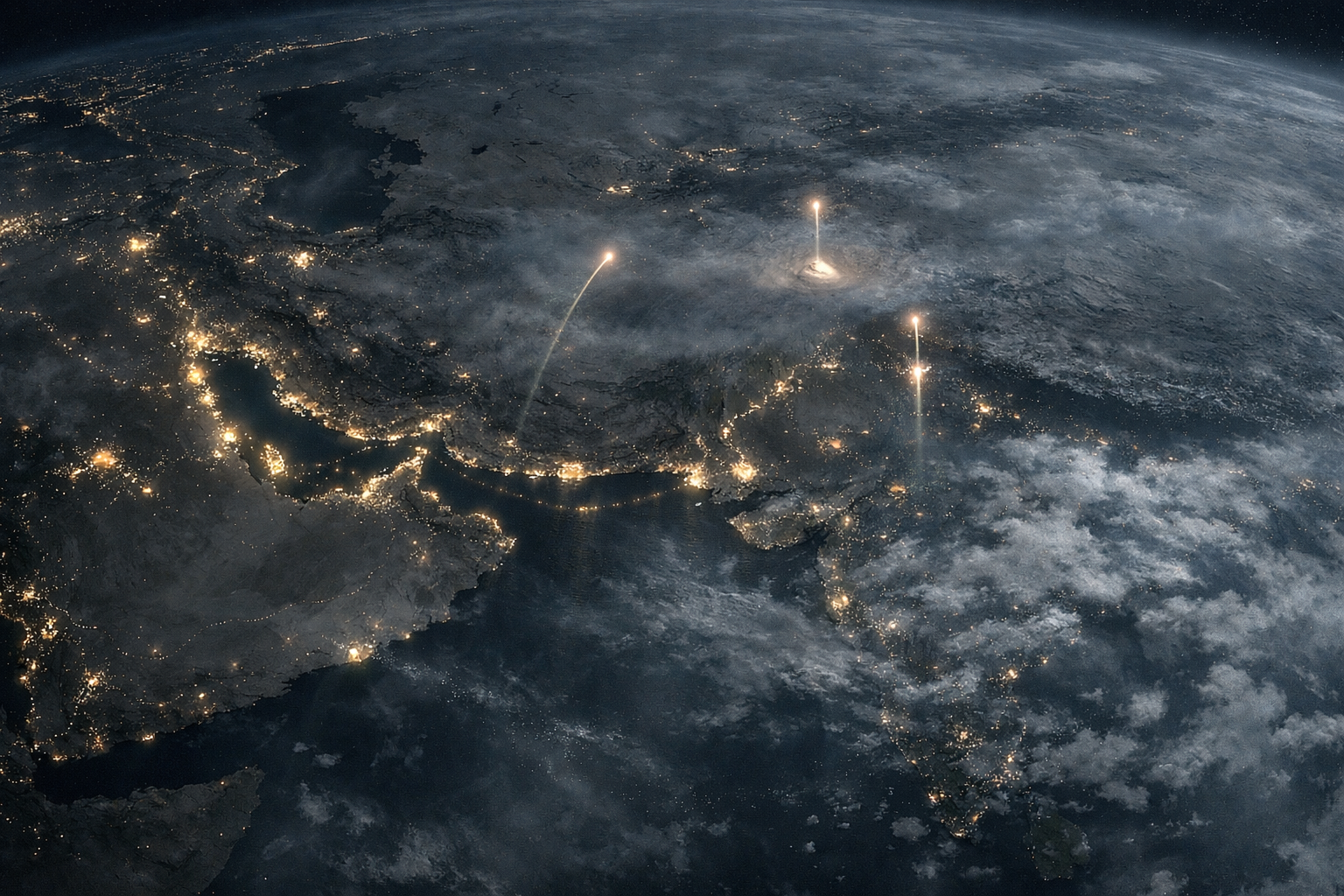
- The Iran–US–Israel scenario is not merely a regional crisis; it is a stress test of the modern world’s deepest assumptions about deterrence, rationality, and interconnected survival.
- Unlike the Cold War, we are no longer living in a bipolar world governed by relatively stable deterrence dyads.
- The frightening reality is that even a small nuclear or radiological event today would intersect with our systems, and surprisingly, they are far more brittle than those of the Cold War era.
- The greatest danger is not that nuclear weapons might be used—but that the world has begun to believe it could absorb their use, and if we think we can survive a nuclear war, it means we don’t know what survival means.
Nuclear crises have never respected geography, and in an interdependent world, their consequences travel faster than diplomacy can contain them. As tensions rise in West Asia, this essay argues that even a “limited” nuclear or radiological escalation would fracture global energy markets, destabilise climate systems, and impose disproportionate costs on countries far removed from the battlefield. For India and the Global South, the danger lies not only in weapons, but in the growing illusion that modern civilisation can absorb their use.
Nuclear Escalation, India in an Interdependent World
As the prospect of war looms between the United States of America and Iran in the Persian Gulf, one must know that wars in West Asia have never stayed confined to the region, and their impact has been felt across the world. With the mercurial Donald Trump at the helm, who is using his country’s military power like the game of Risk: The Game of Strategic Conquest and a defiant Ayatollah Ali Khamenei, who is more afraid of his people than the Great Satan, any attack by the US is literally Godsent for him. However, The Iran–US–Israel scenario is not merely a regional crisis; it is a stress test of the modern world’s deepest assumptions about deterrence, rationality, and interconnected survival.
Which is why one has to delve into the past so we do not repeat the same mistake. But it seems mankind has other ideas.
The Return of an Old Fear in a New World
In the 1930s, as Europe slid toward catastrophe, the dominant illusion was that economic interdependence would restrain war. Nobel Peace Prize winner and British Labour Party politician Norman Angell, author of the book The Great Illusion, published in 1909, in which he argued that modern economies were too interlinked to permit large-scale conflict and “economic interdependence made war irrational and self-defeating”. History, however, disproved him brutally and five years later, Europe was plunged into the First World War.
The current development in the Persian Gulf has all the telltale signs of that forgotten illusion, only to be repackaged as globalisation. Today, the possibility of a direct U.S.–Iran confrontation—potentially involving nuclear facilities, radiological weapons, and attacks on Israeli forces—forces us to confront an uncomfortable truth: interdependence is still not irrational, but it has actually multiplied its reach.
Unlike the Cold War, we are no longer living in a bipolar world governed by relatively stable deterrence dyads. It is a multipolar, emotionally volatile, media-saturated system, where leaders like Donald Trump signal unpredictability as a tactic and escalation ladders are poorly defined. That is why if Iran were attacked and responded by weaponising its nuclear threshold status—through dirty bombs, radiological sabotage, or strikes provoking Israeli nuclear retaliation—the consequences would not remain local. It will have a catastrophic impact on the global energy markets, climate systems, food chains, supply chain and political orders worldwide.
This is speculative alarmism and a measured hyperbole with its conclusions based on over a century of strategic, scientific, philosophical and economic thought.
The Discovery Of The Atom And Its Splitting
The nuclear age did not begin in Hiroshima; it just let the world know that mankind had harnessed the power of the sun. It all started with the discovery of the atom, its split in 1932 in Cambridge and in the 1930s all across laboratories of Europe and the U.S, when physicists like Leo Szilard and Enrico Fermi, working in the University of Chicago, grasped that atomic fission could unleash unprecedented energy. Albert Einstein’s 1939 letter to Franklin D. Roosevelt was not a call for war, but a warning that politics had failed to keep pace with science.
And sadly, that mismatch persists today as we advance in AI and Quantum Mechanics, leading to Geopolitical Imbalance and increasing the gap between rich and poor nations, as during the industrial age.
The early nuclear thinkers—Bernal, Oppenheimer, and later Brodie—understood that nuclear weapons were systemic weapons, capable of altering political behaviour, ethical norms, and ecological balance. Bernard Brodie was the original nuclear strategist in the US and was famous for his 1945 dictum, wherein he said that “the purpose of military establishments must now be to avert war, not win it”. He recognised that nuclear conflict collapses the distinction between battlefield and civilisation. In his seminal work The Absolute Weapon: Atomic Power and World Order, he writes that the fundamentals of nuclear deterrence strategy were not in its deployment but in the threat of its deployment. But what happens when the other side, desperate for survival, has no compunction about using it with a questionable command and control system?
A radiological weapon used in West Asia, even if “limited will have far reaching effect on a more interconnected world.
Deterrence Was Fragile During Cold War
If anyone thinks the Cold War was an era of stable deterrence, they are wrong. In reality, it was a sequence of near-misses. From the Cuban Missile Crisis to Able Archer 83, nuclear catastrophe was avoided as much by luck and individual restraint as by doctrine.
Thomas Schelling, writing in the 1960s, emphasised that deterrence depended not on weapons alone, but on shared expectations and communication. The problem today is that such shared expectations are not there when it comes to Iran, Israel, and the United States, as each interprets signals through different historical and ideological lenses.
When the Cold War was in its infancy, it was perceived in nuclear strategy that any use of the nuclear bomb and its fallout would be geographically bounded. But studies have proven otherwise, and that atmospheric circulation could carry radioactive particles across borders and have a direct or indirect impact on continents. What has changed is the scale of exposure: the global population has quadrupled since 1945, megacities dominate coastlines, and supply chains are finely tuned to stability. But the frightening reality is that even a small nuclear or radiological event today would intersect with our systems, and surprisingly, they are far more brittle than those of the Cold War era.
Nuclear Winter and Environmental Reality
Scientists like Carl Sagan, Alan Robock, and Paul Crutzen advanced the theory of nuclear winter, arguing that soot from burning cities could cool the planet by blocking sunlight. While early models were debated, with the help of computer-based modelling systems WRF-SFIRE-CHEM and E3SM, it can be concluded that large-scale fires and particulate injection into the upper atmosphere can disrupt climate systems. Carl Sagan warned, “Even a limited nuclear war would have consequences so severe that the idea of ‘winning’ would become meaningless.”
A modelled scenario of limited regional nuclear exchanges between India-Pakistan were shown to potentially reduce global temperatures and precipitation. These findings matter enormously in the US-Iran-Israel context.
West Asia sits at the crossroads of major atmospheric circulation patterns. Large-scale fires from attacks on urban centres, oil infrastructure, or refineries could inject aerosols that interact with monsoon systems. For South Asia, where agriculture remains monsoon-dependent, even marginal disruptions can translate into food insecurity for hundreds of millions, and it would lead to catastrophic climate perturbations, food price shocks, and energy disruptions, and systemic stress produced will have a generational effect.
Oil and the Economics
Oil is a macroeconomic multiplier and not just a commodity. The OPEC oil crisis of 1973 is proof, and any conflict that closes or destabilises the Strait of Hormuz—even temporarily—would send oil prices soaring. For India, which imports over 80% of its crude oil, this is not an abstract risk. Higher oil prices mean:
- Imported inflation
- Widening current account deficits
- Pressure on the rupee
- Reduced fiscal space for development and defence
- Direct impact on GDP and growth
But the ripple effect of a nuclear escalation would lead to unstable financial markets, i.e., Stocks and commodities, disrupt shipping insurance, and fight to maintain supply chains. The 2008 financial crisis will pale in comparison because even the remotest prospect of a nuclear crisis would move faster and deeper.
African nations and Asia would be hit hardest with the potential to alter growth trajectories and strategic priorities for a generation. Though we are not directly involved in this conflict, Asia and Africa, with over 77% of the total global population, will be collateral damage because they lack buffers. Europe will also not fare well as it is struggling with energy transitions and demographic stagnation, and this conflict has all the power to push Europe into higher inflation, recession and political polarisation.
Donald Trump may think that the energy-rich United States will remain insulated, but the truth is otherwise. The US would not be insulated from global recessionary pressures that will further exacerbate the current social and political upheaval.
For Trump, tariffs will turn into a double-edged sword because the reality of interdependence ensures that no one watches safely from the sidelines.
Dirty Bomb
A radiological or “dirty” bomb is still a very complex device to make, and it is clear that if push comes to shove, Iran has the capability, but more importantly, it can deliver the package, as it has medium-range ballistic missiles deserves special attention. Studies since the 1960s have shown that radiological weapons cause disproportionate fear relative to their immediate lethality.
Cities contaminated—even lightly—become economically unusable for years. The Chernobyl and Fukushima disasters, though accidental, illustrate how radiation reshapes politics and public consciousness. If such a device were used against Israel or Europe, it would not be a case of nuclear coercion below the threshold; it would be a full nuclear war, undermining decades of non-proliferation norms painstakingly built since the 1960s. Though the control over the proliferation of nuclear technology is questionable, it is not up for debate, as it is moot.
India’s Stand
For India, the implications are multifaceted. Any nuclear escalation in West Asia would weaken global non-proliferation regimes, embolden threshold states, and complicate India’s own deterrence environment—especially vis-à-vis China and Pakistan. Economically, India’s rise depends on predictable and stable energy flows, supply chain, and foreign investment. Nuclear instability in West Asia undermines all. It also threatens Indian expatriates—millions who live and work in the Gulf—creating humanitarian and political challenges at home.
Diplomatically, India would be forced into uncomfortable balancing acts: maintaining relations with the U.S. and Israel, preserving ties with Iran for regional connectivity, and protecting its interests in the Arab world. However, India this time must use its strength and counter Trump, who has been inconsolable since his Nobel Peace Prize snub.
A Fragile Conclusion
Weapons are not only destructive, it brings out the fragility of humans and, at the same time, reveal how power can blind thinking and that a powerful nuclear powered navel armada is an overkill in a fragile situation. Donald Trump, who makes decisions in minutes, could reshape decades. A detonation in one region contaminates lives far beyond borders, and right now, the Iran–US conflict hinges on a leader’s temperament.
In the end, radioactive fallout will have political, economic, social and moral implications. It would settle for decades into our markets, food systems, diplomatic relations, and collective psychology. India and the Global South would pay a price disproportionate to their role in the conflict.
K. Subrahmanyam was one of India’s most important nuclear strategists who said, “No one can win a nuclear war; therefore, the only rational policy is to prevent it.” He believed that nuclear weapons were necessary for deterrence precisely because their use would be catastrophic and irrational. At the same time, he also said, “Deterrence does not depend on the intention to use nuclear weapons, but on the adversary’s belief that they could be used if survival is threatened.”
These were ominous words.
Thinkers like Aldous Huxley and Gerald Heard in the late 1930s warned that modernity had outpaced wisdom and modern civilisation, while technologically advanced, had become spiritually impoverished and detached from its roots. We came a hair’s breadth to extinction during the Cold War, even under structured rivalry. But today’s crisis would unfold in a world less disciplined, more emotional, ideological and vastly more interconnected. To paraphrase some of the greatest political thinkers of our times, like Bernard Brodie, George F. Kennan, Hannah Arendt and Jonathan Schell….
“The greatest danger is not that nuclear weapons might be used—but that the world has begun to believe it could absorb their use, and if we think we can survive a nuclear war, it means we don’t know what survival means.”
History suggests otherwise.
References:
- Einstein, A. (1939). Letter to President Franklin D. Roosevelt
- Szilard, L. (1930s). Writings on chain reactions and nuclear responsibility
- Brodie, B. (1946). The Absolute Weapon
- Morgenthau, H. (1948). Politics Among Nations
- Schelling, T. (1960). The Strategy of Conflict
- Kahn, H. (1962). Thinking About the Unthinkable
- Sagan, C. et al. (1983). “Nuclear Winter.” Science
- Robock, A. et al. (2007–2019). Studies on regional nuclear war and climate
- Crutzen, P. & Birks, J. (1982). Atmospheric effects of nuclear war
- Nye, J. (1990). Bound to Lead
- Beck, U. (1992). Risk Society
- Allison, G. (2017). Destined for War
- IPCC & climate-security literature (2010s–2020s)
- Subrahmanyam K. India and the Nuclear Challenge. Lancer Publishers; 1986.
- Contemporary strategic and energy-security analyses (2020s)
- Jonathan Schell (1982) – The Fate of the Earth
- Hannah Arendt (1961) – The Human Condition

Balaji is a freelance writer with an MA in History and Political science and has published articles on defence and strategic affairs and book reviews. He tweets @LaxmanShriram78. Views expressed are the author’s own.
 Archita Gaur
  Anjali Singh
  Divyanka Tandon