
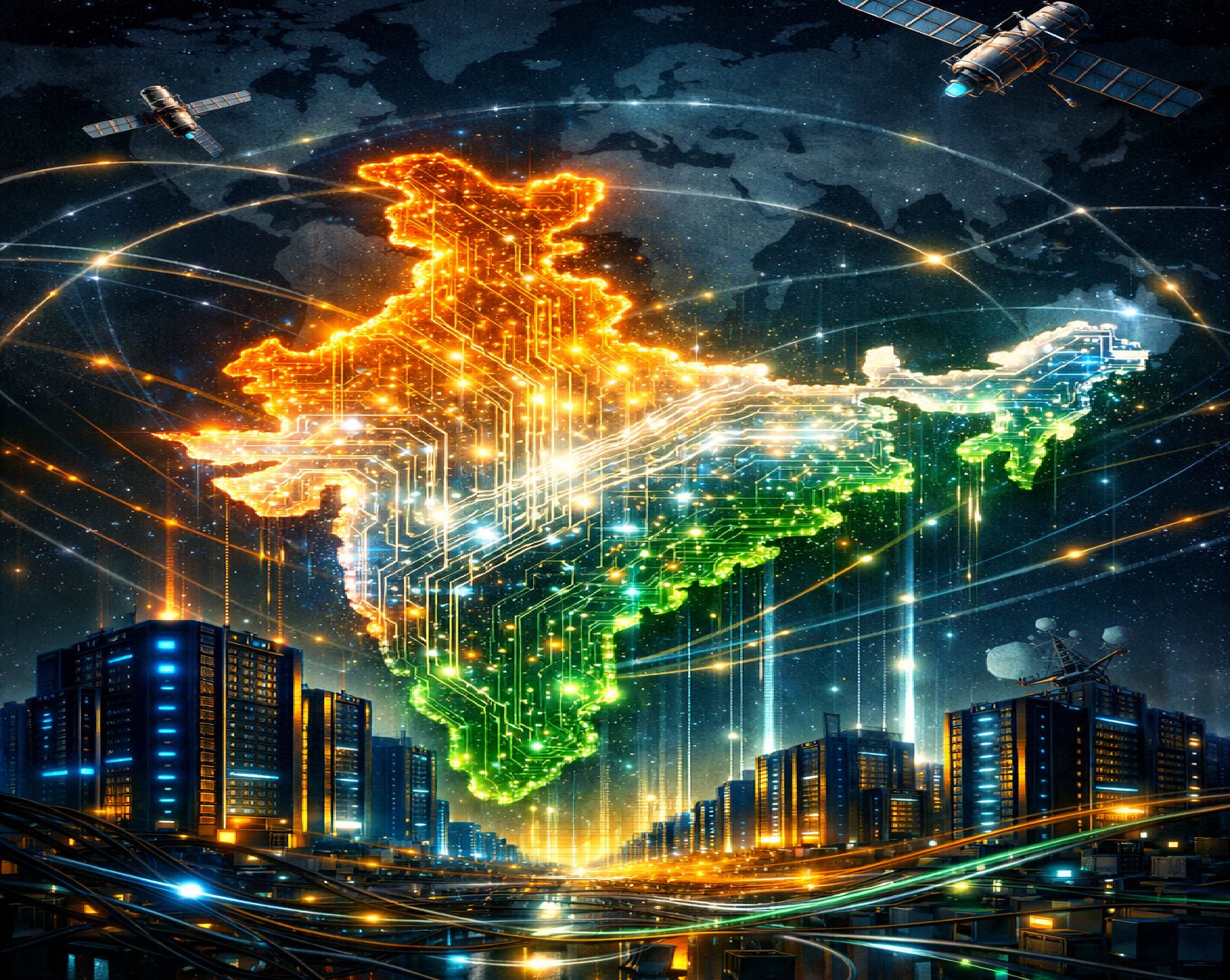
- The Union Budget 2026–27 proposal of a tax holiday till 2047 for global cloud giants using Indian data centres signals India’s rising stature as a decisive force in global economics and technology.
- This decision will be a major factor in redrawing the cloud topology, traffic, and data flow systems across the world and render a place for Indian data centres in overseas markets.
- The semiconductor mission 2.0 and tax holiday for cloud giants both point towards harnessing the full potential of an AI ecosystem powered by Indian raw material, intellect and market.
In the recent Union Budget 2026-27, a tax holiday till 2047 was proposed by Smt. Nirmala Sitharaman for the international cloud giants, using Indian data centers for providing their services nationally and globally. This reflects the changing position of India on the global landscape and its concrete stature in contributing to global economics and technology development endeavours. This can be availed by international firms that use India-based data centres for cloud services to global clients, provided the computing/storage capacity is based on Indian soil and for Indian customers, services should be provided through Indian reseller entities. This is a progressively constructive and future-oriented proposal that intends to revolutionize Indian landscape in terms of dominating cloud topology.
Strategic Attempt Toward Digital Supremacy And Autonomy
India has called on international giants to use our datacenters for delivering cloud services by proposing a tax holiday for them till 2047, this incentivising attempt aligns with our goal of Viksit Bharat and renders more control to India in terms of where the data physically resides. This skips the bait of distant data jurisdictions and abates digital dependence. This is a deliberate endeavour to signal pivotal changes that progress toward a geostrategic infrastructure building and strengthen the idea of national digital policy goals of AI readiness and Digitalization. This tax incentive allows for Indian digital sovereignty on the global map, providing autonomy over data flow trade systems. Besides, it allows for tech decoupling, abating technological interdependence and building an indigenous base for cloud infrastructure. Amidst growing geopolitical tensions and fragile trade flows, this move is beyond commercial but strategic and wise for internal security and global digital control. This lays the foundation for a better and more tactical control of data infrastructure in a growing world of digitalisation. This plan is a strategic,future-oriented vision of the government heading towards making India a global superpower.
This attempt has shifted the geo-economic map with the Indian landscape in the limelight. Traffic and workload that routes through Europe and the US have an alternate option in Southeast Asia, and tend to leverage data flow and digital trade corridors. Hyperscalers are now eyeing India for enormous capex and growth acceleration.
Redrawing Cloud Topology By Commercial Diplomacy
Western cloud providers like Microsoft and Google have an alternate option in Southeast Asia, which tends to boost onshore investments and strategically place India on the global stage of tech, cloud service and data management- placing us as a key player in international digital governance. In terms of Indo-Pacific digital order, this incentives and tax clarity implicitly invites companies to India, breaking the Chinese and Singapore dominance of cloud systems and data flow. This is not only a subtle show of prudent economic strategy but a representation of India’s commercial diplomacy, building tech and digital trade routes alongside setting a global image. This decision will be a major factor in redrawing the cloud topology, traffic, and data flow systems across the world and render a place for Indian data centres in overseas markets. It puts us in a position to influence technical standards and advancements in AI globally by concentrating major AI/GPU computing in India.
This redirection of cloud topology puts us on a secure and well-established tech giant, which greatly dilutes our dependence on foreign data jurisdictions. This cloud infrastructure pertains to a reduced influence of international regulations on the Indian data ecosystem- a leap towards Atmanirbhar Bharat. By setting up these cloud institutions in our country, we have domestic access to global cloud bases, which frees us from the web of global dependence and reduces legal liabilities.
The Future of AI Lies in India
With growing popularity and dependence of the public and institutions on AI, it is essential to focus on AI development, and India is the pioneer and future leader in the same domain, pertaining to its AI schemes and capabilities. The semiconductor mission 2.0 and tax holiday for cloud giants both point towards harnessing the full potential of an AI ecosystem powered by Indian raw material, intellect and market. It needs to be highlighted that, alongside hosting foreign services and investments, indigenous cloud, chip manufacturing and AI capabilities must be ameliorated to ensure a lucrative balance in international demand and domestic supply. This will ensure that the national market adequately syncs with international needs and emerges as a global player in the AI boom.
Vigilance Toward Legal Clarity And Hyperscaler Dominance
Localisation of data territories also puts India on a larger scale of legal responsibility in terms of data access, security and cross-border data service affairs. Legalities in reference to cross-border subpoenas and provider compliance need to be clarified for hyperscalers and associated conglomerates, to align their policies and terms of service, considering Indian domestic rules. Despite the leverage in digital growth, overconcentration should be closely watched to protect the interests of small-scale Indian companies, to thwart multinational monopoly and safeguard the national interest.
Hyperscaler dominance might be a future concern; to tackle the same, it is mandatory to set norms for indigenous firms. This will prevent an international monopoly and boost indigenous companies to take the global stage. It will be important to set threshold market share caps to maintain balance and avoid single-player dominance across India-based servers. Secondly, the clause of providing services to Indian clients via Indian resellers only is a tactical move to neutralise the possibility of this dominance. Although encouragement to domestic production and cloud firms will help establish a stronger “Make in India” cloud base, along with services being offered to international providers for services to global clients.
In terms of digital access and security, stringent laws need to uphold the trust of the international giants alongside favouring domestic rules and regulations, such that a mutually cooperative system of economic and digital affairs can be crafted with caution for growth and development toward a Viksit Bharat.
As we see the changing dynamics of international relations, tariff wars and realigning trade interests, we realise that India has silently and strategically placed itself in global politics and geo-economics. It proves to productively exploit commercial diplomacy for the mutual interests and good of our economy and for global tech giants.

Rishit Anand is a medical student, writer, researcher, and political critic. Views expressed are the author’s own.
 Aayush Pal
  Pranav S
  Archita Gaur