
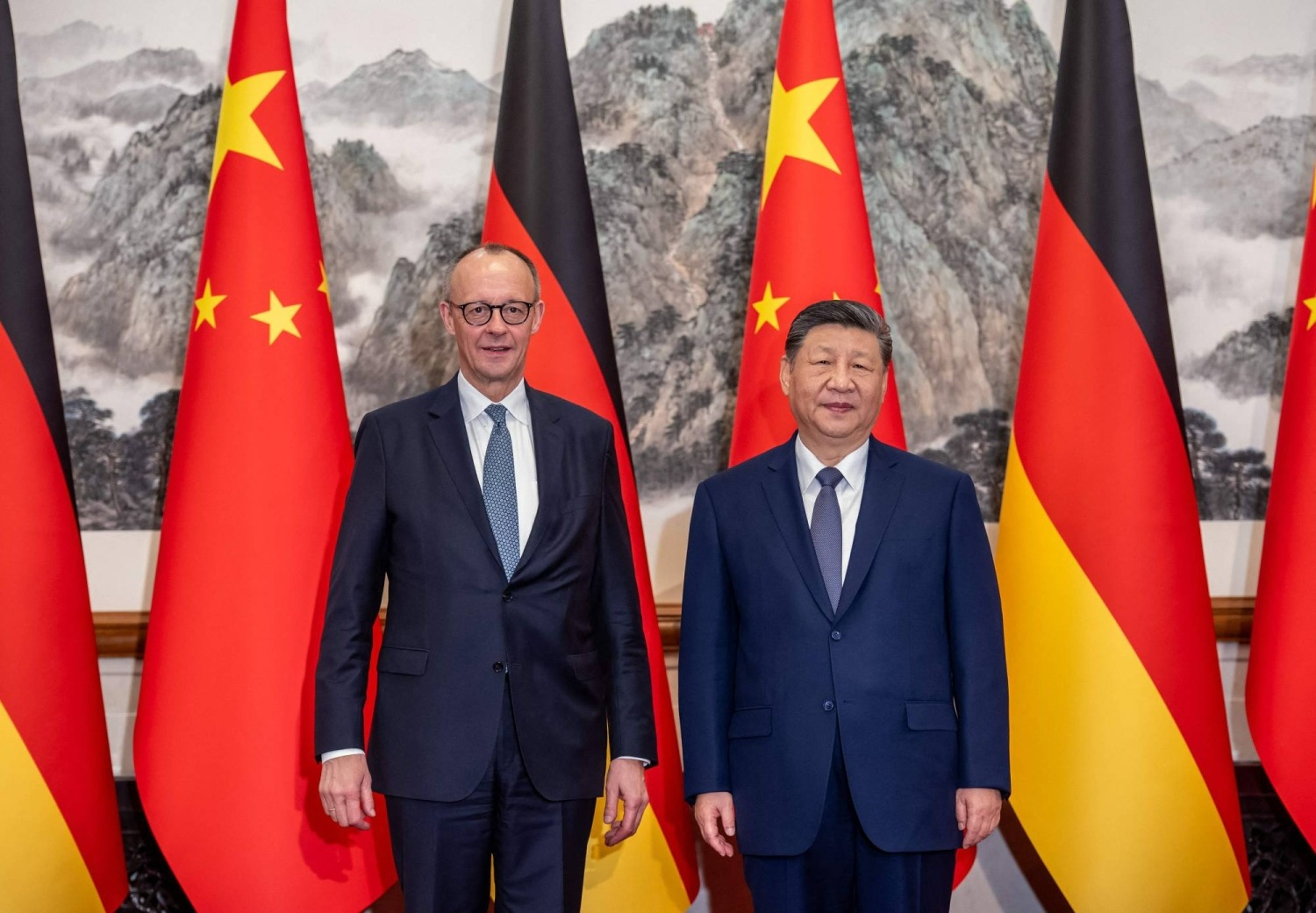
- Merz’s two-day itinerary underscores both opportunity and tension in one of the EU’s most consequential bilateral relationships.
- At the core of discussions with Chinese leadership, including President Xi Jinping and Premier Li Qiang, was the need to deepen economic cooperation while confronting long-standing structural issues.
- Germany’s leadership is under pressure to navigate economic dependencies, domestic industrial concerns, and geopolitical realignments without severing ties or sparking protectionist backlash.
German Chancellor Friedrich Merz arrived in Beijing for his first official visit to China, seeking a recalibration of ties between the two countries against a backdrop of growing geopolitical strain, economic interdependence, and intensifying trade imbalances. Accompanied by a high-level German business delegation including executives from major automakers such as Volkswagen and BMW, Merz’s two-day itinerary underscores both opportunity and tension in one of the EU’s most consequential bilateral relationships.
At the core of discussions with Chinese leadership, including President Xi Jinping and Premier Li Qiang, was the need to deepen economic cooperation while confronting long-standing structural issues. Germany expressed its interest in expanding bilateral trade and investment. Chinese officials responded positively by highlighting their massive consumer market and advanced manufacturing base as attractive for European exporters, and sought to improve market access, transparency, and foreign firm participation.
Germany’s trade deficit with China has become fourfold since 2020, reaching nearly €90 billion in 2025, driven in part by Chinese export overcapacity, an undervalued currency, and substantial imports of electronics, machinery, and consumer goods. German firms, which once benefited from complementary industrial links with China, now face intense competitive pressures at home and abroad. Several policies like subsidies, market distortions, and export controls on crucial materials, particularly rare earths, have prompted discussions in Berlin. Merz said, “We have very specific concerns regarding our cooperation, which we want to improve and make it fair”. Reports note that Merz linked economic collaboration with Beijing’s potential influence on global issues, and both countries are also willing to continue dialogue on climate change and the green transition. Germany also touched on the issue of Taiwan, saying reunification should be done peacefully.
Merz subtly recontextualised his project within a larger context. As tensions rise between the US and China and Europe seeks strategic autonomy, he argued that engaging with Beijing in a constructive yet realistic manner is essential, combining cooperation with firm defence of German interests.
The visit’s diplomatic output, while constructive, was modest. A handful of agreements were signed on climate action, green transition, disease prevention, and cultural exchanges, fewer than recent EU counterparts achieved, signalling the complexity of aligning strategic priorities. Analysts suggest that while both sides want to avoid decoupling, Germany’s leadership is under pressure to navigate economic dependencies, domestic industrial concerns, and geopolitical realignments without severing ties or sparking protectionist backlash.

Anshika Agrawal is a research scholar at the Centre for Russian and Central Asian Studies, Jawaharlal Nehru University, with a strong interest in current affairs, bilateral and multilateral relations, and public policy. Views expressed are the author’s own.
 Aayush Pal
  Dr Nanda Kishor