
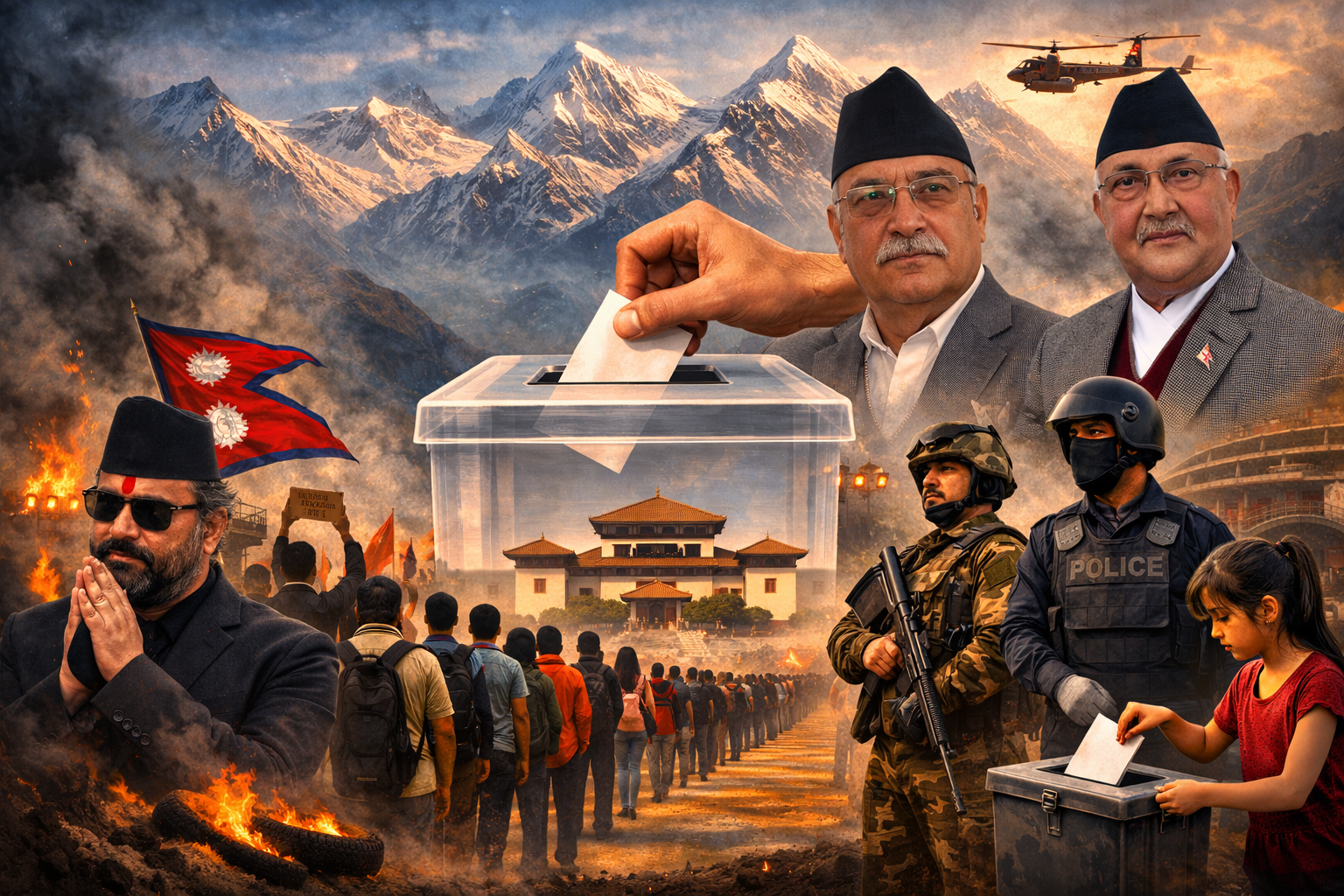
- On March 5, Nepal will host a vital parliamentary election, the country’s first since the government of former Prime Minister K. P. Sharma Oli was forced to resign in September 2025.
- Nearly 19 million people are eligible to vote in the election for the lower house of parliament, the 275-member House of Representatives, as the nation gets ready to cast its ballots.
- The outcome will show whether Nepal’s political system can meet the expectations of a younger generation looking for economic opportunity, transparency, and significant reform.
On March 5, Nepal will host a vital parliamentary election, the country’s first since the government of former Prime Minister K. P. Sharma Oli was forced to resign in September 2025 due to widespread anti-corruption protests organised by the youth. Deep dissatisfaction with corruption, unemployment, and economic stagnation in the Himalayan republic was brought to light by the protests, which were mostly led by the Gen Z populace.
An interim administration led by former Chief Justice Sushila Karki has been in charge of Nepal since the government collapsed. This administration promised to hold elections within six months and bring political stability back. Nearly 19 million people are eligible to vote in the election for the lower house of parliament, the 275-member House of Representatives, as the nation gets ready to cast its ballots. There will be about 800,000 first-time voters among them.
There are two ways to vote in Nepal’s election system. The First-Past-the-Post system will be used to elect 165 of the total seats; the winner is the candidate who receives the most votes. In order to guarantee greater participation of political parties and social groups, the remaining 110 seats will be distributed using proportional representation. More than 1,000 of the 3,400 candidates running for office are under 40, indicating the rise in young people’s involvement in national politics.
The contest includes a number of important political figures and parties. Balendra Shah, also referred to as Balen, the former mayor of Kathmandu and a well-known youth leader who represents the Rastriya Swatantra Party, is one of the most-watched candidates. In the Jhapa-5 constituency, Shah is running against seasoned leader K. P. Sharma Oli, making it one of the most fiercely debated election battlegrounds.
Other prominent candidates include Pushpa Kamal Dahal, the current leader of the Nepal Communist Party and a former Maoist, and Gagan Thapa of the Nepali Congress. It seems improbable that any one party will secure the 137 seats needed for a majority, according to analysts, which raises the prospect of coalition talks following the election.
After the political unrest of 2025, corruption, unemployment, and economic recovery are important election themes. Given the nation’s economic reliance on commerce and investment from China and India, Nepal’s geopolitical balance between the two neighbours is also anticipated to have an impact on campaign discussions.
With almost 320,000 members of the Nepal Army, the Armed Police Force, and the Nepal Police stationed all over the nation, security has been greatly increased ahead of the election. Following the disturbances of the previous year, thousands of voting places have been designated as sensitive by authorities.
The political atmosphere in Nepal remains uncertain as this election approaches. The national dialogue on accountability and governance was altered by the Gen-Z-led demonstrations that overthrew the previous administration. The outcome will show whether Nepal’s political system can meet the expectations of a younger generation looking for economic opportunity, transparency, and significant reform in the nation’s governance, regardless of whether the vote yields a clear mandate or another shaky coalition.

Anjali Singh is a postgraduate student of Political Science and International Relations, a Social Media Analyst, and a former Research Intern at the Indian Council of World Affairs. Views expressed are the author’s own.
 Aayush Pal
  Dr Nanda Kishor