
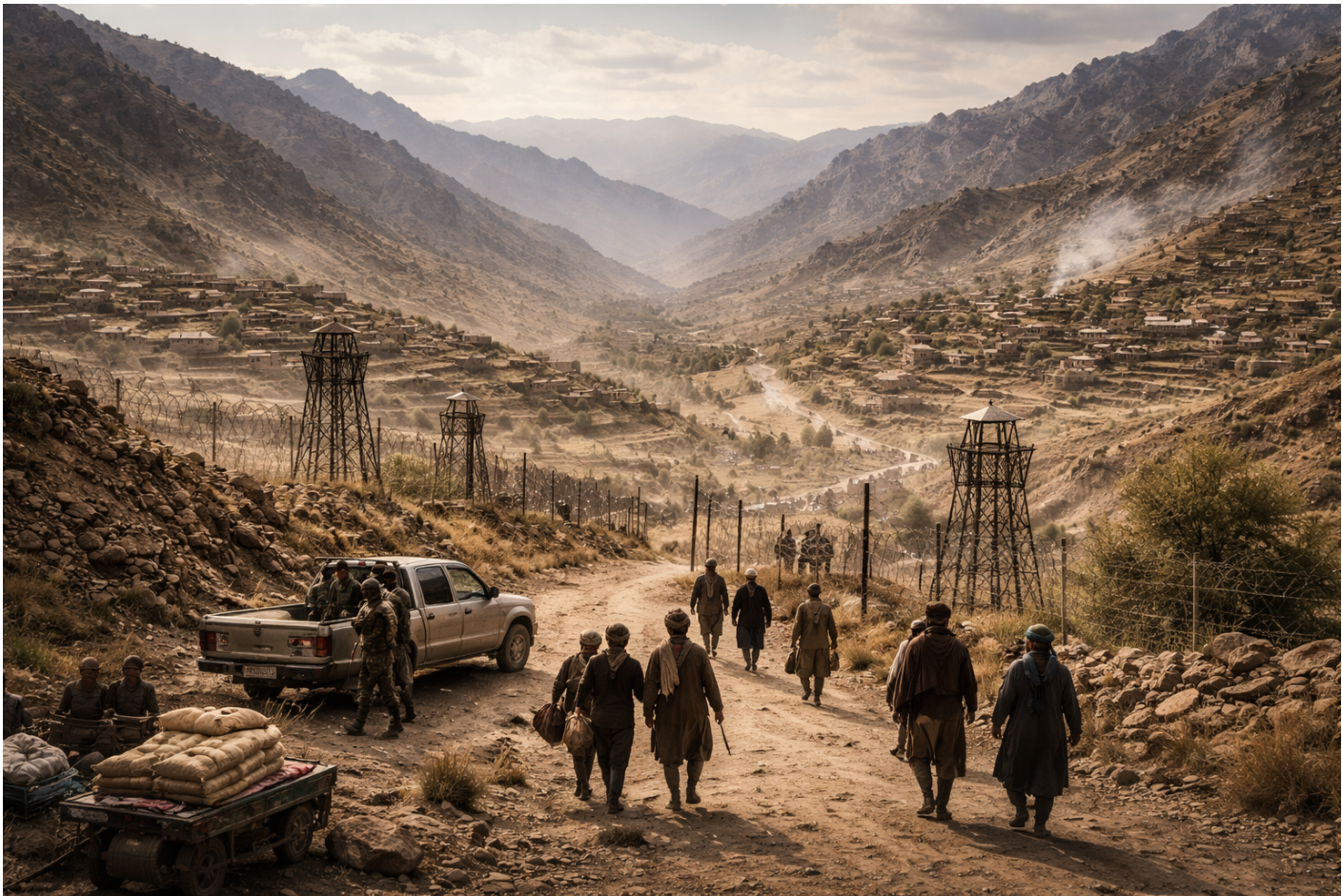
- The ambiguity surrounding the border, combined with the limited institutional capacity of both Afghanistan and Pakistan, has contributed to the emergence and persistence of armed non-state actors.
- The combination of geographic isolation and economic marginalisation strengthens the conditions that enable militant networks to flourish.
- The porous nature of the Durand Line has not only facilitated the movement of people and goods across the frontier but has also enabled insurgent actors and illicit networks to operate with relative ease.
- Weak state control in these areas enabled insurgent groups to establish de facto governing structures, raise taxes, interpret and enforce Sharia law.
The Durand Line, demarcated in 1893 by Mortimer Durand as the boundary between British India and Afghanistan, has long remained a hotspot of geopolitical tension and instability. Its establishment was largely arbitrary and showed little awareness of the complex tribal, ethnic, and linguistic structures that define the region. As a result, the boundary divided Pashtun tribal lands, separating communities between Afghanistan and present-day Pakistan.
This imposed division created lasting resentment and a deep sense of disenfranchisement among local populations who have historically resisted centralised state authority. Afghanistan’s continued refusal to formally recognise the border has further sustained a grey area where sovereign jurisdiction remains fragile, creating a fertile ground for the activities of non-state actors.
With its rugged terrain and limited state presence, the region has evolved into both a literal and symbolic frontier. In this anarchic environment, armed groups are often able to evade state regulation and exploit cross-border networks to sustain their operations.
The porous nature of the Durand Line has not only facilitated the movement of people and goods across the frontier but has also enabled insurgent actors and illicit networks to operate with relative ease. Non-state armed groups such as the Taliban and Tehrik-i-Taliban Pakistan have exploited these liminal spaces to maintain operational flexibility along the border.
During the period of U.S. intervention in Afghanistan, the Taliban frequently used sanctuaries in Pakistan’s tribal regions, particularly North and South Waziristan, to reorganise their forces and plan cross-border attacks. Weak state control in these areas enabled insurgent groups to establish de facto governing structures, raise taxes, interpret and enforce Sharia law according to their own authority, and resolve local disputes—often performing functions traditionally associated with the state.
The ambiguity surrounding the border, combined with the limited institutional capacity of both Afghanistan and Pakistan, has contributed to the emergence and persistence of armed non-state actors. This dynamic illustrates how ungoverned or weakly governed spaces can become fertile ground for sustained insurgency and criminal activity.
The lack of economic development and persistent marginalization is another significant factors exploited by non-state armed groups in the Durand Line region. The frontier districts remain among the poorest areas of both Afghanistan and Pakistan, lacking basic infrastructure, educational institutions, and healthcare facilities. These deficiencies foster a deep sense of abandonment and resentment among local populations, which militant groups skillfully exploit to gain support.
For instance, the early success of the Taliban in provinces such as Kandahar Province and Helmand Province was partly due to their ability to provide basic security and services that were largely absent in state institutions. Similarly, the Tehrik-i-Taliban Pakistan has exploited local grievances against perceived state oppression, offering ideological appeal, financial incentives, and social support to secure loyalty.
This combination of geographic isolation and economic marginalisation strengthens the conditions that enable militant networks to flourish. As the state struggles to project authority in these regions, armed groups often establish parallel structures of governance, allowing them to dominate local communities and further undermine state legitimacy.
Tribal politics and indigenous governance practices in the Durand Line region exert a profound influence on the security dynamics of the area. The code of Pashtunwali, which emphasises honour, hospitality, and vengeance, continues to guide social behaviour in the borderlands.
Local governments often struggle to penetrate these areas because governance traditionally depends on consensus-based tribal deliberations, which stand in contrast to centralised bureaucratic authority. Non-state armed groups frequently exploit these sociocultural networks by co-opting tribal elders or negotiating with local Jirga to secure operational freedom or logistical support.
The Taliban, in particular, has consistently portrayed itself as a defender of local customs and traditions. By aligning its authority with tribal norms rather than imposing external state law, it has been able to cultivate a degree of local legitimacy. This combination of social acceptance and coercive power illustrates how militant actors can embed themselves within communities, especially in regions where formal state institutions remain weak or absent.
The complexities surrounding the Durand Line are further intensified by regional geopolitics. The borderlands have long been viewed by Pakistan as a zone of strategic depth in relation to India, a perception that has influenced its tolerance toward certain non-state actors operating in the region. In contrast, the authorities in Afghanistan regard cross-border insurgent activity as a direct violation of their sovereignty.
This fundamental divergence has resulted in inconsistent policies and interventions, ultimately undermining coordinated efforts to stabilise the region. The involvement of the United States and the North Atlantic Treaty Organisation added another layer of complexity. Coalition operations in Afghanistan often depended on cooperation with the Pakistani government, which at times tolerated semi-autonomous armed groups in pursuit of broader strategic objectives.
These overlapping interests and inconsistent enforcement mechanisms have reinforced the volatile nature of the borderlands. As a result, armed groups are often able to exploit gaps in state authority, allowing them to pursue their agendas with minimal disruption.
The growing presence of non-state armed groups along the Durand Line has become a significant concern in contemporary security relations. These groups undermine the sovereignty of both Afghanistan and Pakistan while simultaneously facilitating transnational criminal activities such as terrorism, smuggling, and human trafficking.
One notable example is the Haqqani Network, which has been associated with cross-border attacks, the use of safe havens in Pakistani territory, and collaboration with other insurgent organisations. Such networks illustrate how insurgency, organised crime, and extremist ideology can converge within weakly governed spaces.
The persistent insecurity in the region has also undermined developmental initiatives and humanitarian interventions while contributing to the periodic displacement of local populations. Consequently, the Durand Line serves as a microcosm of broader structural challenges associated with weak governance, highlighting the complex relationship between fragile state authority, local sociopolitical dynamics, and militant activity.
The Durand Line region has often witnessed fragmented and reactive interventions, highlighting the persistent challenge of establishing centralised authority over areas with a long tradition of autonomy. Military operations conducted by the Pakistan Army—such as Operation Zarb-e-Azb—targeted insurgent strongholds in North Waziristan. While these operations produced limited short-term tactical gains, they ultimately failed to deliver lasting stability.
Similar challenges have also affected parallel efforts by Pakistan to maintain influence in neighbouring regions of Afghanistan, where limited institutional capacity and complex tribal structures have constrained effective governance.
These dynamics underscore the necessity for comprehensive policy approaches that combine security measures with socio-economic development, engagement with tribal institutions, and sustained bilateral cooperation. Without such an integrated strategy, the Durand Line is likely to remain a weakly governed frontier where non-state armed groups continue to exploit longstanding grievances alongside evolving geopolitical uncertainties.
The Durand Line represents a clear example of the contemporary challenges associated with ungoverned or weakly governed borderlands. Its perceived arbitrary demarcation, persistent economic marginalisation, deeply rooted tribal traditions, and complex geopolitical dynamics have created conditions that allow non-state armed groups to flourish, thereby challenging state sovereignty and destabilising the regional balance.
Groups such as the Taliban and Tehrik-i-Taliban Pakistan demonstrate how governance vacuums can be exploited to recruit members, conduct operations, and even establish forms of quasi-governance parallel to formal state institutions.
Addressing these challenges requires a nuanced understanding of local dynamics, targeted investment in socio-economic development, and coordinated regional strategies. Ultimately, the Durand Line is more than a disputed border; it reflects the intersection of historical legacies, fragile state authority, and indigenous sociopolitical structures, all of which contribute to a persistent environment of insecurity that influences political and security dynamics beyond national boundaries.

Kumar Sheni is an Assistant Professor of Political Science at the School of Geopolitics and Public Policy, REVA University, Bengaluru. Views expressed are the author’s own.
 Parag Gilada
  Aayush Pal
  Divyanka Tandon