
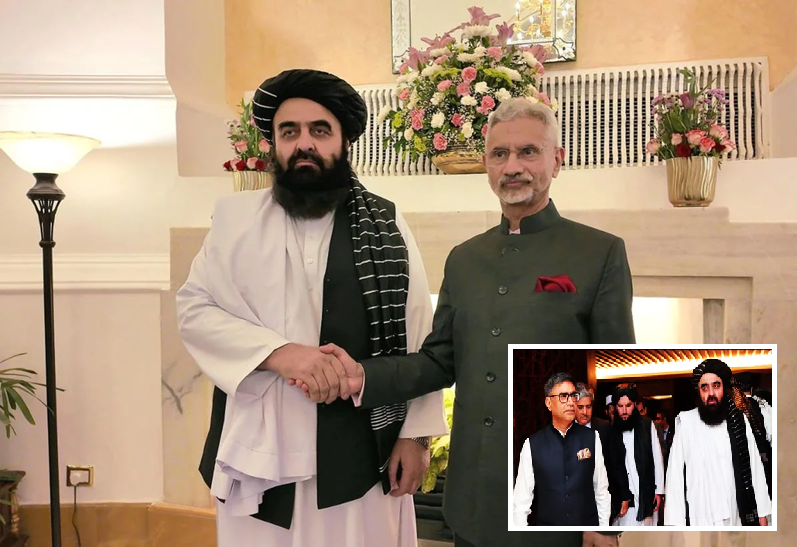
- India condemned Pakistan’s attacks on Afghan civilians, reflecting how its relationship with Taliban-led Afghanistan has shifted since 2021 into a more transactional engagement.
- After years of distrust, India has cautiously re-engaged the Taliban through humanitarian aid and diplomatic outreach to protect its strategic and economic interests.
- The evolving India–Taliban relationship is driven by geopolitical necessity, but remains constrained by mistrust, regional tensions, and the Taliban’s lack of international legitimacy.
India officially condemned Pakistan’s attacks on Afghan territory that killed civilians, especially women and children, during the holy month of Ramadan. Afghanistan sent its condolences to India last year after the Pahalgham terrorist attack in Jammu and Kashmir. Because of these events, India’s relationship with Afghanistan has changed a lot since the Taliban took over in 2021. The article asserts that the transformation of bilateral relations between the two countries is a consequence of modified geopolitical conditions and is fundamentally transactional.
India has not liked the Taliban in Afghanistan in the past. Instead, it has seen it as a proxy for Pakistan and a fundamentalist Islamic militant group. New Delhi thinks this Afghan group is a threat to India’s safety and business interests in the area. Historically, India has consistently supported the Taliban’s adversaries, such as the Northern Alliance from 1996 to 2001. The Taliban was also accused of aiding Pakistani militants in the kidnapping of Air India flight IC 814, which compelled India to release the Chief of Jaish-e-Mohammad. After the U.S. invasion, New Delhi linked itself with the U.S.-supported republican government of Afghanistan and made investments in the nation. Indians in Afghanistan also fell victim to Taliban insurgent assaults, such as the 2008 bombing of the Indian embassy in Kabul, which resulted in injuries. This engendered scepticism and distrust among Indians towards the Taliban.
Following the Taliban’s takeover of Afghanistan in 2021, India opted to shutter its embassy and repatriate its personnel from the nation. However, the situation proceeded to evolve. In 2022, India reinstated its technical mission in Afghanistan and continued to provide humanitarian assistance to the country. This indicated that India did not forsake Afghanistan and instead interacted with the Taliban through secretive diplomacy. India provided humanitarian help to Afghanistan following the devastating earthquake in August 2025. A significant transition occurred when Afghanistan’s acting foreign minister visited India in October 2025. A joint statement was issued with the Indian External Affairs Minister, expressing India’s gratitude for Afghanistan’s denunciation of the Pahalgham terror attack, welcoming the initiation of the India-Afghanistan air freight corridor to enhance trade, and acknowledging Afghanistan’s invitation for India to invest in its mining sector.
The evolving geopolitical landscape necessitated this development: firstly, the Taliban is a somewhat less radical religious faction when compared with groups like IS-KP, as it also guarantees India that Afghan territory will not be used against it. The Taliban currently exerts control over a significant area of Afghanistan, while India’s longstanding ally, the Northern Alliance, has diminished in influence within the country. This compels India to cooperate with the Taliban. Secondly, India’s two decades of investment in Afghanistan through infrastructural projects, humanitarian aid, and military training compel India to engage with the Taliban before their ascension to power in the country. New Delhi’s support for Afghanistan cultivated India’s soft power among the general Afghan populace and even within the ranks of the Taliban. During his visit, Muttaqi endorsed India’s economic endeavours in his nation. Third, India seeks to avoid a recurrence of the mid-1990s, when Afghanistan’s land was utilised to jeopardise its regional security.
Finally, the primary issue is the declining bilateral relations between Taliban-led Afghanistan and Pakistan. The Pakistani Taliban, or TTP, is a significant source of tension in the bilateral relations between Pakistan and Afghanistan. The TTP poses a significant security danger to Pakistan, having executed around 600 terrorist operations against Pakistani military personnel in 2025. The group opposes Pakistan’s aim of assimilating FATA and demands its withdrawal from the Pashtun tribal region. Pakistan has accused Afghanistan of providing humanitarian and military refuge to the Pakistani Taliban and has requested that the Afghan Taliban expel the group from their country. The Taliban’s ideological and emotional alignment with the TTP rendered them reluctant to take action against the outfit. Pakistan conducted aircraft assaults on Afghanistan, asserting that the strikes targeted TTP militants; however, these operations also led to civilian casualties. These strained relations between the two traditional allies prompted the Taliban to collaborate with India against a mutual adversary.
In addition to these causes, India’s reunion with the Taliban is not without constraints. This is inherently transactional rather than founded on long-term interest. The Taliban must overcome its diplomatic isolation, while India requires a presence in Afghanistan to safeguard its economic investments. The Taliban’s initiative to reestablish relations with India is a consequence of Afghanistan’s declining relationship with Pakistan. Numerous factions, including Haqqani, continue to seek peace and stable relations with Pakistan. Afghanistan is a landlocked nation that cannot afford to entirely alienate Pakistan, as this could suffocate its economy without an option. The Taliban constitutes a concern as it is a Deobandi Islamic group with a confined worldview. It views India as a ‘Hindu Other’ that oppresses its Muslim minority. This could pose an issue. India cannot legally recognise the Taliban administration in Afghanistan as long as it lacks international legitimacy from other states, a challenge exacerbated by the Taliban’s apartheid policies regarding Afghan women.
India may utilise its growing influence in Afghanistan and collaborate with other like-minded nations to encourage the Taliban to establish, if not a democratic, at least an inclusive Afghanistan. This is also essential to maintain India’s reputation as a responsible global actor.

Dr Mohammad Rizwan holds a PhD in political science from Jamia Millia Islamia. His doctoral research focuses on Pakistan’s relations with major global powers. Views expressed are the author’s own.
 Aayush Pal
  Rajeev KS
  Hridbina Chatterjee