
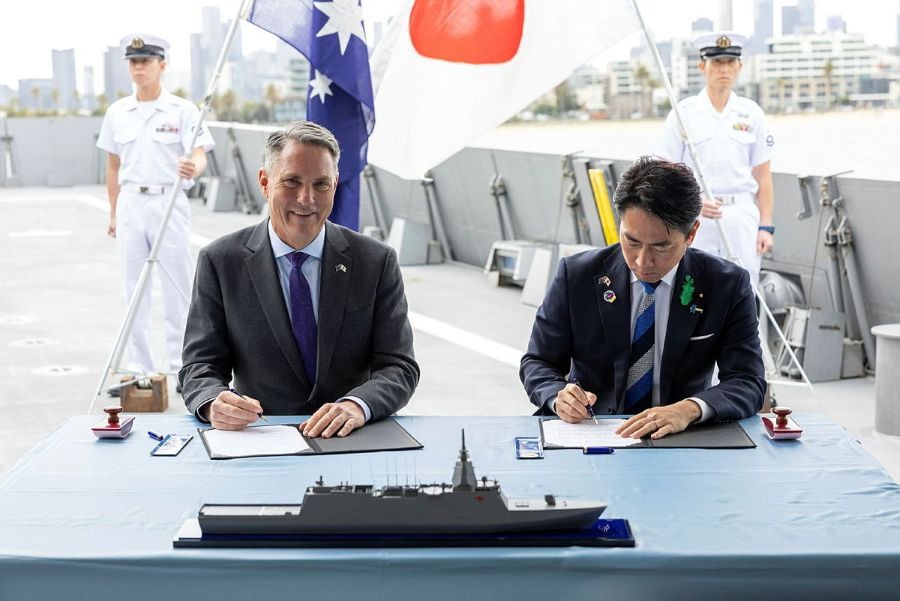
- The historic A$10 billion warship deal between Australia and Japan represents a major shift in Indo-Pacific security dynamics, signalling deeper strategic alignment amid escalating regional tensions.
- Australia and Japan are strengthening their defence capacities and alliances to preserve the balance of power as China increases its naval presence in the Indo-Pacific.
- The warship agreement between Australia and Japan is a strategic symbol of growing Indo-Pacific alignment rather than merely a defence contract.
The historic A$10 billion warship deal between Australia and Japan represents a major shift in Indo-Pacific security dynamics, signalling deeper strategic alignment amid escalating regional tensions. Richard Marles and Shinjiro Koizumi inked the agreement for Mitsubishi Heavy Industries to build cutting-edge Mogami-class frigates for the Royal Australian Navy. Concerns over China’s expanding military might have dictated the agreement‘s wider geopolitical realignment, which goes beyond its industrial significance.
The agreement exhibits traditional balancing behaviour in reaction to a perceived regional danger, according to neorealism. Australia and Japan are strengthening their defence capacities and alliances to preserve the balance of power as China increases its naval presence in the Indo-Pacific. The frigates, which are outfitted with surface combat, air defence, and anti-submarine warfare capabilities, are intended to safeguard crucial maritime commerce routes, highlighting the strategic significance of sea lane security in anarchic international systems.
Additionally, the agreement exemplifies alliance diversification, a notion found in both liberal and realist systems. Although Japan has historically depended on its alliance with the US, this deal demonstrates Tokyo’s attempts to broaden security relations outside of Washington. Japan has steadily normalised its military posture and moved away from rigid postwar pacifism since relaxing its defence export embargo in 2014. Japan can project influence while sharing the responsibility for regional security by partnering with Australia.
From a liberal institutionalist perspective, the accord illustrates how defence cooperation contributes to long-term strategic alliances. In addition to military cooperation, the staged production—first in Japan and then in Australia’s Henderson shipyard—also demonstrates industrial integration and technological transfer. Even in the face of rivalry, such cooperation fosters dependency and mutual trust, which can support regional stability.
The agreement also draws attention to aspects of the dynamics of the security challenge. Australia and Japan present their collaboration as defensive, but China might see it as containment, which could lead to more military growth. Rising tensions in the Indo-Pacific region, where overlapping security concerns and mistrust influence state actions, are typified by this cycle of action and reaction.
From a constructivist perspective, Japan’s changing identity is very noteworthy. Tokyo now sees itself as a proactive security actor rather than a pacifist state as a result of the deal. In addition to material dangers, shifting national and regional standards pertaining to security responsibility are also driving this shift.
Therefore, the warship agreement between Australia and Japan is a strategic symbol of growing Indo-Pacific alignment rather than merely a defence contract. Such alliances will be essential in determining the future security architecture of the area as regional nations react to changing power dynamics.

Anjali Singh is a postgraduate student of Political Science and International Relations, a Social Media Analyst, and a former Research Intern at the Indian Council of World Affairs. Views expressed are the author’s own.
 Archita Gaur