
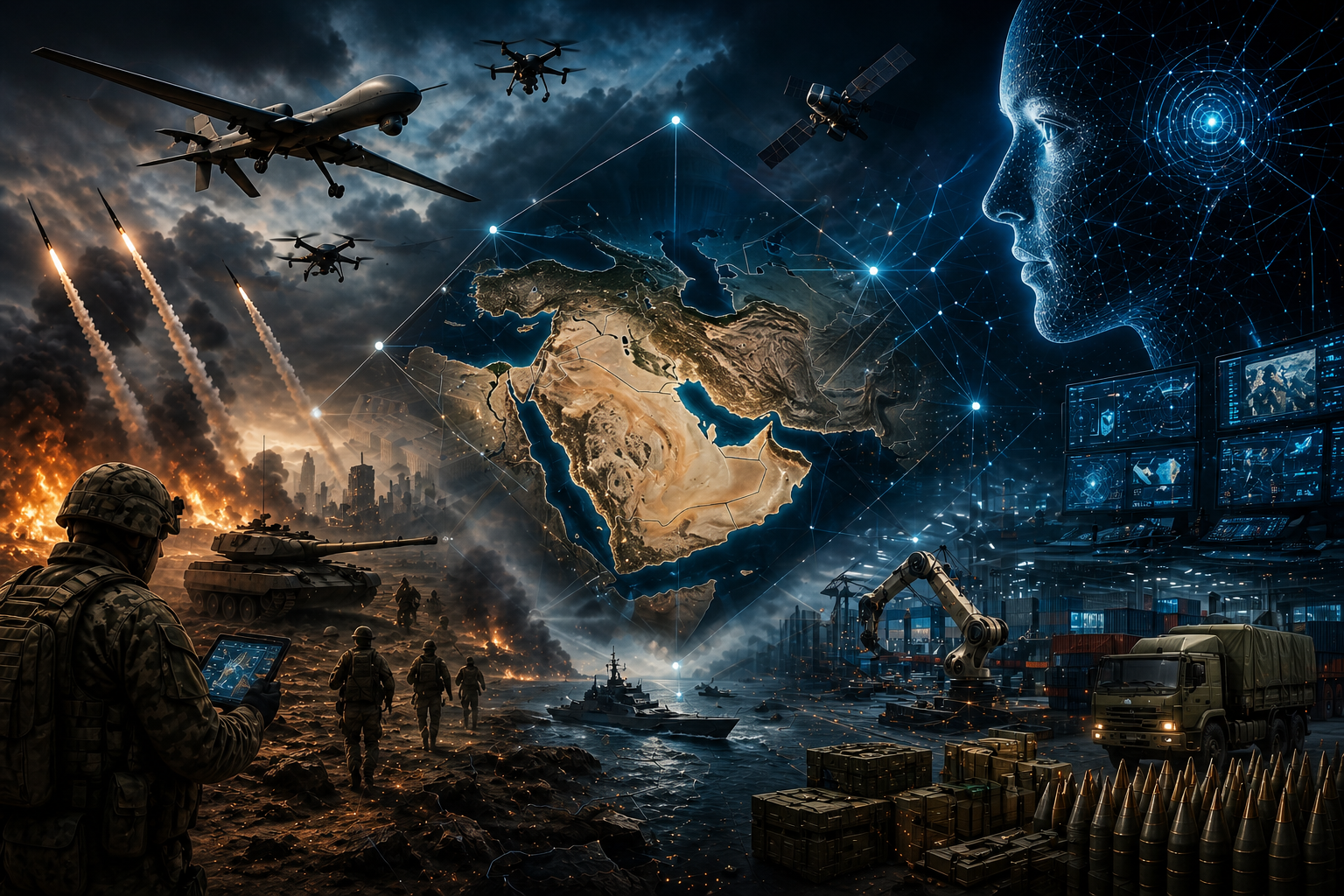
- With the inclusion of venture-backed tech giants, or the “Silicon Insurgents”, the triangle has changed into a diamond. Companies that were once in the business of social media algorithms are now designing and building the “algorithms” of the “algorithmic kill chain”.
- West Asia has now become a live-fire laboratory of experimental technology that is undergoing “battle-testing” for future international applications.
- For the first time, artificial intelligence (AI) & machine learning platforms such as Maven are processing satellite imagery, signals intelligence, and real-time data in order to identify ground-based military targets over the Iranian plateau with minimal human involvement.
- The military-industrial complex has emerged from the shadows into full view as a “supplier of war” and will no longer remain a silent partner in foreign policy.
In 1961, President Dwight D. Eisenhower warned of the “undue influence” of the Military-Industrial Complex (MIC). 65 years later, as the fires of the 2026 crisis in West Asia flicker on the horizon, the complex is now not only alive and well but also morphed into a nimble, faster, and far more expansive force than even the “Five-Star General” could have ever imagined.
The “Diamond” Structure
Experts have described the MIC as an “Iron Triangle” for decades, representing a three-way alliance of the Pentagon, Defense contractors, and Congress. However, due to the latest escalation of conflict involving Iran and its regional adversaries, a new four-sided structure has emerged.
With the inclusion of venture-backed tech giants, or the “Silicon Insurgents”, the triangle has changed into a diamond. Companies that were once in the business of social media algorithms are now designing and building the “algorithms” of the “algorithmic kill chain”. In the theatre of 2026, a weapon system’s value will no longer be based solely on the amount of armour on it but on the speed of its software updates.
A Live Fire Laboratory in the Levant
Military analysts have referred to the current battle environment as the “Great Calibration”. West Asia has now become a live-fire laboratory of experimental technology that is undergoing “battle-testing” for future international applications.
Dr Aris Thorne of the Institute for Strategic Studies says we are experiencing a transition from “just-in-case” manufacturing into “DevOps” warfare (i.e., software development meets military warfare). An anti-drone battery patch for defense contractors becomes available in under a week following the deployment of a new drone swarm architecture in the Persian Gulf.
It is this relationship between manufacturing, warfare, and the massive influx of technology and weapons into the modern battlefield that is exhibited through current autonomous targeting systems. For the first time, artificial intelligence (AI) & machine learning platforms such as Maven are processing satellite imagery, signals intelligence, and real-time data in order to identify ground-based military targets over the Iranian plateau with minimal human involvement. While the military-industrial complex promotes the use of these systems as equivalent to “precision” strikes, the ever-growing instances of incidental collateral damage have led to a worldwide debate about extenuating the moral implications associated with “outsourcing” the ethics of war from military personnel to private-sector algorithms.
The Industrial “Stress Test”
As illustrated by the aforementioned events, the modern industrial “stress test” is experiencing an accelerated crisis. By the first quarter of 2026, the rapid and total depletion of munitions inventories to levels previously seen only in stone-aged societies after devastating wars will shatter the long-held belief in the indestructibility of the so-called Western industrial powers. The last remaining legacy primes cannot maintain production and inventory levels necessary to equip the current and future global conflicts.
The fragility of supply chains has caused a significant change towards “friend-shoring”. A decade ago, this would have sounded unimaginable: the Western military-industrial complex (MIC) is increasingly turning to emerging manufacturing hubs to support its logistics needs. India has emerged as a strategically neutral partner and is proliferating its defense industry exports to cover the strategic inventory deficit created by overstretched U.S. and European manufacturing capability.
The Premium for War
As the global defence budget has reached new heights, totalling $2.6 trillion, the military-industrial complex is prospering through this period of uncertainty. The war premium, achieved through greater separation of defense equity and the declining world economy, is being reflected in investor demand for security technology. Increasing global oil prices (surging higher than $120 per barrel because of the temporary blockade of the Strait of Hormuz) are now driving greater investor demand for security technology.
And finally, yet again, the revolving door continues to spin. Critics of this trend cite the historically high number of retired generals serving in executive roles at AI technology startups, with these companies experiencing an average fourfold increase in their market value since the start of the current crisis.
The New Reality
The military-industrial complex has emerged from the shadows into full view as a “supplier of war” and will no longer remain a silent partner in foreign policy. It is now the engine. The line between national defence and private profit has been blurred through the use of the violent digital fog of modern warfare. This will leave the world wondering if the “unwarranted influence” that was foreseen by Eisenhower has ultimately transformed into a worldwide “norm”.
Reference
- How AI is rewriting the rules of modern warfare- https://www.visionofhumanity.org/how-ai-is-rewriting-the-rules-of-modern-warfare/
- The First AI War: The Dilemma of Military Autonomy- https://idsa.in/publisher/comments/the-first-ai-war-the-dilemma-of-military-autonomy
- The West Asia conflict is exposing India’s steel energy security risk- https://ieefa.org/resources/west-asia-conflict-exposing-indias-steel-energy-security-risk
- The Middle East conflict begins to cast a shadow on the global economy- https://www.deloitte.com/us/en/insights/topics/economy/iran-middle-east-conflict-impacts-global-economy.html
- The Iran war highlights the creeping use of AI in warfare- https://www.chathamhouse.org/2026/03/iran-war-highlights-creeping-use-ai-warfare

Parag Gilada is a Master’s student at IISM Mumbai in Sports Management, with a bachelor’s from OP Jindal Global University in Global Affairs, with an interest in Sports Diplomacy and Governance. Views expressed are the author’s own.
 Kumar Satish
  Anjali Singh