
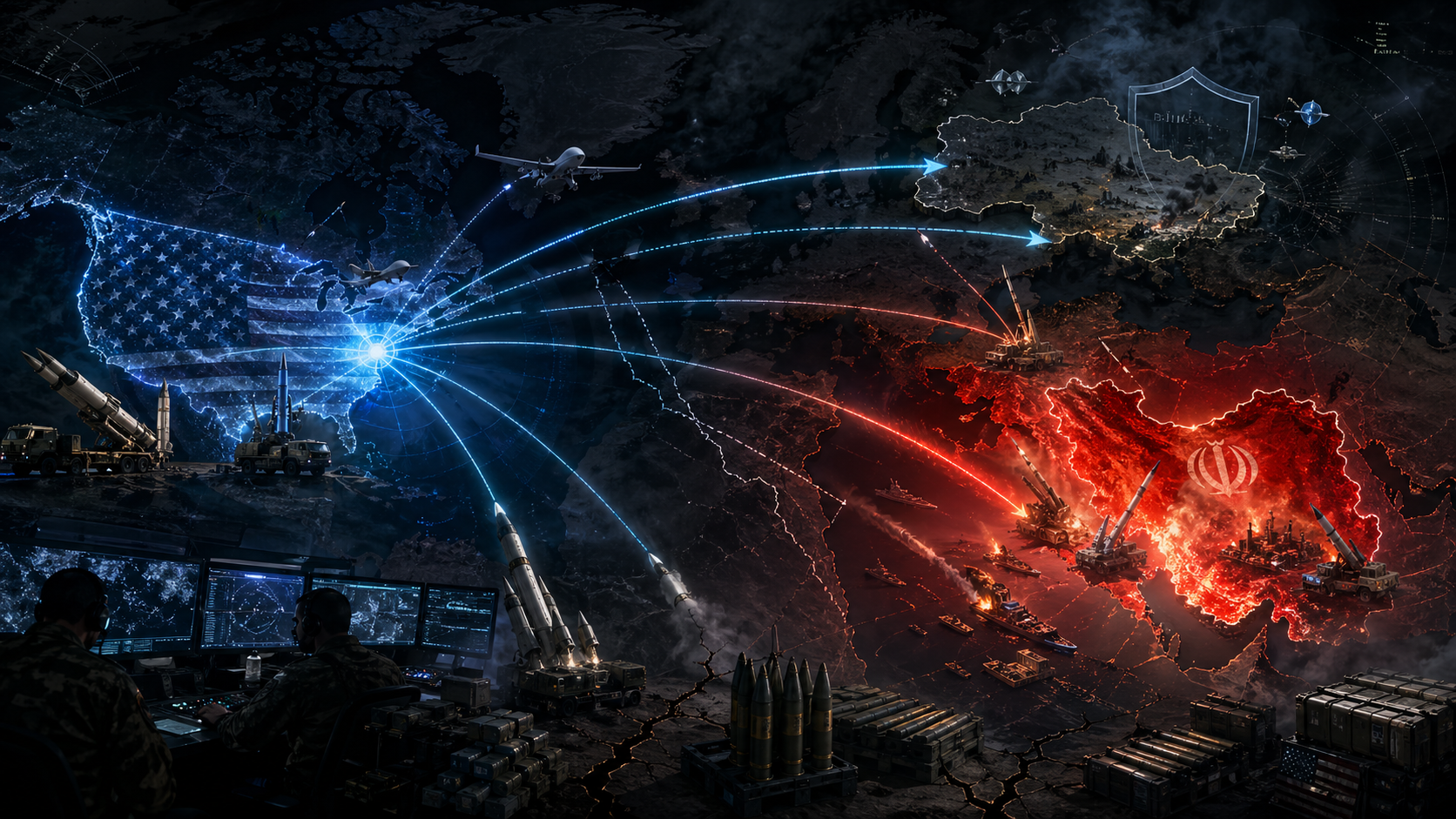
- The U.S. Department of Defense reportedly diverted nearly $750 million from the Prioritised Ukraine Requirement List (PURL) to replenish rapidly depleting American weapons stockpiles.
- Intensive military operations in the Gulf after Operation Epic Fury have consumed large numbers of Patriot and THAAD interceptors, exposing a serious strain on U.S. ammunition reserves.
- America’s defense industry is struggling to replace advanced weapons fast enough, creating a widening gap between production capacity and battlefield consumption.
- A prolonged U.S. strategic shift toward the Gulf could weaken Ukraine’s access to critical advanced air defense systems, increasing its vulnerability against Russian missile and air attacks.
Washington is facing a serious issue but in the Pentagon many people don’t want to talk about it. Their officers keep saying that the Prioritized Ukraine Requirement List (PURL) will always supply Ukraine but the report says something else. On march 23 according to The Washington Post. The U.S. Defense Department informed Congress that around 750 million dollars military funding will be diverted from PURL[1]. .This money will be used to refill America’s weapon stockpile ,which is running quickly. In military terms this type of situation is called Pink Flamingo[2]. This means a crisis that was predictable but the U.S. government ignored it because it was not their main narrative.
The Munitions Hemorrhage In The Gulf
The root of this problem is not in Eastern Europe .It is the Gulf. After the attack against Iran on Feb,28 known as Operation Epic Fury[3]The United States has been using ammunition very fast to deal with Iranian coastal radar systems and their kamikaze drones [4],U.S. forces are heavily dependent on their most advanced weapon.
This number shows how serious this issue is according to Military Watch Magazine ,the U.S. army used more than 800 patriot interceptors in just five days of war[5],in just 11 days it used 150 THAAD Interceptors. This is more than 30 percent of U.S. Army total global stock[6].Admiral Cooper ,who leads U.S. Central Command (CENTCOM) said that the United States fired more than 2000 munitions to hit nearly 2,000 targets in the first 100 hours of war[7].
At the same time Russia is likely aware of what is happening in the Gulf .There are indications that Russia is helping Iran in this war so they can fight for longer duration[8]This will increase pressure on U.S. stockpiles and also pull the attention of the U.S. from Eastern Europe to the Gulf.
The Defense Industrial Bottleneck
The main issue is not only about how weapons are being used. The main issue is the production capacity of the U.S. the defense industry is not able to produce the weapons at the current rate of use .Years of lower investment during the peacetime have reduced the production capacity of US industries.
According to the Times of India ,the U.S. can produce around 600 patriot missiles in a year[9]The US Congressional research service also shows the limit in the production of other weapons. HIMARS rocket production is 96 per year, while GMLRS missile production is around 14,000 per year[10]and Lockheed Martin reports that THAAD interceptor production is around 96 units per year[11]. When these numbers are compared with current usage, the hit gap becomes very clear.
The Zero Sum Reality For Kyiv
These limits will directly affect Ukraine, and the impact could be serious. According to The Guardian the United States only provides 20 percent of Ukraine’s total weaponry[12]. But these weapons are the most advanced and highly important for Ukraine .These weapons are necessary to deal with a major power like Russia that has capabilities like the Kinzhal hypersonic[13] missile and Sukhoi SU- 57 fighter jets[14].
According to the Research of Kiel Institute shows how much Ukraine is dependent on U.S weapons. Around 86 percent of its Rocket Artillery, 82 percent of its howitzers, and 70 percent of its advanced air defense systems[15]come from the U.S. Without systems like Patriot, THAAD, Ukraine’s ability to stop ballistic threats from Russia becomes much weaker, its airspace becomes more vulnerable.
Ukraine has some alternatives but they are limited .In the Ukraine war domestic production now makes up 55 percent this gives some relief but it is not enough to replace U.S. advanced weapon systems.
European allies are also contributing around 25 percent of weapons in the Ukraine war.[16]These include systems like, The British Storm Shadow ,the French Scalp E.G and the German IRIS -T -SLM[17]. However, these systems mostly work as a temporary solution. They can not fully replace the U.S air defense system.
If the United States continues to focus on the gulf at this level, the 750 million shift may only be the beginning. This shows the classic Realist situation where limited resources force countries to make choices between different regions. According to The Washington Post .this could be the starting of the resource shifting from the United States. In that case Ukraine could become more vulnerable . This is especially important if Russia focuses on critical infrastructure like energy systems before winter . A long reduction of U.S. weapons could change the situation on the battlefield.
Conclusion
Whatever is happening is not just a short term pressure on U.S. military resources. It shows a big problem. The speed at which U.S. weapons are being used in the GULF along with slow production is forcing different choices between regions. For Ukraine, this creates real concern even with the help from allies, less access to advanced U.S. systems could weaken its defense over time. More broadly this situation shows a reality. Major power finding difficulties to handle multiple conflicts at the same time .
References:
[1]Kozatskyi, S. (2026, March 27). U.S. repurpose $750 million NATO for Ukraine. Militarnyi. https://militarnyi.com/en/news/us-repurpose-750-million-nato-for-ukrai
[2]Goure, D. (2022, November 10). Pink flamingo: The U.S. military will pay for its munition shortage. The National Interest. https://nationalinterest.org/feature/pink-flamingo-us-military-will-pay-its-munition-shortage-205777
[3]U.S. Central Command. (2026, February 28). Operation Epic Fury. U.S. Department of Defense. https://www.centcom.mil/OPERATIONS-AND-EXERCISES/EPIC-FURY/
[4]Popular Mechanics. (2026). U.S. deploys reverse-engineered Shahed-style drones in first combat use against Iran. https://www.popularmechanics.com/military/weapons/a70736910/lucas-drone-first-combat-use/
[5]Military Watch Magazine. (2026, March 6). U.S. has burned through over $2.4 billion worth of Patriot missile interceptors in just five days of war with Iran. Military Watch Magazine. https://militarywatchmagazine.com/article/us-patriot-interceptors-five-days-iran
[6]Losey, S. (2026, March 6). Race of attrition: U.S. military’s finite interceptor stockpile is being tested. Military Times. https://www.militarytimes.com/news/your-military/2026/03/06/race-of-attrition-us-militarys-finite-interceptor-stockpile-is-being-tested/
[7]Syrian Arab News Agency. (2026, March 4). US says it struck 2,000 targets in Iran in largest regional operation since 2003. https://sana.sy/en/international/2300299/
[8]Pant, H. V. (2026, April 5). A war redefining global order. The Financial Express. https://www.financialexpress.com/opinion/a-war-redefining-global-order/4196335/
[9]TOI News Desk. (2026, April 5). 600-mile strike push: US positions lethal long-range missiles for Iran war – Report. The Times of India. https://timesofindia.indiatimes.com/defence/news/600-mile-strike-push-us-positions-lethal-long-range-missiles-for-iran-war-report/articleshow/130032066.cms
[10]Congressional Research Service. (2024, September). U.S. security assistance to Ukraine: Weapons and equipment. https://crsreports.congress.gov
[11]Lockheed Martin. (2024, October 17). Lockheed Martin and U.S. government expand THAAD interceptor production under framework agreement. https://www.lockheedmartin.com
[12]MacSwan, A. (2025, March 4). The U.S. is halting military aid to Ukraine, so what happens next? CNBC. https://www.cnbc.com/2025/03/04/the-us-is-halting-military-aid-to-ukraine-so-what-happens-next.html
[13]Wikipedia contributors. (2026, March 1). Kh-47M2 Kinzhal. Wikipedia. https://en.wikipedia.org/wiki/Kh-47M2_Kinzhal
[14]Wikipedia contributors. (2026, March 1). Sukhoi Su-57. Wikipedia. https://en.wikipedia.org/wiki/Sukhoi_Su-57
[15]MacSwan, A. (2025, March 4). The U.S. is halting military aid to Ukraine, so what happens next? CNBC. https://www.cnbc.com/2025/03/04/the-us-is-halting-military-aid-to-ukraine-so-what-happens-next.html
[16]European Union Institute for Security Studies. (2025). Plugging the gap: How Europe can replace U.S. military support to Ukraine (Brief No. 14/2025). https://www.iss.europa.eu/sites/default/files/2025-06/Brief_2025_14_Ukraine.pdf
[17]European Union Institute for Security Studies. (2025). Plugging the gap: How Europe can replace U.S. military support to Ukraine (Brief No. 14/2025). https://www.iss.europa.eu/sites/default/files/2025-06/Brief_2025_14_Ukraine.pdf

Shivendra Shukla is pursuing M.A. in Politics and International Studies at Pondicherry University. Views expressed are the author’s own.
 Archita Gaur
  Hridbina Chatterjee
  Divyanka Tandon