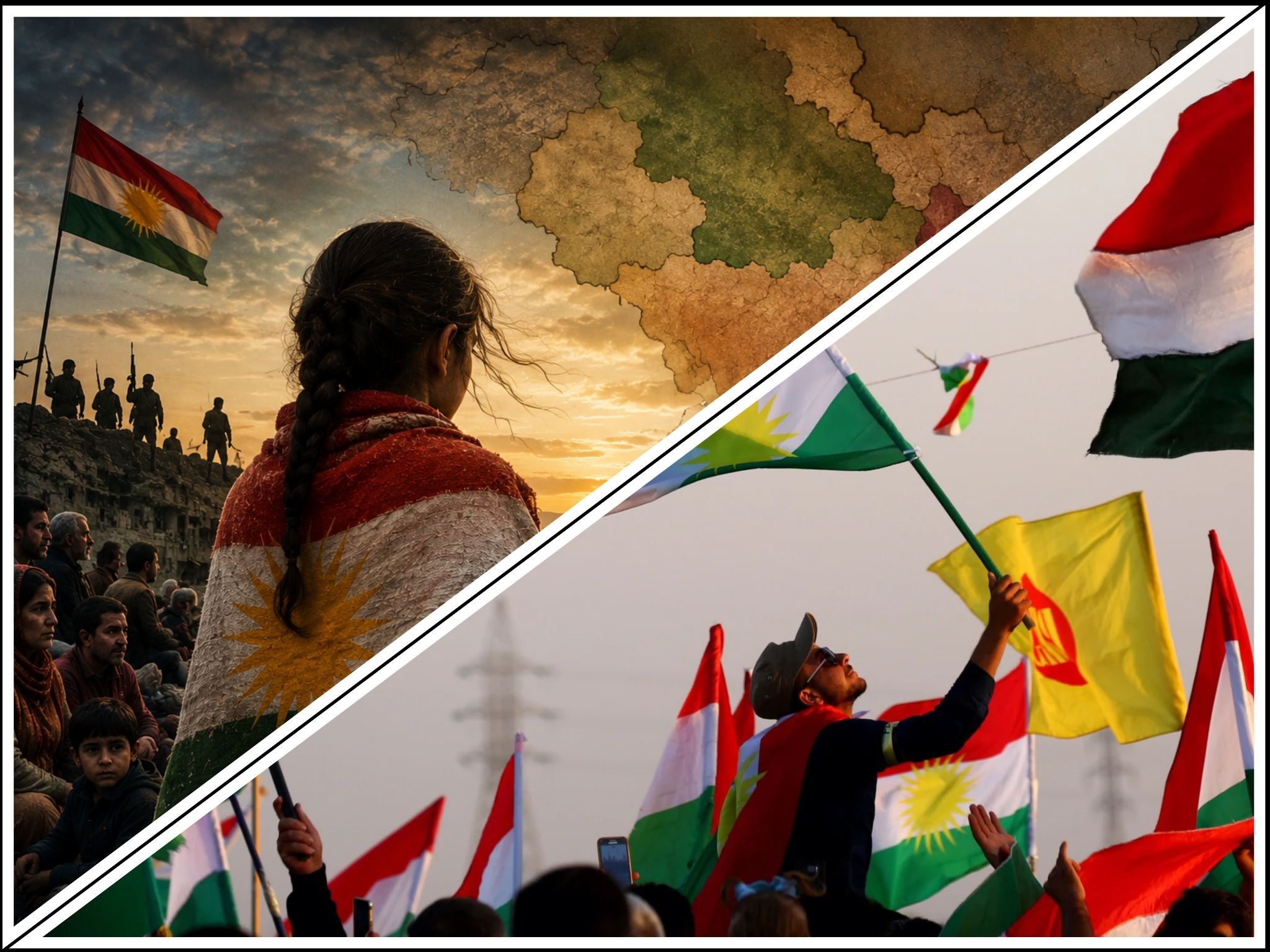
- The Kurdish issue has transcended the question of ethnic identity and minority rights. It has become a complicated geopolitical crisis involving border security, counterterrorism, energy politics, proxy war, refugee displacement, and great power competition.
- The Kurdish question exposes at last a basic contradiction of international politics: the contradiction between self-determination and territorial sovereignty.
- The Kurdish problem is not just an ethnic problem. It is a geopolitical struggle fueled by colonial borders, competing nationalisms, hydrocarbon interests, counterterrorism policies, and great power competition.
The Kurdish fight is one of the longest and most strategically important in the modern Middle East. The Kurds are approximately 30-40 million people, the largest stateless ethnic group in the world, living in Turkey, Syria, Iraq, and Iran. For decades of political activism, armed struggle, and international intervention, the Kurds have not yet been able to create their own state.
The Kurdish issue has transcended the question of ethnic identity and minority rights. It has become a complicated geopolitical crisis involving border security, counterterrorism, energy politics, proxy war, refugee displacement, and great power competition. The rise of Kurdish armed groups in Syria, the independence of Iraqi Kurdistan, and Turkey’s military campaigns against Kurdish militias have brought the Kurdish question to the centre of Middle Eastern geopolitics.
Historical Background of the Kurdish Problem
The modern Kurdish conflict began with the collapse of the Ottoman Empire after the First World War. The Sèvres Treaty of 1920 called for the establishment of a Kurdish nation in eastern Anatolia. However, the treaty was never ratified. Rather, the 1923 Treaty of Lausanne set the current borders of Turkey with no recognition of Kurdish sovereignty.
The Kurdish people were then dispersed among many newly created nation-states. The division only served to further marginalise the Kurds and led to competing state-led efforts to suppress Kurdish culture. For decades, Turkey severely restricted the Kurdish language and political expression. In 1962, discriminatory census rules deprived many Kurds of their Syrian citizenship. There were Kurdish revolts in Iraq and Iran, often put down with military force. The Kurdish conflict is a major source of instability in the region and a challenge to national security and territorial integrity, the Council on Foreign Relations said.
Turkey, the PKK, and the Security Dilemma
The Kurdish problem in Turkey is still the most militarised part of the problem. The Kurdistan Workers’ Party (PKK) was founded in 1978, and it profoundly transformed Kurdish resistance. The PKK, led by Abdullah Öcalan, began an armed insurgency against Turkey in 1984, initially demanding an autonomous Kurdish state.
Turkey, the United States, and the European Union all designate the PKK as a terrorist organisation. The conflict is said to have killed more than 40,000 people. The Turkish state views Kurdish militancy as an existential threat that can divide national territory. This impression was greatly enhanced when the Syrian Civil War began. In northern Syria, Kurdish forces, especially the People’s Protection Units (YPG), won land and international recognition for their role in fighting the Islamic State.
Turkey says the YPG is inextricably tied to the PKK. In response, Ankara has launched a string of cross-border military campaigns—Operation Euphrates Shield (2016), Operation Olive Branch (2018), and Operation Peace Spring (2019)—aimed at preventing the creation of a Kurdish-controlled corridor along the Turkish-Syrian border. Turkey’s strategic value, as highlighted in NATO’s official profile, makes it hard for Western countries to work with Syrian Kurdish forces.
Syria and The Rise of Kurdish Power
The Syrian civil war has had a major impact on Kurdish geopolitics. In 2011, as the Syrian government lost control of territory, Kurdish groups set up autonomous administrations in northern Syria, united under the Syrian Democratic Forces (SDF) banner. With heavy American backing, the SDF became one of the most effective anti-ISIS forces in the region.
The Kurdish-led war against ISIS ended with the capture of Raqqa in 2017 and the territorial defeat of ISIS in 2019. According to the U.S. Department of Defense in the Operation Inherent Resolve report, the Kurdish-led forces were vital in dismantling ISIS territorial networks. But Kurdish-American cooperation revealed weaknesses in Western policy. Washington viewed the Kurdish militias as tactical allies in the fight against ISIS but was not in favour of a Kurdish state or providing guarantees for long-term autonomy.
Most recently, this geopolitical ambiguity was brought into focus in 2019 when the US largely withdrew forces from northern Syria, enabling Turkey to conduct military operations against Kurdish-held regions. Human Rights Watch said the Turkish offensive in Syria had displaced many residents and made the humanitarian crisis worse in areas with a Kurdish majority.
The Syrian Kurdish project is therefore structurally weak. Its survival depends not only on military power but also on the calculations of other powers like the United States and Russia.
Iran’s Kurdish Question
Iranian Kurdish activism is still heavily policed. Tehran routinely accuses Kurdish political groups seeking autonomy or cultural rights of being separatist and foreign-backed destabilisers. Iranian security forces often clash with armed Kurdish groups near the border with Iraq.
Iran’s concerns are driven by local and geopolitical factors. The Kurdish-dominated areas have strategically significant territory adjacent to Iraq and Turkey, and Tehran is suspicious of foreign actors using ethnic fault lines to undermine the Iranian state.
Moreover, the Kurdish question is inextricably tied to energy geopolitics. Kurdish-controlled parts of Iraq have large oil and gas reserves, and are therefore of economic interest to regional and global actors alike.
The Kurdistan Regional Government sought autonomous energy export agreements, primarily through pipelines connecting Iraqi Kurdistan to Turkey. Such arrangements tended to lead to disputes with Baghdad over constitutional power and revenue-sharing arrangements. According to the International Energy Agency’s Iraq energy profile, northern Iraq’s hydrocarbon resources are of strategic importance for regional energy markets. Control of Kurdish energy infrastructure, thus, influences not only Iraqi politics but also wider regional economic relations.
Energy dependency has also produced an anomaly in Turkish-Kurdish relations. Turkey opposes Kurdish nationalism but has an economic interest in energy transit and trade with Iraqi Kurdistan.
Contradictions: Geopolitical
The Kurdish question exposes at last a basic contradiction of international politics: the contradiction between self-determination and territorial sovereignty. Kurdish movements argue that decades of repression justify the need for autonomy or independence. But regional governments view these demands as an existential threat to the unity of the state.
Kurdish groups have always been used as tactical partners by global powers, but permanent Kurdish sovereignty has never been accepted. The United States has fought alongside Kurdish militias against ISIS but has opposed the Iraqi Kurds’ independence vote. Parallel to Russia’s relations with Kurdish parties in Syria were strategic relations with Turkey and the Syrian government.
This tendency has produced widespread Kurdish suspicions toward outside powers. The Kurdish movements are often used as a pawn of regional strategy, but without a long-term political guarantee.
Conclusion
The Kurdish problem is not just an ethnic problem. It is a geopolitical struggle fueled by colonial borders, competing nationalisms, hydrocarbon interests, counterterrorism policies, and great power competition. More than a century after the fall of the Ottoman Empire, the Kurdish question continues to baffle because there is no agreement at the regional or international level on how to address Kurdish aspirations.
The fate of the Kurds will likely be determined less by military victory than by the capacity of Middle Eastern states to fashion political structures that balance national sovereignty with minority rights and regional stability. Until then, the Kurdish problem will be one of the Middle East’s longest-running and strategically most volatile conflicts.

Anusreeta Dutta is a columnist and climate researcher with experience in political analysis, ESG research, and energy policy. Views expressed are the author’s own.
 Aayush Pal
  Kumar Satish