
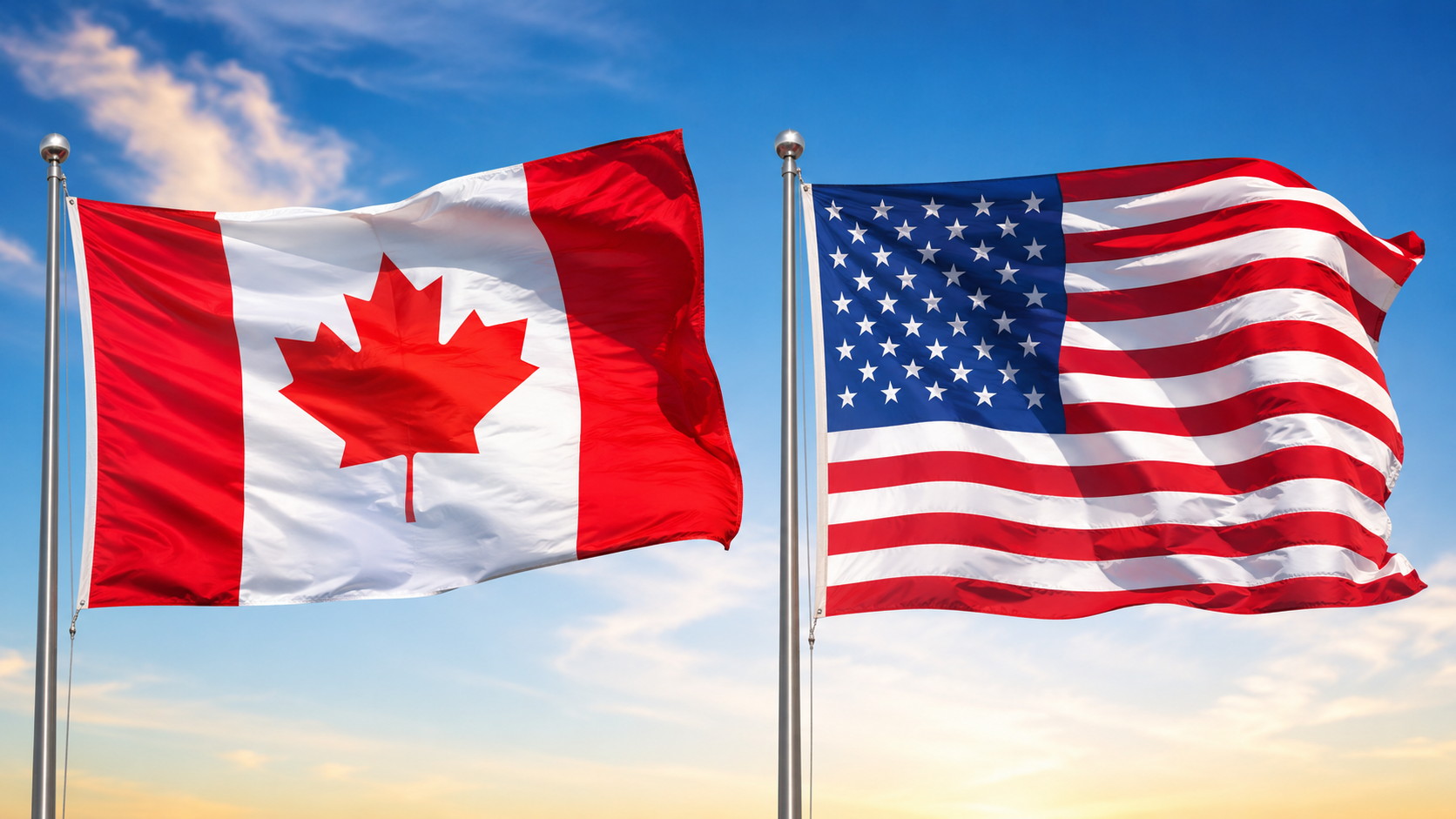
- The two countries share a border and are both members of NATO, while maintaining deep cultural, political, and economic linkages.
- This economic interdependence makes the current confrontation particularly significant.
- Prime Minister Mark Carney is therefore increasingly looking towards strengthening Canada’s internal market while fostering greater economic relationships across Asia.
- The situation highlights the importance for countries of maintaining economic independence and avoiding excessive dependence on the United States.
In a remarkable development, the United States of America and Canada are now engaged in an economic war, as months of trade negotiations between the two countries have completely collapsed. Canadian Prime Minister Mark Carney has described the situation as an economic attack by the United States, bringing a complicated, difficult, and unique phase to the Canada–US relationship.
The two countries share a border and are both members of NATO, while maintaining deep cultural, political, and economic linkages. The trade relationship is particularly significant because their economies are closely connected through automobiles and auto parts, oil and natural gas, steel and aluminium, lumber, machinery and many other goods and services.
These economic linkages led Canada and the United States to sign the North American Free Trade Agreement, or NAFTA, in 1994, which was subsequently replaced by the USMCA in 2020. Under the agreement, a significant portion of trade between the two countries is tariff-free.
However, President Trump has consistently argued that the United States should benefit equally from its trade relationships and has historically opposed several free trade arrangements. This was evident during his first presidency, when the United States imposed tariffs of up to 10% on certain Canadian imports, although these measures were eventually rolled back during the Justin Trudeau administration.
President Trump’s second administration has taken a much tougher position towards Canada. In April last year, the United States introduced a 25% tariff on Canadian imports. This economic measure was also accompanied by strong political rhetoric from Washington, including from President Trump and his allies.
President Trump has repeatedly suggested that Canada should become the 51st state of the United States and has argued that Canada is heavily dependent on American support. This has further complicated an already difficult relationship, with Canada facing what it considers both a political and economic attack.
The 25% tariff was not implemented immediately. Its implementation was delayed and postponed, leading to a series of negotiations between Washington and Ottawa. Despite the economic tensions, the two countries remained deeply interconnected, with Canada exporting major quantities of oil, natural gas, machinery and lumber to the United States, while the United States exports machinery, heavy industrial goods, metals and other manufactured products to Canada.
This economic interdependence makes the current confrontation particularly significant. When both countries were reportedly close to reaching a trade agreement, President Trump withdrew from the negotiations at the last moment and imposed a 50% tariff on approximately $20 billion worth of Canadian imports.
Prime Minister Mark Carney has said that President Trump and his team betrayed Canada, arguing that Ottawa was prepared to agree to a trade arrangement but that the negotiations were called off at the very last moment. The move represents the latest escalation in what has become a serious economic confrontation between the two countries.
The fundamental question now is how Canada will sustain itself when a major portion of its economy remains deeply dependent on the American market. Prime Minister Mark Carney is therefore increasingly looking towards strengthening Canada’s internal market while fostering greater economic relationships across Asia. Canada has shown interest in developing stronger economic ties with Asian economies, including India and China, as well as with the wider Asian market.
Asia could potentially provide alternative destinations for Canadian exports, particularly if Canada’s dependence on the United States continues to create economic vulnerabilities. However, reducing this dependence will not be an immediate process given the depth of integration between the two economies.
At the same time, the economic losses resulting from the dispute raise fundamental questions about the political relationship and broader geopolitical coordination between the two countries. Canada is a member of NATO, the G7 and several other major international institutions. Any major bilateral dispute between Ottawa and Washington can therefore have implications beyond the two countries and could eventually be reflected on wider global platforms.
President Trump’s second administration has created significant uncertainty not only for the Canadian economy but also for the wider global economy. The Canadian experience provides an important lesson for many American allies and partners, including India, which has also experienced difficult phases in its bilateral relationship with the United States.
The situation highlights the importance for countries of maintaining economic independence and avoiding excessive dependence on the United States. Although reducing such dependence may be difficult in the short term for countries such as India, Canada and European partners of the United States, in the longer run, it could create an opportunity to diversify their economies, strengthen alternative partnerships and develop greater economic options elsewhere.

Aayush Pal is a freelance writer on contemporary geopolitical developments. The views expressed in his work are entirely his own.
 Kumar Satish