
- The agreement includes joint exercises, personnel and expert exchanges, information sharing, logistical support, port access, and maintenance and repair facilities.
- This development comes at a pivotal time when Japan has further strengthened its relationship with India and advanced its commitment to a Free and Open Indo-Pacific, while India has also been particular about its MAHASAGAR vision.
- This becomes particularly important as China has, in recent years, attempted to expand its presence across the Indo-Pacific and increase its military footprint in the region.
- The partnership is therefore not only important for the development of bilateral relations but also for maintaining stability, balance and a rules-based order across the wider Indo-Pacific region.
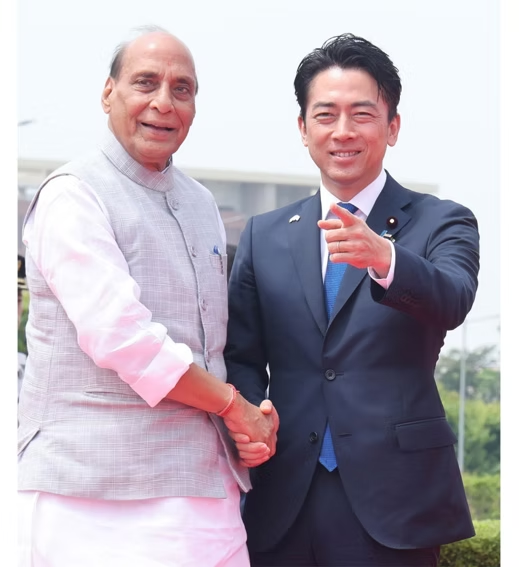
In an important development, Japanese Defence Minister Shinjiro Koizumi visited India in a move to further bolster the bilateral relationship between India and Japan. This comes months after Japanese Prime Minister Sanae Takaichi’s visit to India. During the important visit, the Japanese Defence Minister met his Indian counterpart, Defence Minister Rajnath Singh, and signed a Memorandum of Arrangement on Maritime Security Cooperation to strengthen greater coordination between the Indian Navy and the Japan Maritime Self-Defense Force.
This comes at a time when Japan has shown clear intentions to further develop its maritime capabilities and strengthen its presence in the wider Indian Ocean region. The agreement includes joint exercises, personnel and expert exchanges, information sharing, logistical support, port access, and maintenance and repair facilities. The two sides have also agreed to explore joint development and design of naval ships, marking an important step towards deeper defence-industrial cooperation.
This development comes at a pivotal time when Japan has further strengthened its relationship with India and advanced its commitment to a Free and Open Indo-Pacific, while India has also been particular about its MAHASAGAR vision. The two countries have traditionally shared a strong relationship and have coordinated across multiple domains, including military, political, economic and socio-cultural engagement. India has developed a high degree of trust towards Japan, and the current geopolitical situation has encouraged both countries to further advance their strategic partnership.
For Japan, India is an important economic partner as well as a major strategic partner in the wider Indo-Pacific region. Both countries share the view that the Indo-Pacific is an important geopolitical focal point of the 21st century, and that like-minded countries such as India and Japan have an important responsibility to ensure that the region remains inclusive, transparent and free from unilateral attempts to change the status quo.
This becomes particularly important as China has, in recent years, attempted to expand its presence across the Indo-Pacific and increase its military footprint in the region. Both India and Japan remain concerned about attempts to alter the existing regional balance and the status quo through unilateral actions. The two countries, along with the United States and Australia, are also members of the Quad and have coordinated on several important issues concerning the Indo-Pacific.
Japan has also been seeking to strengthen its relationships with neighbouring Asian countries, with India remaining one of its most trusted strategic partners. Tokyo has faced growing security challenges from China, including China’s expanding military presence in the region and increasing pressure around Japan’s maritime environment. At the same time, North Korea’s continued missile launches, including those affecting waters around Japan, have further complicated Japan’s security environment.
Japan therefore increasingly understands the importance of strengthening its deterrence capabilities through deeper partnerships with like-minded countries, and India has emerged as an important partner in this strategy.
For India, Japan has also been a trusted and long-standing partner. Japanese investment has played an important role in India’s economic development, with Japan remaining an important source of foreign direct investment and a significant partner in infrastructure, technology and industrial development. Japanese technology and innovation have also contributed to India’s economic growth, while defence cooperation between the two countries has continued to expand.
Beyond defence and economics, India and Japan have also used their growing engagement to strengthen people-to-people connections and cultural exchanges. Both countries have developed a broader relationship that extends beyond strategic cooperation.
At a critical time when the geopolitics of the Indo-Pacific is undergoing significant transformation, with countries increasing their presence and challenging the existing balance of power, the India-Japan relationship has acquired greater importance. The partnership is therefore not only important for the development of bilateral relations but also for maintaining stability, balance and a rules-based order across the wider Indo-Pacific region.

Aayush Pal is a freelance writer on contemporary geopolitical developments. The views expressed in his work are entirely his own.
 Hridbina Chatterjee
  Divyanka Tandon
  Kumar Satish