

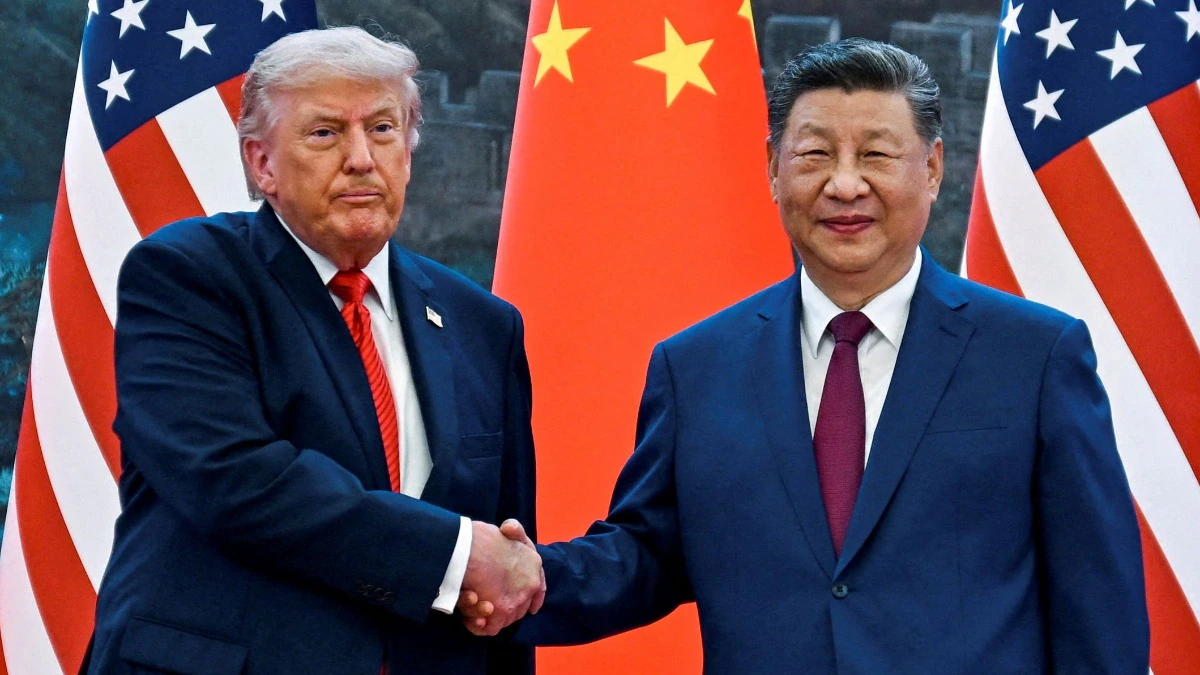
- The September 2026 state visit of Chinese President Xi Jinping to Washington was more than a ceremonial meeting between two of the world’s most powerful leaders.
- The most important message from Washington, therefore, may not be the individual agreements announced during the visit.
- If Washington and Beijing establish a more stable mechanism for managing their rivalry, India will have to deal with a China that is simultaneously competing with the United States and negotiating with it.
- It is how effectively India can build enough national capability to cooperate with both where interests converge, compete where interests diverge, and preserve the freedom to make independent decisions when neither side’s preferences fully match India’s own.
The September 2026 state visit of Chinese President Xi Jinping to Washington was more than a ceremonial meeting between two of the world’s most powerful leaders. It was a reminder that even amid intense strategic competition, the United States and China remain capable of negotiating, managing tensions and creating limited areas of cooperation. For India, this development carries particular significance. New Delhi has spent the past decade strengthening its relationship with Washington while simultaneously maintaining its strategic autonomy and managing a difficult but increasingly important relationship with Beijing.
Xi Jinping’s three-day state visit to the United States from September 23 to 25, 2026, was the first White House visit by a Chinese president in more than a decade. President Donald Trump and Xi discussed trade, investment, artificial intelligence and emerging technologies, Iran, Taiwan, critical minerals, fentanyl-related issues and broader questions concerning the future of US-China relations. The two sides also agreed to continue high-level engagement, including cooperation around the APEC and G20 processes.
The most important message from Washington, therefore, may not be the individual agreements announced during the visit. It is that Washington and Beijing are attempting to establish mechanisms for managing competition without allowing it to completely destabilise their economic and strategic relationship.
For India, this creates both opportunities and uncertainties.
From confrontation to managed competition
The Trump–Xi summit did not eliminate the structural rivalry between the United States and China. Differences remain over Taiwan, technology, military power, trade, supply chains and the Indo-Pacific. However, the summit demonstrated that competition and engagement can coexist.
The two countries agreed on a number of mechanisms dealing with trade and investment, while continuing discussions concerning critical minerals and emerging technologies. Washington and Beijing also agreed to establish a dialogue concerning what the US described as “super intelligence”, reflecting the growing importance of advanced AI technologies in the strategic relationship.
This is important because the global economy has increasingly been organised around US-China competition. Restrictions on advanced semiconductors, competition over artificial intelligence, supply-chain diversification and disputes over rare earths have affected countries far beyond Washington and Beijing.
India has benefited from the diversification of global supply chains, particularly through the broader “China plus one” strategy. But a partial stabilisation of US-China relations could complicate that trend. If American and Chinese companies regain greater predictability in bilateral trade, some investment that might otherwise move towards alternative production centres could remain within the existing US-China economic ecosystem.
At the same time, the summit does not mean that strategic competition has disappeared. Businesses and governments are still looking to diversify supply chains because the structural sources of tension remain.
For India, this means that economic strategy cannot depend solely on the assumption of permanent US-China confrontation.
India’s strategic space
The most interesting dimension of the summit for India is the question of strategic autonomy.
New Delhi has deepened its relationship with Washington through defence cooperation, technology partnerships, the Quad and economic engagement. At the same time, India remains a member of BRICS and the Shanghai Cooperation Organisation and continues to engage with Russia, China and other emerging powers.
This approach has sometimes been described as strategic hedging. The underlying idea is relatively straightforward: India does not want its foreign policy to become dependent on any single major power.
The recent developments surrounding BRICS demonstrate this clearly.
India hosted the 18th BRICS summit in New Delhi in September 2026, bringing together countries representing a substantial portion of the developing world. Xi Jinping met Prime Minister Narendra Modi on the sidelines of the summit, and Chinese officials described the two countries as partners while highlighting improvements in bilateral relations.
This is significant because India-China relations had been heavily affected by the border crisis and military tensions of the previous years. The subsequent effort to stabilise the relationship does not erase the strategic rivalry between the two countries, but it creates additional diplomatic space for both sides.
The timing is important.
Xi met Modi in New Delhi before travelling to Washington.
The sequence illustrates something fundamental about India’s position in the emerging international order: India is capable of engaging China without abandoning its relationship with the United States, just as it can deepen cooperation with Washington without completely aligning itself with the American position on every international issue.
The Global South dimension
The US-China contest is no longer confined to the Pacific or to bilateral trade negotiations. Increasingly, it is also a contest for influence across the Global South.
China has expanded its economic, infrastructure, technological and diplomatic presence across Asia, Africa, Latin America and the Middle East. Beijing’s appeal in many developing countries is linked to infrastructure financing, trade, technology and its willingness to engage without attaching the same political conditions that Western governments sometimes emphasise.
The United States, meanwhile, continues to possess enormous economic, technological, financial and military influence, but Washington’s relationships with developing countries are increasingly being judged against questions of market access, tariffs, development finance and strategic autonomy.
India occupies an unusual position in this competition.
New Delhi is simultaneously a major developing economy, a member of the G20 and BRICS, a participant in the Quad and an important strategic partner of the United States. India also presents itself as a voice for the developing world while resisting the transformation of the Global South into an explicitly anti-Western political bloc.
This distinction is important.
India’s preferred approach has generally been to argue for a more representative international system rather than simply replacing Western dominance with Chinese dominance. During its BRICS leadership, New Delhi has emphasised development, resilience, technology, reform of international institutions and cooperation among developing countries.
Consequently, India’s role may become increasingly important as Washington and Beijing compete for influence among countries that do not want to choose sides.
The China factor
For India, however, China remains fundamentally different from the United States.
The two countries share a long border, have unresolved territorial disputes and are strategic competitors in the Indian Ocean and Indo-Pacific. China is also India’s largest or among its largest trading partners, while India continues to face a substantial trade imbalance with China.
At the same time, complete economic separation is neither an immediate reality nor necessarily India’s stated objective.
This produces a complicated relationship: competition in security, dependence in parts of trade and manufacturing, cooperation in multilateral institutions, and growing diplomatic engagement.
The recent India-China rapprochement should therefore not automatically be interpreted as an alliance or strategic alignment. Analysts have described the improvement as a tactical or pragmatic stabilisation rather than the disappearance of fundamental differences.
That distinction matters even more after the Trump–Xi summit.
If Washington and Beijing establish a more stable mechanism for managing their rivalry, India will have to deal with a China that is simultaneously competing with the United States and negotiating with it.
That could be more complicated than a straightforward bipolar confrontation.
Critical minerals and technology
One of the most important areas for India is the emerging competition over critical minerals and advanced technology.
The United States and China discussed rare earths and critical mineral supply chains during the summit. This is directly relevant to India because rare earth elements and other critical minerals are essential for electric vehicles, renewable energy, electronics, defence systems and advanced manufacturing.
India has been attempting to strengthen cooperation with partners in critical-mineral supply chains. The challenge is to develop domestic capacity while building diversified international partnerships.
Artificial intelligence presents another major area of competition.
The creation of a US-China dialogue on advanced AI technologies suggests that Washington and Beijing recognise the necessity of establishing communication mechanisms around technologies that have implications extending beyond commercial competition.
For India, this creates a dual challenge.
New Delhi wants access to advanced American technology and investment while simultaneously developing domestic AI capabilities. At the same time, India wants to prevent excessive dependence on any single technological ecosystem.
The emerging global technology order could therefore become as important for India’s strategic autonomy as traditional military alliances.
What the summit means for India’s relationship with Washington
The Trump–Xi meeting should not automatically be interpreted as a weakening of India-US relations.
The United States has strong reasons to continue engaging India. India is a major economy, a significant Indo-Pacific power and an important participant in the Quad. Washington also has an interest in diversified supply chains and alternative manufacturing centres.
However, India cannot assume that US policy will always be structured around countering China.
The summit demonstrates that American foreign policy can simultaneously involve competition with China and negotiations with China. Washington can seek cooperation with Beijing on trade, technology or global crises while maintaining security partnerships with other countries.
This is precisely why India needs to retain flexibility.
If the US-China relationship becomes more stable, India will have to compete for investment and technology on economic grounds rather than simply benefiting from geopolitical rivalry.
That could ultimately make domestic competitiveness even more important.
India as a third pole
The emerging international system is sometimes described as a new bipolar competition between Washington and Beijing. But India’s growing economic, technological and diplomatic weight complicates that description.
India is not China, and it is not an American ally in the traditional treaty-alliance sense. Its foreign policy has historically sought room for independent decision-making.
The significance of India lies precisely in this middle space.
New Delhi can cooperate with Washington on defence, technology, critical minerals and the Indo-Pacific. It can simultaneously engage Beijing through BRICS, bilateral diplomacy and multilateral institutions. It can work with Russia on energy and defence while expanding relationships with Europe, Japan, Australia, the Gulf and Southeast Asia.
The objective is not to balance every country against another country. Rather, it is to maximise India’s strategic options.
This becomes particularly important when the world’s two largest powers are themselves trying to manage their rivalry.
The road ahead
The Trump–Xi summit should therefore be understood less as the beginning of a US-China partnership and more as another stage in the development of managed competition.
The United States and China remain strategic competitors, but they also have powerful incentives to prevent their rivalry from becoming completely uncontrollable. The September summit produced mechanisms for continued engagement, but major disagreements remain unresolved.
For India, the lesson is equally clear.
New Delhi’s strategic environment cannot be reduced to choosing between Washington and Beijing. India’s interests extend across the United States, China, Russia, Europe, the Gulf, Africa and the wider Global South.
The India-China engagement at the BRICS summit, followed by Xi’s Washington visit, is particularly revealing. Beijing was able to engage New Delhi and Washington within the same month, while India itself engaged both countries from different diplomatic platforms.
This is the emerging geometry of twenty-first-century geopolitics.
India’s importance may increasingly come not from becoming an extension of one power bloc, but from possessing enough economic scale, diplomatic reach and strategic autonomy to engage multiple centres of power simultaneously.
The Trump–Xi summit therefore does not place India outside the US-China equation. It makes India’s position within that equation more consequential.
As Washington and Beijing attempt to manage their competition, countries such as India will have greater incentive to diversify their partnerships, strengthen domestic capabilities and avoid excessive dependence on any single geopolitical relationship.
The central question for New Delhi is consequently not whether it should stand with Washington or Beijing.
It is how effectively India can build enough national capability to cooperate with both where interests converge, compete where interests diverge, and preserve the freedom to make independent decisions when neither side’s preferences fully match India’s own.
References:
- The White House — Fact Sheet: President Donald J. Trump Advances a Fair and Reciprocal Relationship with China While Hosting Historic State Visit
September 25, 2026. Covers the Trump–Xi summit, trade and investment mechanisms, critical minerals, G20/APEC coordination and the new US-China “Super Intelligence” dialogue.
White House – Trump–Xi State Visit Fact Sheet - Reuters — Trump welcomes China’s Xi with fanfare, but no breakthroughs emerge
September 24, 2026. Useful for the political and strategic context of the Washington summit, including trade, Taiwan, AI and the broader US-China rivalry.
Reuters – Trump welcomes Xi in Washington - Prime Minister’s Office, Government of India — PM’s bilateral meeting with Chinese President Xi Jinping
September 12, 2026. Important primary source for Modi–Xi discussions at the BRICS Summit, including border issues, trade imbalance, supply chains and India-China relations.
PM India – Modi–Xi Bilateral Meeting - Prime Minister’s Office, Government of India — BRICS New Delhi Declaration 2026
September 12, 2026. Provides the official BRICS framework and India’s approach to multilateralism, development, economic cooperation and a more representative international order.
BRICS New Delhi Declaration 2026 - The Indian Express — US, China in competitive mode, India & others need to de-risk, diversify to secure interests: Jaishankar
September 2026. Particularly useful for the article’s argument about India’s need to diversify economic and strategic relationships amid US-China competition.
Indian Express – Jaishankar on US-China Competition and India

Divyanka Tandon holds an M.Tech in Data Analytics from BITS Pilani. With a strong foundation in technology and data interpretation, her work focuses on geopolitical risk analysis and writing articles that make sense of global and national data, trends, and their underlying causes. Views expressed are the author’s own.
 Kumar Satish
  Aayush Pal