
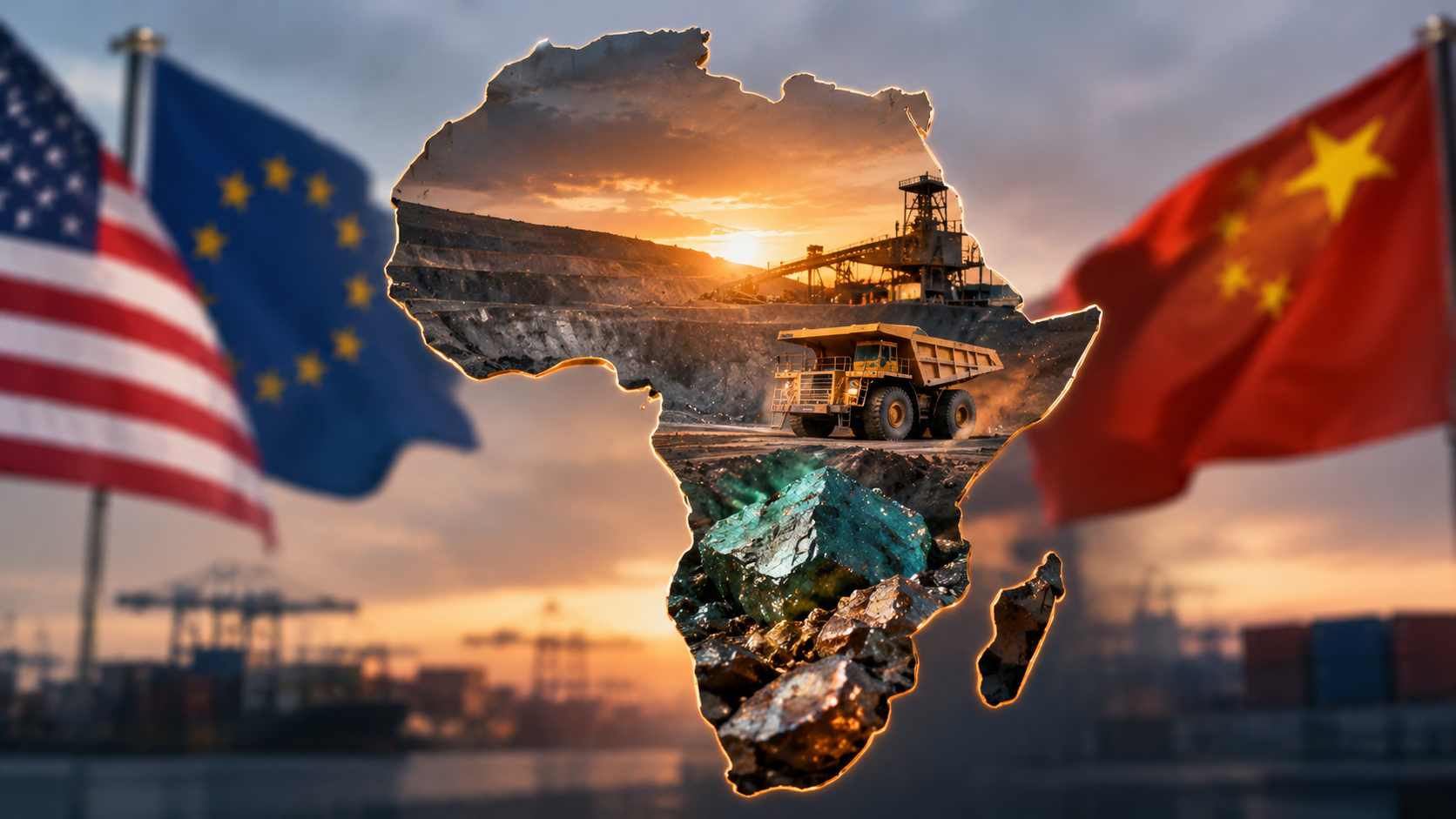
- From the Democratic Republic of the Congo’s cobalt reserves to Zimbabwe’s lithium industry and Zambia’s copper sector, governments are exploring ways to move beyond raw-material exports towards domestic processing, industrial development and greater economic autonomy.
- The competition for Africa’s resources is not simply a contest between two external powers; it is also a test of whether African governments can translate competing interests into more favourable economic arrangements.
- The DRC’s approach to cobalt demonstrates a different dimension of resource leverage. As a leading global producer of cobalt, the country introduced export restrictions in 2025 and subsequently moved to a quota-based system.
- The real measure of resource sovereignty is not the ability to restrict exports or attract competing powers; it is the ability to ensure that the wealth beneath the continent’s soil contributes more substantially to prosperity above it.
For decades, Africa has occupied a paradoxical position in the global economy: a continent rich in critical minerals, energy resources and strategic geography, yet one that has often captured only a limited share of the value generated from them. Today, as competition among the United States, China, the European Union and Gulf powers intensifies, this paradox is acquiring a new geopolitical dimension. The global transition to clean energy, the race to secure critical mineral supply chains and the search for new investment destinations have made African states increasingly important to the strategic calculations of external powers.
However, the significance of this competition lies not merely in who gains access to Africa’s resources, but in whether African governments can use that competition to renegotiate the terms of their engagement with the global economy. From the Democratic Republic of the Congo’s cobalt reserves to Zimbabwe’s lithium industry and Zambia’s copper sector, governments are exploring ways to move beyond raw-material exports towards domestic processing, industrial development and greater economic autonomy. The central question, therefore, is whether intensifying great-power rivalry can create meaningful opportunities for African resource sovereignty—or whether it will reproduce older patterns of external dependence under a new geopolitical order.
From Resource Dependence to Strategic Leverage
The growing importance of Africa in critical-mineral supply chains has raised an important question: what role will the continent occupy in the global economic order? Resource abundance alone, however, does not guarantee bargaining power. The strategic significance of minerals depends on the extent to which producing countries can influence the conditions under which they are extracted, processed and traded. For decades, mineral production in many African economies has remained concentrated in the early stages of the value chain, while much of the higher-value processing and manufacturing has taken place elsewhere. This has limited the extent to which resource wealth translates into domestic industrial capacity.
Some governments, however, are attempting to change this pattern. Recent policy shifts indicate a move towards retaining more value domestically by encouraging the processing of raw materials into higher-value products. Zimbabwe took a significant step in this direction in February 2026, when it suspended exports of raw minerals and lithium concentrates, citing concerns over irregularities and the need to promote domestic value addition. However, the policy also highlights the challenges associated with mineral processing, including the need for substantial capital, reliable electricity, technical expertise and stable regulatory frameworks.
This raises a broader question about Africa’s economic and political strategy: can measures aimed at strengthening resource control improve the bargaining position of African governments and help them secure more favourable trade and investment terms? Export restrictions may influence investment decisions and trade flows, but such measures alone cannot create competitive industrial sectors. The central challenge is to transform control over natural resources into productive capacity that generates skilled employment, strengthens local businesses and reduces dependence on exporting unprocessed commodities.
China, the West and Africa’s Bargaining Space
The competition for Africa’s resources is not simply a contest between two external powers; it is also a test of whether African governments can translate competing interests into more favourable economic arrangements. China’s established position in mineral extraction, refining and infrastructure gives it considerable advantages, while the United States and its partners are seeking to diversify critical-mineral supply chains and reduce their dependence on Chinese processing. The US-backed Lobito Corridor, connecting Angola’s Atlantic coast with mining regions in the Democratic Republic of the Congo (DRC) and Zambia, illustrates how infrastructure investment is increasingly linked to wider strategic objectives.
For African governments, this competition creates opportunities to secure alternative sources of finance, infrastructure and market access. However, the ability to attract multiple external partners does not necessarily translate into greater economic sovereignty. A country may attract new investment in mining while continuing to export unprocessed commodities, depend on foreign technology and remain vulnerable to fluctuations in global markets. Diversifying foreign partnerships, therefore, cannot be an end in itself. Governments must negotiate arrangements that develop domestic industrial capacity and strengthen local participation in mineral value chains.
This consideration underpins Africa’s increasingly assertive approach to global competition. Governments have several instruments at their disposal, including local-processing requirements, the renegotiation of mining agreements, export controls and long-term supply contracts. However, the effectiveness of these instruments depends on institutional capacity, access to capital, regional coordination and the availability of viable domestic markets. As analyses of Africa’s evolving geopolitical position have highlighted, national bargaining strategies can create opportunities but may also generate new dependencies when they are pursued without sufficient regional coordination.
The question, therefore, is not simply whether African states can choose between China and the West. It is whether they can negotiate favourable terms with both—and whether those terms translate into tangible gains in industrial development, employment and economic autonomy.
Zimbabwe and the DRC: Testing the Limits of Resource Sovereignty
Zimbabwe and the Democratic Republic of the Congo offer two revealing examples of how African governments are attempting to convert mineral wealth into greater economic leverage. Although their approaches differ, both cases reflect a broader trend: resource-rich states are increasingly seeking greater control over the sale and processing of their minerals rather than leaving the terms of trade entirely to mining companies and international markets.
Zimbabwe’s lithium policies illustrate an attempt to capture a greater share of the value generated by the global energy transition. In February 2026, the government suspended exports of raw minerals and lithium concentrates, citing irregularities and the need to strengthen domestic value addition. In April, it outlined conditions for resuming exports, including quotas and commitments to establish local processing facilities. The government’s longer-term objective is to move beyond exporting lithium-bearing material towards producing higher-value inputs for battery supply chains.
However, the policy also highlights the limitations of using regulation to accelerate industrialisation. In July 2026, Zimbabwe’s only operating lithium sulphate plant was reported to be at capacity, limiting its ability to process material from other producers, while several proposed facilities remained under construction. Although export restrictions may encourage investment in domestic processing, imposing them before sufficient capacity becomes available risks disrupting production and reducing export earnings.
The DRC’s approach to cobalt demonstrates a different dimension of resource leverage. As a leading global producer of cobalt, the country introduced export restrictions in 2025 and subsequently moved to a quota-based system. In April 2026, it also established a strategic reserve covering cobalt, coltan and germanium, giving the state additional means of influencing the availability of critical minerals in international markets. These measures reflect an attempt to exercise greater control over mineral supply and market conditions.
Yet the two cases point to an important distinction between controlling exports and achieving economic sovereignty. Zimbabwe’s challenge is to establish sufficient processing capacity, infrastructure and technical expertise. The DRC, meanwhile, must translate its influence over cobalt supply into stronger domestic industrial capabilities and broader economic gains. Neither export restrictions nor strategic reserves can, by themselves, guarantee these outcomes.
The broader lesson is that resource sovereignty requires more than ownership of minerals or the ability to regulate their movement across borders. It depends on whether governments can use that leverage to develop competitive industries, strengthen domestic institutions and secure a greater share of value within their economies. The effectiveness of Africa’s evolving resource diplomacy will ultimately be measured not by the restrictions governments announce, but by the productive capacity they manage to build.
Conclusion: From Strategic Importance to Economic Sovereignty
Africa’s growing importance in global critical-mineral supply chains presents an opportunity, but not a guarantee, of greater economic autonomy. As competition among external powers intensifies, African governments may find greater room to negotiate investment, infrastructure and market access. Yet geopolitical relevance does not automatically translate into domestic industrial development. Without adequate infrastructure, technological capabilities, regional coordination and effective institutions, resource-rich economies risk remaining suppliers of raw materials even as the strategic value of those resources increases.
The challenge, therefore, is to move beyond treating competition between China and the West as an opportunity in itself. The more consequential question is whether African states can collectively shape the terms of that competition. Regional cooperation, stronger bargaining frameworks and investment in domestic processing could help transform mineral wealth into productive capacity, skilled employment and more diversified economies. Initiatives such as the African Continental Free Trade Area offer a potential framework for building regional value chains, although their success will depend on implementation.
Ultimately, Africa’s position in the emerging global order will depend not simply on how much the world needs its resources, but on how effectively its governments convert that dependence into lasting economic gains. The real measure of resource sovereignty is not the ability to restrict exports or attract competing powers; it is the ability to ensure that the wealth beneath the continent’s soil contributes more substantially to prosperity above it.

Archita Gaur is a postgraduate student at the School of International Studies, JNU. She specialises in the World Economy and has a strong interest in public policy, economic research, and governance. The views expressed are the author’s own.
 Anjali Singh
 Aayush Pal