
|
Getting your Trinity Audio player ready...
|
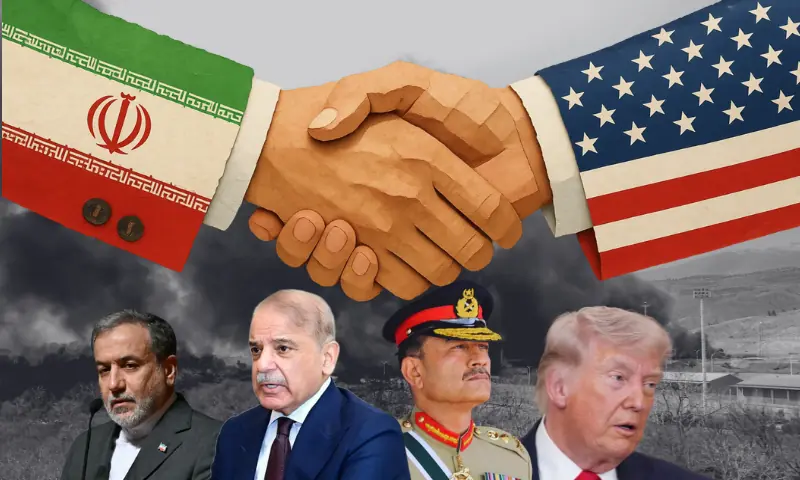
- Pakistan is celebrating again. This time, it is telling the world that it played a crucial role in stopping a war between Iran and America.
- The idea was simple and intoxicating — use Afghan soil to pressure India, erase India’s $5 billion investment, and finally have a friendly, controllable neighbour to the west.
- Within a few years, the same Taliban were sheltering the TTP, the terrorist group actively killing Pakistani soldiers and civilians.
- When you destroy a state, when you humiliate a population, when you leave a vacuum with no legitimate governance — something always fills it.
There is a familiar smell in the air coming from Islamabad. It is the smell of premature victory. Pakistan is celebrating again — this time claiming it played a crucial role in preventing a war between Iran and the United States. Its media is buzzing, officials are hinting, and a narrative is being carefully assembled: Pakistan, once again, is positioned at the centre of global events.
But before accepting that claim, it is worth pausing — because this pattern is not new. We have seen this exact sequence unfold before. Afghanistan was one such moment. Iraq, another. Each time, the celebration came first. The consequences came later.
The Afghanistan Hangover They Forgot
When the Taliban returned to power in Kabul in 2021, Pakistan reacted with unmistakable satisfaction. The event was treated not merely as a geopolitical shift, but as a strategic victory. Senior leadership spoke openly of Afghanistan as a restored “strategic backyard.” The underlying assumption was clear: a friendly regime in Kabul would secure Pakistan’s western flank, diminish India’s influence, and provide long-term leverage in the region.
This was not an accidental outcome from Pakistan’s perspective. For years, it had maintained connections with the Taliban leadership. By multiple credible accounts, Pakistan provided support — logistical, political, and possibly operational — especially in the final phases of the Taliban’s advance. In effect, Pakistan did not simply witness the Taliban’s return. It helped enable it.
Yet the outcome did not follow the script Islamabad had imagined.
The Taliban, once in power, pursued autonomy rather than alignment. They did not behave like a proxy. Instead, they asserted independence and recalibrated their priorities. Within a short span of time, the Tehrik-i-Taliban Pakistan (TTP) found safe haven in Afghanistan and escalated attacks across the border. What Pakistan had envisioned as a strategic buffer quickly became a source of direct security threats.
Meanwhile, India — whose influence Pakistan believed it had neutralised — adapted quietly. It maintained engagement where possible and avoided overreaction.
Pakistan had celebrated too early. The strategic costs are still unfolding.
Now Iran: The Same Mistake, Different Stage
Fast forward to the present. Pakistan is once again positioning itself as indispensable, claiming that it quietly mediated between Tehran and Washington and helped de-escalate tensions.
There is, however, a fundamental problem with this claim: Iran has not acknowledged it.
No senior Iranian authority — not the Supreme Leader, not the President, not the Foreign Minister — has publicly credited Pakistan with any meaningful role. Iranian statements instead emphasise their own diplomatic posture or, at most, suggest the involvement of other actors such as China.
At best, Pakistan may have acted as a communication channel — passing messages between parties. At worst, it is presenting routine diplomatic facilitation as strategic mediation.
This distinction matters. Mediation implies influence, leverage, and trust from both sides. Acting as a messenger does not.
The Deeper Problem: Capacity Without Capability
Even if one assumes Pakistan played a limited role, the more serious question lies ahead: what follows?
Iran faces significant challenges. Years of sanctions have already strained its economy. Any further instability compounds existing vulnerabilities — infrastructure degradation, limited access to global markets, and internal economic pressure. Recovery, if required at scale, would demand vast financial and technological resources.
Pakistan is in no position to provide any of that.
It is itself reliant on external financial assistance, navigating recurring economic crises, and struggling to maintain internal stability. It does not possess the capital, industrial capacity, or technological base necessary to contribute meaningfully to Iran’s recovery.
More importantly, Pakistan appears to have given little thought to the secondary effects of instability across its border with Iran.
The two countries share a long and sensitive frontier through Balochistan — a region already facing internal stress. If Iran were to experience prolonged disruption, refugee flows into Pakistan would not be a distant possibility; they would be inevitable. Such a development would place immediate pressure on an already fragile region.
There is no visible preparation for this scenario — no policy clarity, no public discussion, no contingency planning.
Pakistan is celebrating a development whose consequences it has not fully considered.
When States Break, Vacuums Fill
Recent history offers clear lessons on what happens when states weaken or collapse.
The 2003 invasion of Iraq dismantled the country’s governing structure. It did not replace it with stability. Instead, it created a vacuum. Sunni communities, which had previously held power, found themselves marginalised and excluded from the new political order. That exclusion did not dissolve their influence; it redirected it.
Over time, insurgent networks formed. These networks eventually coalesced into ISIS. By 2014, ISIS had captured major cities, including Mosul, and declared a Caliphate.
This was not an unpredictable outcome. When governance disappears, and large segments of society are alienated, alternative power structures emerge. They are rarely moderate and often violent.
Syria followed a parallel trajectory. As the central state weakened, multiple armed groups emerged, each controlling territory and backed by different external actors. The result was not a single conflict but a fragmented landscape of overlapping crises.
Years later, Syria remains unstable.
Iran’s Internal Fault Lines
Iran, despite its strong central institutions, is not immune to such pressures. It is a multi-ethnic state held together by a combination of political authority and security structures. If that balance weakens, existing fault lines could become more pronounced.
In the northwest, Kurdish groups such as PJAK have long pursued greater autonomy. Across the broader region, Kurdish movements have demonstrated a consistent pattern: they advance politically and territorially when central authority weakens.
In Khuzestan, sections of the Arab population carry longstanding grievances related to resource distribution and political representation. In Sistan-Baluchestan, Baloch communities — divided across Iran, Pakistan, and Afghanistan — have experienced persistent marginalisation.
Militant groups like Jaish al-Adl operate within this context, carrying out attacks inside Iran. At the same time, wider Baloch movements reflect deeper political and economic concerns that cannot be reduced to security issues alone.
When states weaken, such movements tend not to diminish. They expand — and in the absence of political solutions, they can radicalise.
A Region Losing Its Balancing Structures
For decades, Iran extended its influence through a network of allied non-state actors — Hezbollah in Lebanon, Hamas in Gaza, the Houthis in Yemen, and various militias in Iraq. This network functioned as a form of strategic depth, allowing Iran to project power beyond its borders.
That system is now under strain.
Hezbollah has suffered significant losses and is operating within a deeply unstable Lebanon. Hamas has been heavily degraded. Syrian networks have diminished in relevance, and Iraqi militias face increasing constraints.
This erosion matters because it removes a layer of strategic insulation. Iran is now more exposed, at the same time that internal pressures are rising. The convergence of internal vulnerability and external weakening creates a more volatile environment.
ISIS-K is already active across the Afghanistan–Pakistan–Iran region. Its attack in Kerman in 2024, along with continued operations in Peshawar and Balochistan, demonstrates its capacity to exploit precisely these conditions — weak borders, overlapping conflicts, and fragmented governance.
In some respects, the current environment is even more fragile than the one that preceded the rise of ISIS a decade ago.
India: The Power of Consistency
While Pakistan emphasises its claimed role in recent events, India has followed a different trajectory — one based less on visibility and more on consistency.
Over the years, India has built its engagement with Iran through steady diplomatic and economic interaction. It has responded during moments of crisis, including assisting Iranian personnel at sea, and has worked to maintain stability in critical maritime routes such as the Strait of Hormuz.
India has also sustained economic engagement where possible, balancing international pressures with long-term strategic considerations. Its investment in the Chabahar Port project provided Iran with economic connectivity while advancing India’s access to Afghanistan and Central Asia.
Equally significant is the manner in which India has conducted its engagement. It has avoided framing Iran in subordinate terms and has not used the relationship for short-term signalling. In diplomacy, perception carries weight. States respond not only to material support but to how they are treated.
Pakistan’s approach, in contrast, has often appeared reactive — shaped by immediate circumstances rather than long-term strategy.
Iran is likely to recognise that difference.
Influence is rarely built in moments of crisis. It is accumulated gradually, through consistent engagement over time.
The Lesson Is Already Written
Pakistan does not need new examples to understand the risks ahead. Afghanistan provided a recent and ongoing lesson. Iraq, an earlier one. The pattern is consistent: early celebration followed by strategic miscalculation.
Today, the regional environment is defined by multiple, simultaneous pressures — a strained Iran, an unstable Lebanon, a fragmented Syria, a volatile Afghanistan, and an economically challenged Pakistan.
These are not isolated situations. They interact with and reinforce one another. The conditions that historically precede major instability are already present. Pakistan is celebrating a moment it may not have significantly shaped, while positioned in close proximity to the consequences that could follow.
History, in this case, is not subtle about what comes next.
Nations that confuse activity with influence, and noise with power, always discover their mistake too late, not in the halls of diplomacy, but on their own streets.
Ajith is an active voice in regional and international politics, providing critiques on governance and contemporary social and geopolitical issues. Views expressed are the author’s own.
 Atri Patel
  Anusreeta Dutta
  Aayush Pal