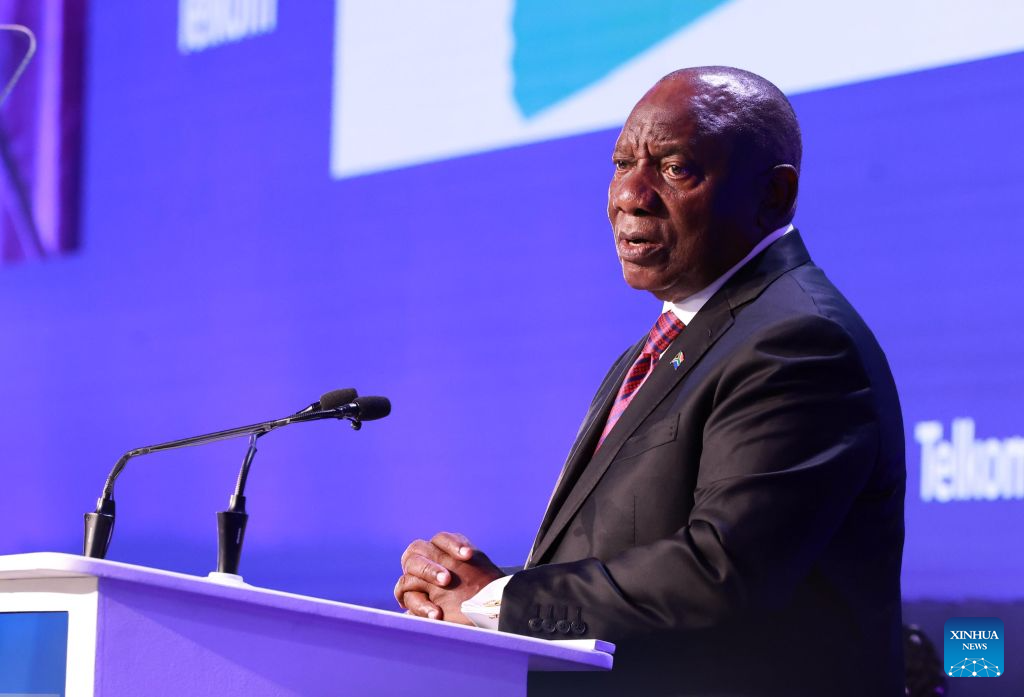
- Over 80 per cent of the votes have been tallied, showing that the party received only 31.8 per cent of the total votes cast across the nation, marking a drop of about 14 percentage points from its 2021 tally.
- The problems with unemployment, corruption, electricity blackouts, lack of water, and bad infrastructure damaged the relationship between the party and citizens.
- For example, the Democratic Alliance (DA) gained 24.1 per cent of the vote share nationally, and the party of former president Zuma, uMkhonto weSizwe (MK), won 9.3 per cent.
- The weakening of the ANC reflects the rising importance of governance, accountability, and economics versus political legacy.
This comes after the decline of the African National Congress (ANC), which used to be the most powerful political force in South Africa. Over 80 per cent of the votes have been tallied, showing that the party had received only 31.8 per cent of the total votes cast across the nation, marking a drop of about 14 percentage points from its 2021 tally. It has become obvious that the party is unpopular among voters as a result of the citizens’ displeasure regarding unemployment, crime, corruption and lack of services.
It is important to note that this is happening amid the decline of the ANC in spite of the role it played during the end of apartheid rule in South Africa in 1994.
The Decline of Liberation Politics and Democratic Legitimacy
With respect to democratic legitimacy, the electoral loss of the ANC is the difference between historical legitimacy and performance legitimacy. The authority of the ANC is based on the fact that it led the fight against the white minority government and its association with Nelson Mandela. Over many years, such a heritage helped the party a lot with its election campaign.
However, democratic legitimacy presupposes that the government has to sustain public trust by means of accountability and effectiveness in terms of providing various services to citizens. The problems with unemployment, corruption, electricity blackouts, lack of water, and bad infrastructure damaged the relationship between the party and citizens.
The situation in Johannesburg is one of the best examples of that. People there were faced with various problems related to water and electricity blackouts, waste being collected, and roads which became very bad. The municipality recognised the problem with the infrastructure investment backlog of 220 billion rand.
Political Fragmentation and the Emergence of Coalition Politics
Furthermore, the election results point towards the move from the dominance of one political party to a more politically fragmented situation. For example, the Democratic Alliance (DA) gained 24.1 per cent of the vote share nationally, and the party of former president Zuma, uMkhonto weSizwe (MK), won 9.3 per cent.
In addition, the ruling African National Congress (ANC) is also expected to lose the position of the largest party in Gauteng and KwaZulu-Natal, being two of the most populated provinces in South Africa. For example, the DA is currently leading with 40 per cent of the vote in Johannesburg, followed by the ANC with 17.5 per cent and ActionSA with 15.5 per cent, while the counting is ongoing.
In such a way, political fragmentation can be described in terms of political pluralism, according to which the competition between different political actors is an important element of democracy.
Politics of Identity and Realignment of Political Coalitions
The emergence of the MK party in KwaZulu-Natal marks yet another aspect of the evolving political landscape of South Africa. Under Jacob Zuma, the party embraces a socially conservative Zulu nationalism and promised redistribution of land and wealth. The MK party shows that identity, past grievances and economic inequalities continue to drive politics in the country.
Under a constructivist theory in international relations, political identities and histories play an important role in how communities perceive their interests and politics. The emergence of the MK party shows how the elements of culture and discontent with current political leadership can be used together to build a new constituency.
On the other hand, the increasing power of the DA implies that opposition politics has become increasingly competitive. However, conflicts among the opposition parties, including Herman Mashaba’s unwillingness to cooperate with Helen Zille, show that forming alliances is not always easy even when all have the same goal in mind.
Implications for South Africa’s Democracy and Place in the International Arena
The declining fortunes of the ANC go beyond municipal politics. South Africa has considerable influence politically and economically on the continent of Africa and is a major actor in debates on issues such as development, inequality, and institutional reforms of the international order. The issues of instability and uncertainty regarding the formation of coalitions can affect policy-making and investment stability.
For political economy, the connection between governance and economic growth is crucial in order to assess the outcome of the election. Unemployment, poor infrastructure, and inefficiencies in service delivery have become a political liability for the government in power. Now there is a need to do something about the new municipality because of the political situation. Nonetheless, this does not mean that the ANC is disappearing as an important political player. With election results pending, the ANC maintains its position nationally, and even recognises the need for reflection.
Conclusion
The 2026 local elections in South Africa have been a turning point in South Africa’s democratization process. The weakening of the ANC reflects the rising importance of governance, accountability, and economics versus political legacy. The rise of the opposition, as well as the dominance of coalition governments, symbolises the coming-of-age of South African democracy and fragmentation.

Anjali Singh is a postgraduate student of Political Science and International Relations, a Social Media Analyst, and a former Research Intern at the Indian Council of World Affairs. Views expressed are the author’s own.
 Aayush Pal