
|
Getting your Trinity Audio player ready...
|
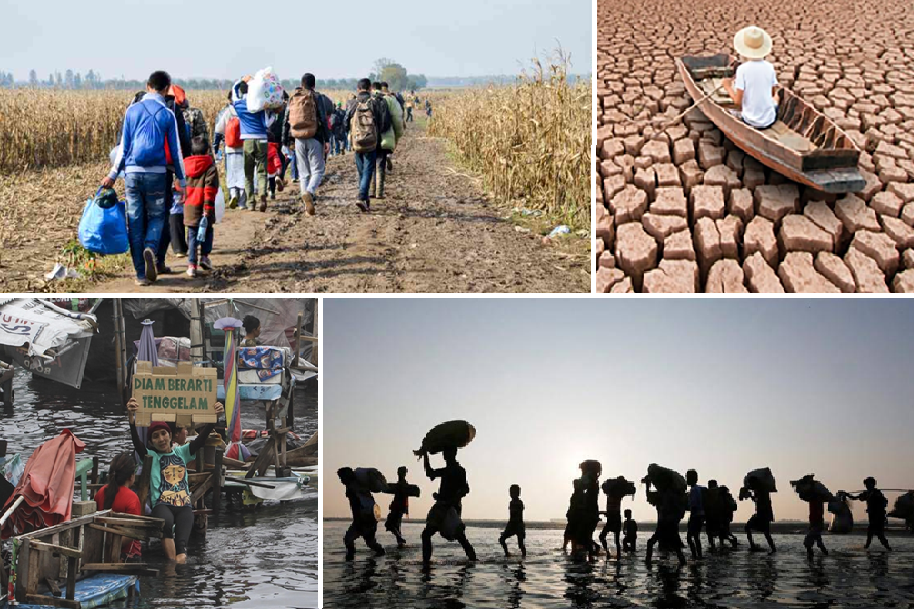
- Migration due to climate change is no longer just a possibility for the future; it is happening right now.
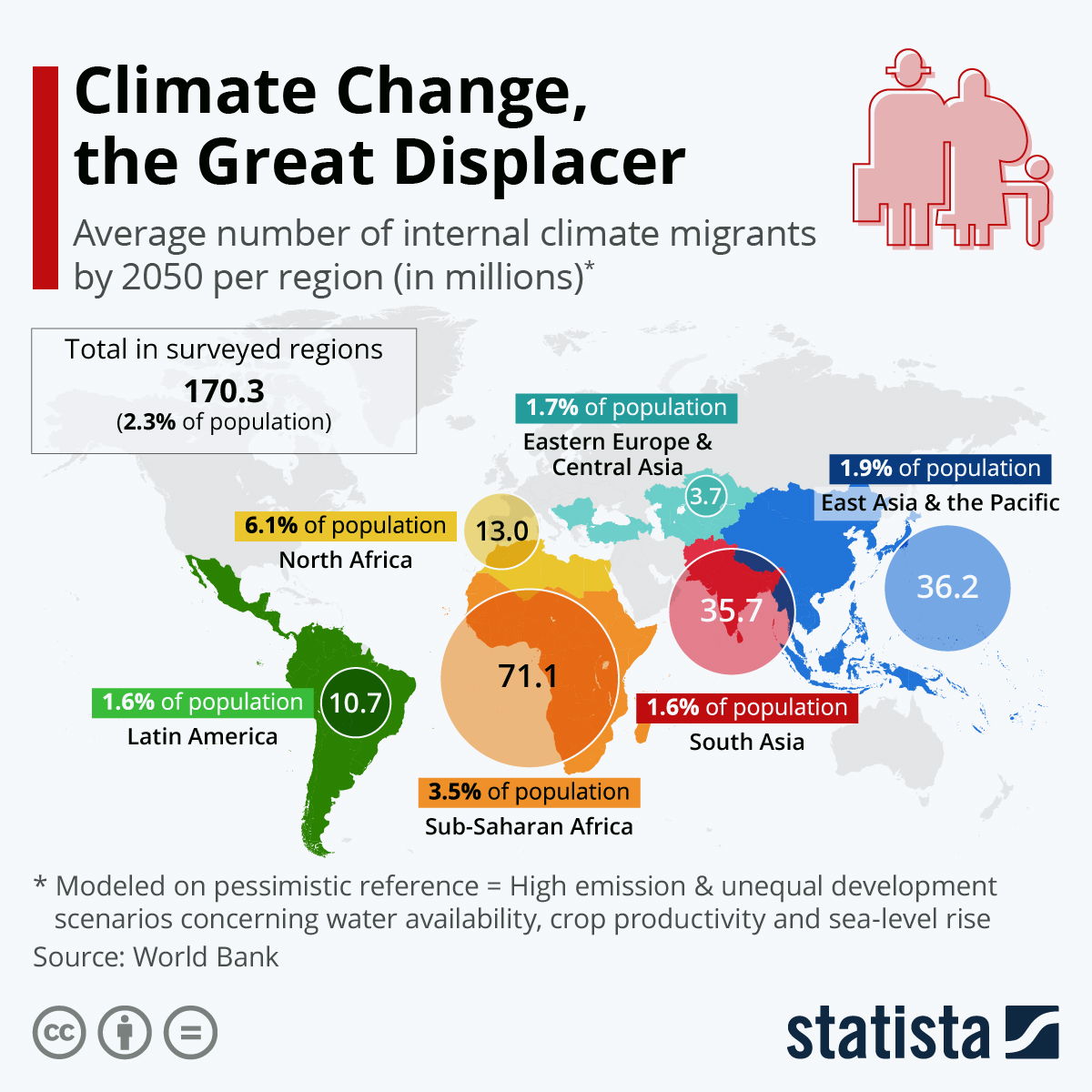
- World Bank says approximately 216 million people could become climate migrants by 2050 across Sub-Saharan Africa, South Asia, and Latin America.
- When migrants are seen as economic rivals or cultural outsiders, political narratives put exclusion ahead of working together.
- Displacement is anticipated to transpire at unprecedented magnitudes, altering labour markets, urban infrastructures, and international relations, in the absence of intervention.
The most important geopolitical issue of the next few decades may not be traditional interstate conflict but rather the ongoing and unintentional movement of people across borders due to climate change. It’s not just a theory anymore that rising sea levels, bad weather, desertification, and a lack of water are affecting where and how people can live. As environmental problems get worse, borders that used to be seen as fixed points of sovereignty are becoming places of conflict, negotiation, and humanitarian hardship.
Migration due to climate change is no longer just a possibility for the future; it is happening right now. The most important thing to ask is if the current political, legal, and institutional systems are ready to respond.
A Crisis of Definition Beyond the Refugee Framework
One of the most obvious problems with dealing with climate migration is how languages and laws are grouped. The 1951 Refugee Convention says that a refugee is someone who runs away from persecution because of their race, religion, nationality, political beliefs, or membership in a certain social group. Displacement caused by climate change does not meet this standard. This has created a gap in the structure.
Under current international law, a farmer who has to leave because of a long drought or a coastal community that has to move because the sea levels are rising cannot get refuge. So, the issue is more than just a matter of words; it’s a matter of institutions. Climate migrants are not protected by formal systems because they are not recognised, which leaves millions of them in legal and humanitarian limbo.
The refusal to expand this concept is primarily political. Adding more to the category would give states, especially those in the Global North, more work to do. Many of these states are already resistant to people moving there. So, the lack of clarity in naming is more due to geopolitical hesitation than carelessness.
Uneven Geography: Who Moves and Why?
Climate migration is extremely uneven in both scale and impact. According to the World Bank, if no action is taken, approximately 216 million people would become internal climate migrants by 2050 across Sub-Saharan Africa, South Asia, and Latin America.
Rising sea levels and increased salinity in South Asia, particularly in the Sundarbans, have already rendered agricultural land useless, necessitating displacement. In Sub-Saharan Africa, recurring droughts in the Sahel region are hurting pastoral and agrarian livelihoods. While the majority of this mobility occurs within, cross-border migration becomes increasingly frequent as adaptive capacities deteriorate.
Importantly, climatic migration is rarely influenced by a single reason. It is the result of multiple vulnerabilities, including poverty, governance weaknesses, and pre-existing social inequities, which interact with environmental stress. This makes migration patterns complex, nonlinear, and difficult to anticipate using conventional frameworks.
From A Humanitarian Issue To A Political Flashpoint
The transformation of climate migration into a geopolitical concern is shaped as significantly by perception and political framing as by statistics. Real-life examples show that migration often becomes political, no matter what the reason is. Some parts of Europe saw migration as a cultural and security threat during the 2015 refugee crisis. This helped right-wing nationalist groups grow. In the same way, migration issues in the United States have become more about security, which has affected border policy and politics around elections.
Concerns about climate migration are going in the same direction. When migrants are seen as economic rivals or cultural outsiders, political narratives put exclusion ahead of working together. Perception-based politics can:
- Make nationalist movements stronger.
- Make the border more militarised.
- Weaken cooperation between many countries.
So, the problem isn’t just managing the flow of people moving around; it’s also dealing with the stories that shape how people and politicians react.
Moral Duty and Political Truth
The moral case is clear: countries that pollute a lot are more to blame for climate change than others. But turning moral duty into policy requires practical methods.
Some possible ways to do this are:
- Raising climate finance obligations, especially for people who have to leave their homes
- Creating humanitarian visas for communities affected by climate change
- Helping people adapt in their own communities to stop forced migration.
Political will, on the other hand, is still limited by forces within the country. Migration is still a sensitive topic in most democracies, which makes it hard to make big promises.
Displacement: A Crisis Or An Opportunity?
Climate migration could be one of the most important geopolitical issues of the twenty-first century. Displacement is anticipated to transpire at unprecedented magnitudes, altering labour markets, urban infrastructures, and international relations, in the absence of intervention.
But if you only look at the crisis, you might miss its potential as a way to adapt. Migration can make people more resilient, give them more options for making a living, and lower their risk if it is done right.
The real test is how things are done. If states keep responding in limited, security-driven ways, climate migration could turn into a crisis in world politics. But if political foresight, institutional innovation, and cooperative frameworks win out, it could become a place where people from all over the world can work together.
In the future, climate migration will depend on how the environment is doing and how politicians decide to hold people accountable, work together, and see borders in a globalised world.

Anusreeta Dutta is a columnist and climate researcher with experience in political analysis, ESG research, and energy policy. Views expressed are the author’s own.
 Aayush Pal
  Hridbina Chatterjee
  Mohmmad Rizwan