
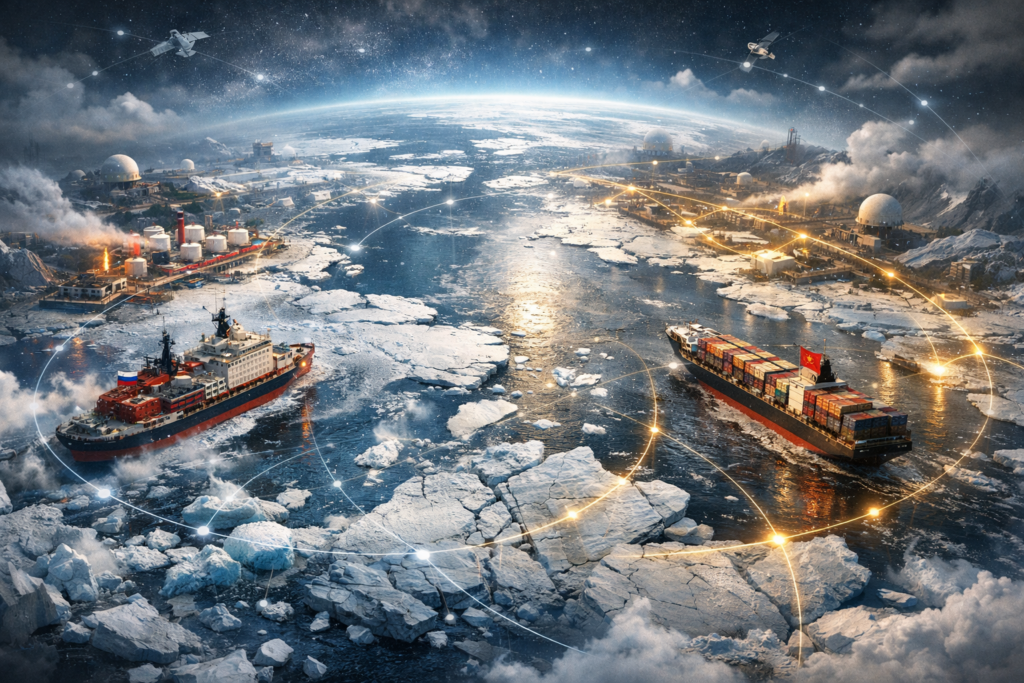
- The closure of European markets, combined with Western oil companies’ investment cuts, has forced Moscow to depend on Chinese money and technology to keep extracting from the North.
- These moves go well beyond resource aspiration; they reflect a strategic decision to remain embedded in the region for decades.
- Yet on the ground — or, more accurately, across the ice — it is gradually materialising into a functional network.
- The Arctic is no longer relevant to India purely as a scientific zone but is increasingly linked with energy security, shipping resilience, and long-term access to the northern logistics networks.
A Region Moving From Margin to Centre Stage
For most of the 20th century, the Arctic was considered a non-factor aspect of world politics by the global powers. It was mostly the concern of researchers, sometimes referred to in environmental talks, and rarely seen as a major strategic location. The distance that world powers had to deal with in that regard is no more. The ice melting at a rapid rate, the discovery of sea routes that are commercially viable, and the triggering of political disputes between countries have all played their part in making the Arctic a decisive area of competition among the powers. One of the most impactful changes within the larger upheaval is the gradual, intentional tightening of the bond between Russia and China – a partnership that has consequences that are far-reaching even outside the Arctic region.
Russia’s Reorientation and China’s Opening
Russia’s renewed focus on the Arctic was not just a reaction to its confrontation with the West, but the sanctions that came post-2022 have turned the Arctic into a life support for Russia. The closure of European markets, combined with Western oil companies’ investment cuts, has forced Moscow to depend on Chinese money and technology to keep extracting from the North. China, on the other hand, has all but gained access to the stakes in LNG fields, port development, and shipping ventures that are otherwise out of reach for it on the basis of the long-term agreement it has with Russia.
What makes this cooperation remarkable is the timing involved, rather than the scale of the cooperation: Beijing entered precisely when Russia’s Arctic dreams were in danger of being frozen due to a lack of interaction.
China’s Arctic Entry: More Than “Near-Arctic State” Branding
Beijing’s declaration of itself as a “near-Arctic state” was initially treated with curiosity, even scepticism. Yet, instead of relying on rhetoric, China has invested in the hard capabilities that validate its presence. Its polar research fleet is expanding, including deep-sea scientific platforms and an increasingly capable class of icebreakers. Equally important is China’s interest in the data infrastructure of the Arctic — satellite monitoring, climate modelling, and maritime situational awareness — which enables it to operate independently in harsh conditions. These moves go well beyond resource aspiration; they reflect a strategic decision to remain embedded in the region for decades.
The Polar Silk Road: Not an Idea, But an Emerging System
The phrase “Polar Silk Road” has often been dismissed as a branding exercise. Yet on the ground — or, more accurately, across the ice — it is gradually materialising into a functional network. Joint ventures along the Northern Sea Route, coordinated shipping trials, and long-term LNG contracts have begun tying Chinese commercial interests directly into Russia’s Arctic infrastructure.
Should these routes be reliable, the map of world maritime commerce will shift. A transit route connecting East Asia to Northern Europe, which avoids the usual bottlenecks, provides China with backup and Russia with control — both acquirers of strategic space at a moment when both are under Western pressure.
A Subtle but Significant Military Recalibration
The Arctic has long been viewed as an area where countries maintained a cautious equilibrium. That atmosphere is thinning. Russia has revived and modernised several Soviet-era bases across its northern coastline, added radar and air-defence layers, and improved its ice-capable naval deployments. China, for its part, has avoided overt military signalling, but its dual-use technologies — particularly seabed mapping and satellite systems — have raised quiet concerns among regional militaries.
While neither claims to be forming a military alliance in the Arctic, the combined effect of their separate actions is a redistribution of influence, particularly in zones adjacent to the Northern Sea Route.
Western Responses: A Mix of Concern and Catch-Up
The northern attitude of the US and its NATO allies has drastically changed. Arctic engagement, for decades, had been based on the belief that Russia, even though it was quite assertive, was still mostly trusting of the existing institutions and legal frameworks. This belief has now been broken down. China’s growing participation nation that does not assert any Arctic claims has made the situation more complex and redirected attention from just an Arctic delimiter to the entire Northern Hemisphere.
In the meantime, the Atlantic coast has experienced some new ideas regarding icebreakers, satellite networks, surveillance infrastructure, and joint military exercises. However, the advancements vary in their pace, and as a result, Russia and China can further solidify their positions.
Why This Matters for India
From the very beginning, India’s Arctic interaction was mainly driven by climate research and the connection between the monsoon and the Arctic, yet in light of the new strategic realignments, a broader interpretation is being warranted. Russian oil is pointing more and more towards the east, and India has emerged as the largest market for the oil moving through the Arctic routes.
At the same time, New Delhi’s partnership with Russia on the Eastern Maritime Corridor and the North Sea Route is all evidence of a much bigger interest in economic sectors. The Arctic is no longer relevant to India purely as a scientific zone but is increasingly linked with energy security, shipping resilience, and long-term access to the northern logistics networks.
A Region Where Environment and Power Politics Intersect
The tension that defines today’s Arctic is not simply between rival states but between competing visions of the region’s future. Environmental vulnerability collides with strategic ambition; scientific collaboration coexists uneasily with military upgrades; and climate-driven openness has invited actors who were traditionally outside the Arctic circle.
The Russia–China partnership has accelerated this transition. By filling economic vacuums, expanding infrastructure, and aligning complementary interests, they have altered the tempo of Arctic politics. The shift may not be confrontational, but it is structural — and it marks the beginning of a new chapter in the geopolitics of the north.
Conclusion
The changing dynamics of the Russia-China relationship in the Arctic are an indication of a silent but significant reorganisation of a previously untouched area by the great power rivalry. What was initially a partnership between a sanctioned Russia in need of investment and a resource-happy China looking for new grounds for exploitation has gradually turned into a trilateral relationship that impacts trade routes, military postures, energy flows and institutional politics even outside the polar circle. The Northern Sea Route is becoming more and more important, and the Polar Silk Road is emerging, which will lead to the recalibration of strategies by countries across Asia, Europe and the Indo-Pacific. The Arctic region is no longer the scene of a distant change; it is now the place where the realignment of global power is seen in the context of climate disruption, strategic competition, and the fragmentation of global governance.
References:
- State Council Information Office of the People’s Republic of China. (2018, January 26). China’s Arctic Policy. Retrieved December 8, 2025, from https://english.www.gov.cn/archive/white_paper/2018/01/26/content_281476026660336.htm
- Lanteigne, M. (2025). Polar Partners? Russia and China in the Arctic. China Research Centre. Retrieved December 8, 2025, from https://www.chinacenter.net/2025/china-currents/24-2/polar-partners-russia-and-china-in-the-arctic/
- Valdai Discussion Club. (2024). China’s New Role in the Arctic. Retrieved December 8, 2025, from https://valdaiclub.com/a/highlights/china-s-new-role-in-the-arctic/
- The Maritime Executive. (2019, June 7). Russia and China Sign Arctic Deal. Retrieved December 8, 2025, from https://maritime-executive.com/article/russia-and-china-sign-arctic-deal
- Centre for European Policy Analysis (CEPA). (2025, July). Sino-Russian Cooperation in the Arctic. Retrieved December 8, 2025, from https://cepa.org/comprehensive-reports/sino-russian-cooperation-in-the-arctic/
- The Arctic Institute. (2023). The Arctic for China’s Green Energy Transition. Retrieved December 8, 2025, from https://www.thearcticinstitute.org/arctic-chinas-green-energy-transition/
- Humpert, M. (2024). The Future of the Northern Sea Route: Climate, Economics, and Geopolitics. High North News. Retrieved December 8, 2025, from https://www.highnorthnews.com/en/future-northern-sea-route-climate-economics-and-geopolitics
- National Snow and Ice Data Centre. (2024). Arctic Sea Ice News and Analysis. Retrieved January 8, 2024, from https://nsidc.org/arcticseaicenews/
- Pincus, R. (2023). Great Power Competition and the Militarisation of the Arctic. Arctic Yearbook. Retrieved December 8, 2025, from https://arcticyearbook.com/arctic-yearbook/2023
- European Parliament Research Service. (2023). China’s Arctic Ambitions and Their Geopolitical Implications. Retrieved December 8, 2025, from https://www.europarl.europa.eu/thinktank/en/document/EPRS_BRI(2023)739359

Raghvendra Tripathi is an independent researcher with a background in computer applications and a keen interest in technology and geopolitics. His articles focus on how emerging technologies influence international strategy, policy, and global power dynamics. Views expressed are the author’s own.
 Anjali Singh
  Aayush Pal
  Piyush Anand